


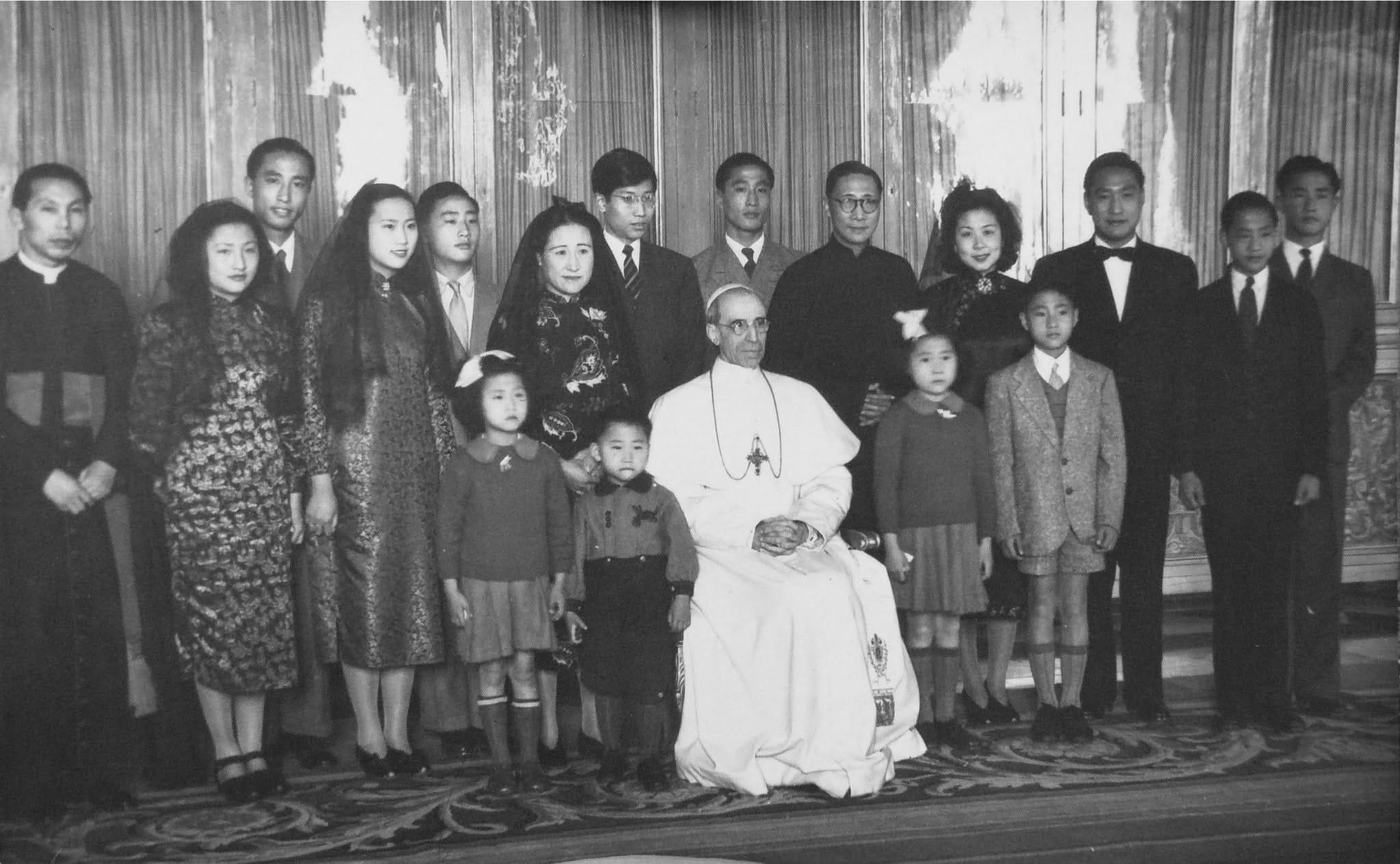
One of the most wonderful authors I’ve gotten to know in the past few years is a Chinese legal philosopher and Catholic convert named John C.H. Wu (1899–1986), whose life was extraordinary in so many ways: he corresponded for years with Justice Oliver Wendell Holmes, Jr.; he drafted the Constitution for the Republic of China in the 1930s; he and his wife had 14 children, one of whom was miraculously cured through the intercession of St. Thérèse of Lisieux, leading the way to the conversion of the entire family; he produced admirable translations of the Psalms and the New Testament into literary Chinese; he served as ambassador of China to the Holy See under Pius XII; he taught at many universities—in Hawaii, New Jersey, Taiwan. One of his sons became a Maryknoll priest: Fr. Peter A. Wu (1932-2020).
Of greatest interest to me is John Wu’s series of publications in which he translates and comments on sages from Taoism, Confucianism, and Buddhism, pointing out their parallels or analogies, on a natural level, with divinely-revealed wisdom in Scripture, seeing this ancient lore, at its best, as a kind of praeparatio evangelica to pave the way for the Far East to embrace Christ.1
The most moving and delightful of his books is Beyond East and West (Sheed & Ward, 1951; republished by University of Notre Dame Press, 2018), which has been compared—appropriately, in my opinion—with the Confessions of St. Augustine. It’s a book I believe everyone should read. Also highly recommended is the collection of essays Chinese Humanism and Christian Spirituality (Angelico, 2017).


Today, my focus will be on a book my wife and I just finished reading aloud, savoring every page of it: The Interior Carmel: The Threefold Way of Love (Arouca Press, 2025). Wu elegantly organizes the classic Carmelite spirituality of St. Teresa of Avila, St. John of the Cross, and St. Thérèse of Lisieux according to the Beatitudes and offers poetic or ethical parallels from ancient Chinese literature. He fully recognizes the infinite distinction between the orders of nature and of grace, but believes that the sages had intuitions into reality that they themselves were unable to justify or to complete, and that God in His mercy reached down into suffering, longing, light-glimpsing humanity to heal it and elevate it.
I highly recommend this work, originally published in 1953; as someone who has studied a fair amount of Carmelite literature, I can vouch for its accuracy. He has a deep love of Scripture, the traditional liturgy, and the saints; all this comes out very clearly and beautifully.
In what follows, I will share some favorite passages, with no effort made at being comprehensive or synoptic. I have grouped them loosely according to themes.
Advancing in the spiritual life
Christ has summed up the three stages of our spiritual life in words at once simple and profound: Ask and it shall be given you; seek and you shall find; knock and it shall be opened to you. You ask for graces and gifts and even for your daily bread, so that you may be provided for in your journey of life, and they will be given to you inasmuch as they are necessary means to enable you to reach your destination. But in this you are thinking primarily of your own needs. So your love is more or less self-centered and possessive. You look upon God chiefly as your benefactor.
When you advance a stage higher, you begin to seek Him because of His attractions; and this plainly is a higher form of love than merely to expect gifts from Him. The higher you rise, the more beautiful he appears to your eyes. Then comes a point where you are so enamored of Him that you cannot help knocking at the door of His inner chamber in order that you may be united with Him forever. When it will be opened to you depends upon His good pleasure; but knock you must. If you are so lucky as to be admitted into His intimate company, you will enjoy the liberty of the children of God, as free as a butterfly. But it must be remembered that before one becomes a butterfly, one must pass through the larval stage and that of the chrysalis. There is no Easter without Good Friday. (8)
So long as we remain pilgrims on earth, there is always a longing for Home. It is God Himself who draws us towards Him, lest we should forget our true destiny. In the words of Father Poulain, S. J., “With a loving cruelty He may quite well enkindle a great craving for eternal blessedness, breathing into us a homesickness for the Divine Essence, that true country of our souls.” In order to reach that Home, we must begin our journey on earth. We journey neither eastwards nor westwards, but inwards; because in the center of our soul dwells the Divine Essence, which is our true home. We must, by the help of grace, make ourselves fitting homes for God, if we want ultimately to find our Home in God. Thus, grace is the seed of glory; our spiritual life is a continuous process which begins here below and finds its consummation in heaven. (197-98)
The Beatitudes are “the way of His steps” (Ps. 84). If we follow Him step by step, we are not only assured of our life of bliss hereafter, but of the indwelling of God and of the Divine friendship even during this life. Grace is the seed of glory. There is a continuity between our life on earth and our life in heaven. Heaven, therefore, must in some way begin on earth if we are to know heaven at all. The rewards as stated in the Beatitudes, such as “they shall be comforted,” “they shall find mercy,” “they shall see God,” “they shall be called children of God,” and “theirs is the kingdom of heaven,” refer primarily to our ultimate goal; but they refer also to the inchoate happiness of the spiritually ripe. (202)
Purification
Now, in the budding of love, the soul is awakened to the utter worthlessness of earthly riches and worldly honors, on the one hand, and to the infinite riches and ineffable glories of the kingdom of heaven on the other. “Vanity of vanities,” sighed the splendid Solomon, “vanity of vanities, and all is vanity” (Eccles. 1:2). “I am poor and needy, and my heart is wounded within me” (Ps. 108:22), said another king, David. To realize that “a man’s life does not consist in having more possessions that he needs” (Luke 12:15) is to be “poor in spirit.” St. Angela of Foligno said that “To know God’s allness and man’s nothingness: that is perfection.”
I do not know whether it is perfection; at least, it is the beginning of wisdom. We cannot too often remind ourselves that “man is insufficient without God because without God he would not even be,” and that “there is an abyss of nothingness at the very heart of our being.” It was no accident that the prodigal son came to himself before he returned to his father. This thought is in line with the idea of St. Catherine of Siena that there is an interior cell with twin chambers within us, one of which is the chamber of self-knowledge and the other the chamber of the knowledge of God. “It is in the chamber of self-knowledge that one learns his wretchedness, because he sees with his spiritual eye his defects and his nothingness, and he sees in truth. And when the man knows himself, he knows also the goodness of God towards him.” Cardinal Bérulle also said, “Abnegation is founded on the greatness of God, and on the state of the creature drawn from nothing and tending to nothingness by his own condition and owing to sin, and also on another kind of nothingness of self through grace.” (10-11)
This insight is the first step in what Father Gerald Vann calls “the quest for self-loss in God.” Without this initial insight, there can be no talk of the spiritual life; for the spiritual life is nothing but a self-realization through self-immolation in Christ. (12)
This struggle of the inner man against the concupiscence of our body costs tears of anguish and contrition, but it leads to the salutary knowledge that we can do nothing of ourselves, that it is by the grace of God that we can conquer ourselves, and that the grace of God comes only through our abiding in Christ. Our relation with Christ is infinitely closer than any human relation can possibly be. It can best be symbolized by the Vine and its branches, for we are members of the Mystical Body of which Christ is the Head. (12)
The best way for a soul in this state to conduct itself is in complete abandonment to the good pleasure of the Lord, and in absolute confidence in His power to cure even the cancer of self-will and the leprosy of evil desires. Let Him operate in you, and trust in His power to Cure you. Say to Him with David: “Create a clean heart in me, O God, and renew a right spirit in me” (Ps. 50:12). Approach Him as the wise leper did: “Lord, if thou wilt, thou canst make me clean.” And He will certainly stretch forth His hand and touch you, saying, “I will: be thou cleansed” (Luke 5:12–14). The more hopeless you are in yourself, the more hopeful you are in the Lord. Only keep your heart open and let Christ, the Eternal Sun, shine into it, and He will purify it and cause it to open out in His light, until it overflows with the joy and sweetness it has received.
Christ came that we might have life, and have it more abundantly (John 10:10). But there is no other way to that abundant life than mortification. This sounds like a paradox, but the truth is that to be a Christian is to put on the New Man, and in order that the New Man may live, the old man in us must die. The unfortunate thing is that the old man dies hard; and this is the reason why the life of a Christian is a continual warfare against the evil tendencies and habits of his old self…. There is nothing morbid about mortification, which is but another name for self-denial. I do not know of any religion or moral philosophy worthy of the name that preaches self-indulgence rather than self-denial. (49)
One has no idea of how many deaths and births one has to undergo before one’s love is thoroughly purified, before one can truly say with St. Paul, “And I live now, yet not I; but Christ liveth in me” (Gal. 2:20). Those who believe in the transmigration of souls often say that to attain perfection one has to die and be reborn many times. We Christians do not believe in transmigration, but we do believe in dying daily and living every day anew in this very life, which furnishes our only chance to strive for perfection. (105)

Living on the surface vs. plunging into the depths
This introduces you into the unitive stage, where what the mystics call “spiritual betrothal” and “spiritual marriage” take place. I should prefer to speak of it in terms of the consummation, so far as is possible in this life, of our birthright as children of God. We have seen that in the first stage the Son led you to the Father, and in the second, the Father led you to the Son. In this third stage, Father and Son together pour Their Spirit of Love into your heart; and “because you are sons, God hath sent the Spirit of his son into your hearts, crying: Abba, Father” (Gal. 4:6). Only then have we begun to live on the deeper levels of reality. “Most of us,” as Mother St. Austin says, “live on the surface of ourselves; underneath is a fathomless sanctuary where ‘Spirit and spirit can meet.’ That is the secret place where the Holy Ghost, the Love of the Father and of the Son, makes love to us.” When you have the spirit of the Son, then you have His freedom, His peace, and His joy, which the world cannot take away from you. (19-20)
Happy the soul who can say: “I am become in his presence as one finding peace” (Cant. 8:10). Night or day, in season or out of season, for better or for worse, for richer or for poorer, such a soul is wedded to the tremendous Lover, and finds Him more and more lovable as the years go by. In these circumstances life is a veritable prelude to heaven. (21)
Contemplation, in this life, is nothing but an awareness of being shone upon by God and reflecting His glory as in a mirror. His shining upon us transforms us “into the same image from glory to glory” (2 Cor 3:18). This is the work of the Spirit of Love. (24)
“We are all passing shadows,” says a holy priest. In fact, these words form the constant refrain of all his speeches and conversations. Every time I hear it, I feel a thrill in my heart. Thank God that our life here on earth is but a temporary exile! The fact that we have a true Home to look forward to gives us the necessary courage to face all the vagaries and vicissitudes of life without blinking, and to undergo all the trials and tribulations without flagging. (33)
To take just one instance out of a million, Blessed John Almond, immediately before his execution, said: “One hour overtaketh another, and though never so long, at last cometh death. And yet not death; for death is the gate of life unto us whereby we enter into everlasting blessedness. And life is death to those who do not provide for death, for they are ever tossed and troubled with vexations, miseries, and wickedness. To use this life well is the pathway through death to eternal life.” (34)
Every little happening and anecdote of our pilgrimage acquires an eternal significance if we refer it to God, our Origin, our Home, and our Way. The saints, who realize this in their very bones, are the true realists; the rest of us are mere daydreamers. How wise the prayer of St. Gertrude: “O Almighty God, I sanctify, dedicate and consecrate to Thee every beating of my heart, and every pulsation of my blood; and I desire to make this compact with Thee, that their every movement shall say to Thee, Holy, holy holy, Lord God of Sabaoth: and I beseech Thee to impart this meaning to them, so that they may be before Thy Divine Majesty as the unceasing echo of that heavenly canticle which seraphim sing without ceasing unto Thee. Amen, amen.”
Now, here is the paradox: If we regard our earthly existence as our abiding home, we become homeless waifs; if, on the other hand, we regard ourselves as birds of passage, we feel at home even in our exile. Similarly, if we regard ourselves as somebody, we are nobody; if we regard ourselves as nobody, we are somebody. The Lord empties the full, but fills the empty. The more we are emptied of ourselves, the more we are filled with God. This presents in its essence the whole process of the spiritual life, with its polarity of negative and positive phases, or, as the Chinese would express it, the Yin and Yang aspects. (34)
All spiritual life begins with an initial insight as to our poverty and helplessness, and the absolute necessity of the grace of God. It is only because the Lord is our shepherd that we shall want for nothing. It is only because Christ has given us the kingdom of heaven that our very poverty is turned into a blessing. All that we need to do is to see eye to eye with Christ and be willing, heart and soul, to accept His blessing; but we must acknowledge that even that insight and that good will come from His grace. (37)
Now here is the living embodiment of the spirit of poverty in its plenitude. Christ, in whom dwells all the fullness of the Godhead bodily (Col. 2:9), emptied Himself to such an extent that He could say of Himself, “I am a worm and no man, the reproach of men and the outcast of the people” (Ps. 21:7). This infinite condescension is hard for us finite beings to comprehend in its full purport. Even to think of it makes the mind reel. But its lesson for us is clear enough. He had to empty Himself in order to fill us. All that we need to do is to take our stand upon our emptiness in order to be filled. He detached Himself from His true riches and glory as God, so that He might share them with us. The only price that we have to pay for all this is a wholehearted and grateful acceptance of His ineffable gifts; and we only need to detach ourselves from false riches and vain glories, to which we foolishly cling. God became a “worm” that we worms may become gods. Our salvation and our deification is thus a gift from God. That is why Our Lord said to the disciples, “Freely you have received, freely give.” Again, in the Apocalypse, the idea of grace as a free gift of God is emphasized: “And he that sat on the throne said: Behold, I make all things new. . . . I am Alpha and Omega: the beginning and the end. To him that thirsteth, I will give of the fountain of the water of life, freely” (21:5–6). (39)
This question brings to a focus all the groanings of the spirit of man. All of us feel an abysmal void within us which can be filled only by God. We have tried to fill it with rubbish; and our unhappiness mounts with the heap. This rubbish must be turned out before God can dwell in us. (45)
The awareness of this bottomless “spiritual emptiness” and “interior poverty” in our age of unprecedented material civilization— this awareness is the prerequisite to a genuine Christian awakening. (46)

Meekness is not weakness
Humor is an essential ingredient of Christian perfection. A humorous man laughs at himself, while a wit laughs at others. In this definition, wit is pagan, but humor is Christian. The devil may be witty, but he cannot be humorous. For there is something sharp and venomous about wit, and something mellow and kind about humor…. Meekness is a tree rooted in humility and watered by humor; it flowers in the form of a serene mellowness, and bears the fruit of docility to the Holy Ghost…. Suffice it to say that humor flows from meekness, which, in turn, is replenished by it. It helps grace to score a victory over nature, not violently, but in a subtle and unobtrusive way. (60-61)
Meekness is not to be confused with weakness of character, or a spineless conformity to the ways and conventions of the world. On the contrary, it presupposes a high degree of self-possession, which enables a man to adapt himself to his environment without losing his central harmony. As St. Thomas Aquinas has put it, “Meekness is a virtue which supposes a noble soul; that is, those who possess this virtue are superior to all one may say or do to them. Though they receive indignities from others in word or action, they preserve their tranquility and lose not their peace of soul.”
There is therefore nothing abject or slavish about meekness. Tout au contraire, the meek man is the free man. For, if one’s tranquility and peace of soul can be disturbed by the actions or words of others, then one is truly a slave to others. If, on the other hand, one can maintain one’s equipoise in the face of insults, then one enjoys true independence and freedom. In fact, nothing is so dignified as self-mastery in the spirit of piety. (64-65)
It is, indeed, not easy to take in other people’s criticisms of us as if we were drinking the sweet dew. But a rational consideration will, perhaps, help us in this matter. Other people’s criticisms of us may be either just or unjust. If they are just, of course, they hurt you to the quick, for truth hurts. But what is there to prevent you from reforming yourself in accordance with the criticisms, thus making the critic your spiritual guide? You should be happy to learn a lesson without being charged for it. What difference does it make to you whether the criticism was made in good faith or with malice? Even if it was made maliciously, it does not hurt your soul, so long as you do not resent it. If the criticism is unjust, then you are in a still better position, for you can offer it cheerfully as a little cross to be united with the Cross of Christ. Of course, in the matter of self-mastery as in all spiritual exercises, it is easier said than done. The saints are not insensitive people; but by trusting themselves in the hands of Providence they achieved self-mastery in the midst of the most provoking and trying of circumstances. (65-66)
Only God knows how much energy is needed to master oneself when one happens to be fiery in nature, as most Christian saints are. In their case, therefore, meekness means intense energy under intense control; it has nothing in common with the idea of a milk-and-watery character, a nice person who simply lets himself be shoved around. A meek person is not a goody-goody any more than a roughneck is a strong character. As Confucius said, “The goody-goodies are thieves of goodness.” They are thieves because they only appear good, but are not really good. (66-67)
The meek, or the true gentlemen, are so far from the goody-goodies that they belong to the first order of persons, those who follow the Golden Mean. They are as careful in avoiding evil as the scrupulous, but they know that the avoidance of evil is only the beginning of goodness. They are as eager for goodness as the idealists; but they know that goodness must be cultivated with patience and perseverance, and they are careful to check words against conduct. (68)
One cannot help marveling at the way the Divine Artist deals with souls. He made use of the extreme sensitivity of Thérèse and transmuted it into an extreme responsiveness to the whisperings of the Holy Spirit! He does not destroy our nature, but raises us at precisely our weakest point. In the case of Thérèse, He opened her eyes to the supernatural value of suffering, and Thérèse, the docile disciple, used her native sensitivity in the exploration of the opportunities for suffering and sacrifices in her daily life. Thereafter, she was no longer egocentric; she became Christocentric. (71)
A deep filial love for God will spontaneously beget in us the spirit of harmony and mildness, and make us radiate an atmosphere of joy and gladness, and behave sweetly and cordially towards others. Thus, we see that love is at the bottom of it all; but it takes time and practice for Love to acquire some mellowness so as to attain the state of meekness. (75)
The truth is that only the meek and humble of heart could have the impetuous audacity of love without falling into the bottomless pit of presumption and pride. Each of us is a temple of the Holy Ghost; but this temple must be built upon the solid foundation of humility, and the deeper the foundation the higher the temple will rise. (93-94)
Love and peace
In order to keep this commandment [“Thou shalt love the Lord thy God, with thy whole heart, and with thy whole soul, and with thy whole mind, and with thy whole strength” (Mark 12:29–30)], it is well to recall to mind the four dimensions of Christ’s love. We have seen how infinitely broad, long, high and deep His love is. To imitate Him well, your heart must be big enough to embrace the One and all; your soul should be filled with immortal longings and aspire after an ever closer union with God; your mind should try to understand the ways and thoughts of God, so that you may to some extent see eye to eye with God; and, finally, all your physical forces should be mobilized in the service of God, so that “with the instrument of the body, you may prove and exercise the virtues” (St. Catherine of Siena, The Dialogue). (102)
There is a tendency in human nature to exalt self and belittle others. To combat this tendency one has first to cultivate a sense of reverence towards one’s fellow men…. To counteract our inborn egoism, it would be good for us to form a habit of always seeing the good qualities of others and our own bad qualities…. So it is always a wise rule to judge yourself in the light of your rotten past, to judge others in the light of their golden future, and to judge everything in the light of God’s infinite mercies. (107-8)
Matter can be spiritualized by the fire of love. To put it more plainly, material things can be transmuted into spiritual values in the furnace of divine love. On the other hand, spiritual riches can degenerate into worthless metal if they are spoiled by selfishness and possessiveness. (111)
By the gift of understanding which He infuses into you, He makes you realize many secret truths of which you had no idea before, especially two main lessons. First, with regard to your past, He wants you to understand that all your interior attainments and exterior accomplishments are due to His grace rather than to your own merit. You must understand, as Bishop Sheen puts it, “that even the desire for God came from God and that the fires that burned within itself were kindled from the hearth of God.” It is not enough for you to have just a nodding acquaintance with this truth; you must be utterly convinced of it and feel it in your very bones. (133)
There is a close analogy between the spiritual life and the art of poetry. It was the mystical poet Coventry Patmore who said, “The quality of all emotion which is not ignoble is to boast of its allegiance to law.” Alice Meynell has likewise remarked, “Those who have nothing to say clamor for large license in which to say it, and hence the vers libre. Those who have something to say cling to the order and discipline of bonds valuing that voluntary obedience which is the force of art, literature, morals, religion and politics.” There is a deep meaning in these words. In every field of human endeavor, superlative excellence is attained only by the harmonious cooperation of reason and intuition. In jurisprudence, for instance, nothing is more interesting than to study how law and equity, justice and mercy, rigidity and fluidity, complement each other in the formation of any living juridical order. So in the spiritual life, there is also an orderly subordination of passions and emotions to reason, and of reason to grace. As Patmore observes, “the spirit of man is like a kite which rises by means of those very forces which seem to oppose their rise; the tie that joins it to the earth, the opposing winds of temptation, and the weight of earth-born affections which it carries with it into the sky” (Aurea Dicta, XII). (147)
One of the surest signs that you are possessed by the Holy Spirit is that every experience puts you in mind of the words of Christ and of the Holy Scripture. (148)
In this life, only relative peace can be attained; and even this can only be maintained on the condition of our ever-watchfulness. Like a soldier on the battlefield, a Christian should sleep with his armor on and with the sword for a pillow. And the better armed he is, the more soundly and peacefully he can sleep. This, I think, is the reason why Christ, who has given us His peace, has also furnished us with His sword, the sword of Truth. These two things are so far from contradicting each other that the sword is actually an indispensable means toward the attainment and maintenance of true peace. (155)
Seek God, and you will have peace; seek peace apart from God, and you will have war upon war. (156)
It is only in the Word Incarnate that mercy and truth have embraced each other, and justice and peace have kissed each other. It is only in Him that heaven and earth have united. It is only in the way of His steps that salvation is to be found. (157)
The holier you are, the greater glory you give to God; for His power is revealed in the very distance between your present attainment and what you might have been without His grace. (160)

Dangers of activism
You remember in what high spirits the seventy-two disciples returned from their first missionary trip, reporting to Christ, “Lord, even the devils are made subject to us in thy name” (Luke 10:17). Christ, who knew what is in man, discerned at once their inborn tendency to attach their hearts to the fruits of their labors, and bade them to raise their minds to heaven and fix their eyes on their ultimate destiny, saying, “You, instead of rejoicing that the devils are made subject to you, should be rejoicing that your names are enrolled in heaven” (Luke 10:20).
How many zealous missionaries and lay apostles are stunted in their spiritual development because they set too much store by what they have accomplished and are unconsciously infected by a kind of partisan spirit, a group egoism! So long as you are not completely detached from the fruit of your hands, your love for God is not pure. (18)
It is not easy to talk about the apostolic mission of Carmel; because it is incidental to its principal mission. The principal mission of Carmel is to be the garden of delights for the Divine Lover, our Lord. The apostolic work is only an effect of the supreme romance between God and the soul in love with God. So long as it remains a garden of delights for the Divine Lover, it will necessarily continue to bear fruit; but as soon as it ceases to be a garden of delights, it will become a barren piece of ground…. In this age of ours, when pragmatism and activism seem to prevail, we cannot too often remind ourselves of what St. John of the Cross said: “An instant of pure love is more precious in the sight of God, and of the soul, and more profitable to the Church than all good works put together.” (113-14)
Happy are the saints who joyfully drink sober inebriation of the Spirit! They can be quiet without being quietists, and active without being activists; for there is activity in their quiet and quiet in their activity. They are quiet because even when they find themselves in a crowd, they are still aware of the Holy Trinity dwelling in the very center of their souls. They are active because souls on fire with love can never remain inactive. In such souls love and reason work together harmoniously. (170)
In love with God
In the state of Spiritual Marriage, the soul burns inwardly and sweetly through love and wisdom. Love is like fire and wisdom is like water. The soul that has entered into this state is at once fiery and watery…. The soul in peace is a divine symphony, where all kinds of counterpoints are harmonized. (167, 169)
Every service that we are able to render to God is a sign of His love for us more than of our love for Him. (181)
O the magical power of love! Love is the Alpha and the Omega; love is also the Way. Love separates; love purifies; love tames. Love makes you thirst for God. Love unites you with Him and with His whole creation. Love gives simplicity to your heart and peace to your soul. Love enables you to suffer with joy. Love binds together in one volume all the loose leaves “that the universe holds scattered through its maze.” Even the eight Beatitudes are but steps on the Way of Love.
Love impels you to renounce the pride of life and the pomps of the devil. Love urges you to advance unceasingly toward God. Love makes you perfect….
Love causes you to weep for your sins, for it is your sins that estrange you from the object of your desires. Love presses you to ornament yourself with virtues in order to win the heart of your Beloved. Love makes you despise your own beauty, because you can never be beautiful enough for Him. Love puts you at the mercy of your Beloved, and emboldens you to beg for His love in spite of your unworthiness. Finally, love initiates you into the joy of the cross, and gives you a foretaste of eternal bliss. O the mystery of love! It began by separating, and ends by embracing all. (186-87)
A man in love with God has begun his heaven on earth. Life is a continual feast and a perpetual spring to him. He finds God within and without. To him the whole universe is a hymn to God. God is singing in the birds, smiling in the flowers, shining in the sun, twinkling in the stars, showering blessings in the rain, rejoicing with the happy, weeping with the prisoners. He is the Father of the orphans, the Friend of the lonely, the Hope of the forlorn, the Music of life. He fills the air with gladness; the earth is full of His glory. He dances to the rhythm of your heart, and causes your cup of joy to brim over. The true lover of God “always swims in joy, always keeps holiday, and is always in a mood of singing” (St. John of the Cross). He dances with Christ in the bosom of the Father to the tunes of the Holy Spirit. He is still a wayfarer, it is true. But he already feels like a river about to pour its waters into the ocean. To borrow the words of Tagore, “In the music of the rushing stream sounds the joyful assurance, ‘I shall become the sea.’” (187)
They are mistaken who say that we Christians are mercenary workers, because we talk of reward. They should know that the reward we are hoping for is not extrinsic but intrinsic, for it consists in the union with the Source of our being. A lover is not mercenary when he desires to be united with the object of his love. Nor can a fish in shallow waters be said to be a mercenary fish when it yearns for its home in the deep. Happy are the saints, for their sorrows are the sorrows of the Sacred Heart of Christ, and their joy is identical with His joy. The sorrows are temporal and human, the joy is eternal and divine. The sufferings and tribulations of the saints are many, but they can be measured. Who can ever measure the joy of the saints? Who can ever recount all the tender caresses and attentions that God lavishes upon a soul in union with Him? The joy of the saints is not their joy, but the joy of Christ. For, as St. Thomas Aquinas says: “Since the enjoyment of God, deservedly due to His excellence, surpasses the power of all creatures, it follows that this complete and perfect joy does not enter into man but rather man enters into it. Enter into the joy of thy Lord” (Matt. 25:21). (193-94)
The doctrine of spiritual childhood is of special importance to the present age. Since the Renaissance in Europe, mankind has developed its natural talents to such an extent that it can fly in the air and split the atom. Psychology has probed deep into the complexities and subterranean urges of the human soul. It is about time to return to simplicity and to remember our dependence upon God. Spiritually, man will never become mature unless he is converted into a child again. It is providential that God should have raised up a saint like the Little Flower of Lisieux to re-emphasize the message of spiritual childhood in an age when it is most needed. (210)
A salutary reminder of the intellectual liberty that exists within the boundaries of Catholic orthodoxy:
Those who do not know Catholicism are apt to think that in our Church everything is laid down ex cathedra in black and white, so that Catholics need not think for themselves. The fact is that, within the framework of dogma, there is ample room for differences of opinion and for creative work and original thinking. The Church of Christ is a house of many mansions, but there is no mansion for provincialism. Although I have profited by my association with first-rate theologians of different schools, I recognize ultimately only one Father, one Master, and one Teacher—the Holy Trinity. (221)

Mysticism true and false
When the Holy Trinity takes up His abode in you, then you will have peace that surpasses understanding, and joy that no man can take away from you. Furthermore, your devotion to the Sacred Humanity of Christ and to the Blessed Virgin will deepen beyond measure, for no one can truly be united with the Holy Trinity without being convinced of the eminent appropriateness and necessity of the Incarnation. This is the surest sign of true mysticism. (129)
The mysticism of the Catholic saints is so comprehensive and profound, because it is not composed of irresponsible fancies of isolated individuals, but is rooted in theoretical and moral theology, and is constantly nourished by the Spirit through the living channels of grace. In other words, it is not purely intuitive-emotional, but is balanced and supported by the institutional and rational elements. (141)
The airplane can fly precisely because it is built according to the laws of physics. A mystic can be truly united with God only if he follows strictly the laws of reason and the principles of metaphysics. This may be called intellectual asceticism, which, together with moral asceticism, must be passed through before one can hope to be a temple of the Holy Spirit or a sanctuary of the Blessed Trinity. Only an unleavened bread can be fully leavened by the Holy Spirit. In mystical parlance, you must tame the Green Lion before you can give it wings. (146)
To realize that the expressed is also the inexpressible, that the known is also the unknown, that the immanent is also the transcendent, is to move beyond image and logic, and this is the essence of contemplation. (178)
Wisdom traditions
As the Psalmist says, “In Thy light shall we see light.” Since all lights, whether natural or supernatural, come from God, a scribe steeped in the Kingdom of God should be able to bring forth from his storeroom “things new and old” without too much incongruity between them; because whether old or new they flow from the one living Source, which is neither old nor new. To my mind, things new and old must meet beyond old and new, just as the East and the West must meet beyond the East and the West….
It is true that the work of Creation has been spoiled by man’s disobedience, but it is not wholly spoiled, and therefore grains of truth are to be found in the philosophies and religions of all peoples. So long as they are grains of truth, they belong to God, because according to the saying of Saint Ambrose, which Saint Thomas Aquinas delighted to quote, “every truth, whoever said it, comes from the Holy Spirit.” In fact, it is the Light of Revelation that enables a Christian to judge all things, while he himself is judged by no man. (See 1 Cor. 2:15.) As Father Otto Karrer has put it: “Christianity is ‘the fulfilment of all religions,’ not only because it possesses in the pure state all religious values, but because it comprehends in their utmost extent and fullness values elsewhere scattered and fragmentary.” To use an analogy, Christ is the Sun who gives light to the whole world, while the Church is like the biconvex lens through which His luminous rays are brought together and focused in order to cast fire on earth. We must put our soul under this focus so that it may be inflamed with divine love. (78-79)
Without any doubt, Christ is the greatest Teacher, the only Teacher of humanity. Compared with Him, all other “teachers” are at most as candlelights compared with the Sun. For He who comes from above is over all and speaks of the things of heaven; while they who are from earth belong to the earth, and of the earth they speak. He not only teaches these lofty doctrines, but gives us the grace to put them into practice. (98-99)
Christian appreciation of nature
A Christian can enjoy all the lyrical ecstasies of a pantheist at their very Source, and without the danger of being drowned in the ocean of creatures. The truth is that, as God contains all things in Himself, so His lovers carry in their hearts all other creatures. In the words of St. Leo the Great, “Christian poverty possesses all things, for it possesses the master of all things.” (17)
The soul in peace with God and with itself lives harmoniously with the whole universe and with the spirit of the liturgy, being perfectly attuned to the rhythms of life and to the liturgical cycles of the Church. There is a parallel of this harmony even in the natural sphere, for natural contemplation attunes one’s spirit to the Cosmos…. If a Christian does not love Nature, he is worse than a pantheist; but if he does, he will drink all the joys of a pantheist at their very Source. (172-73)
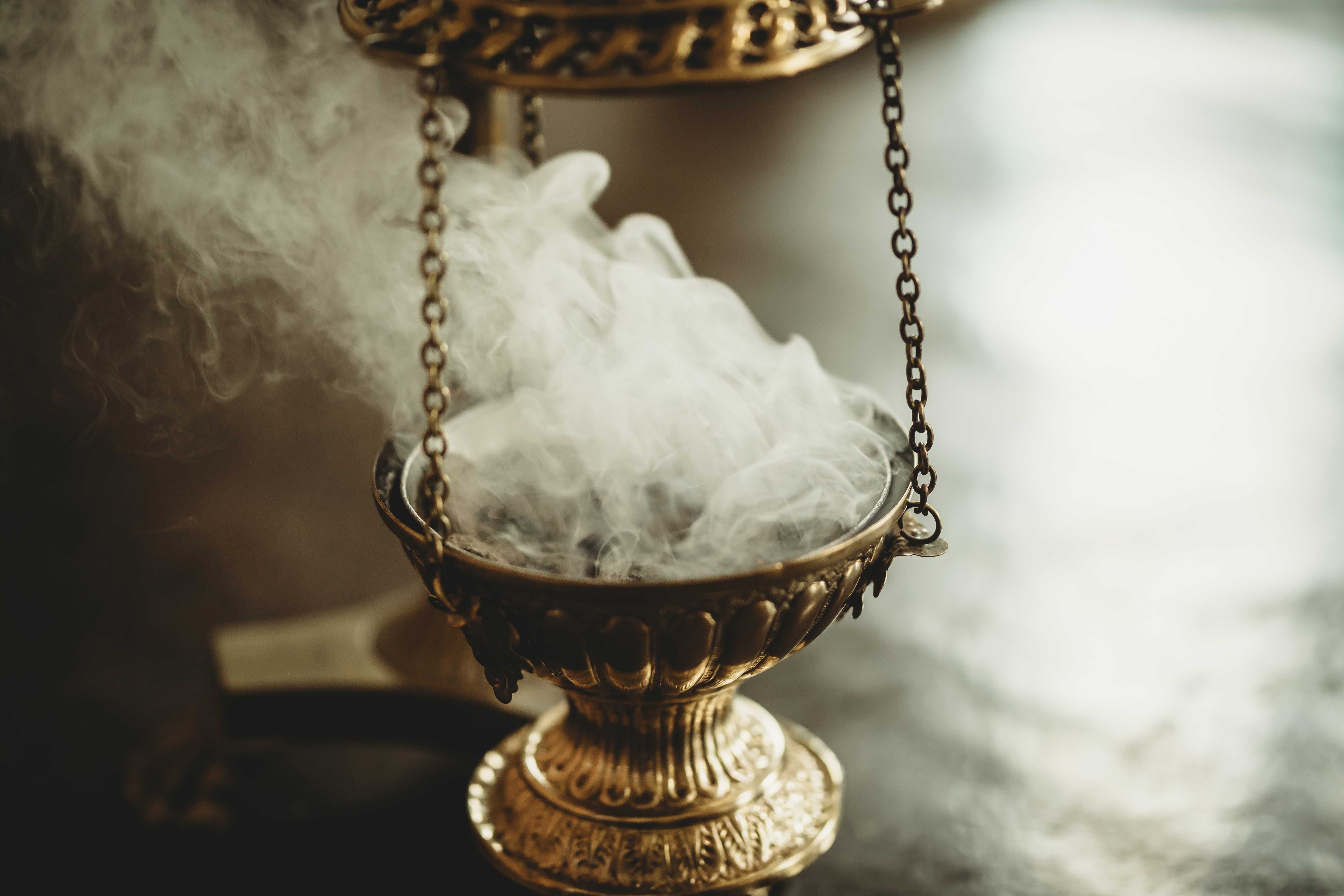
Liturgy and the spiritual life
In attending the Mass, we must not do it as a matter of formality; we must try to assimilate its spirit, so that we may live the Mass. Not the least important of the lessons it gives us is the progress of love. You will realize that the Mass is the perfect embodiment of the threefold way of love.
The first part, called “the Mass of the Catechumens,” corresponds to the budding of love. There the keynote is the Confiteor, and the principal interior disposition is the willingness and eagerness to learn the truth. The middle part, called “the Mass of the Faithful,” corresponds to the flowering of love, whose keynote is the spirit of sacrifice. The third part, called “the Banquet of the Faithful,” corresponds to the ripening of love, whose keynote is peace and joy. It is not for nothing that the word “peace” is so often repeated in the Communion. “Mercifully grant peace in our days.” “The peace of the Lord be always with you.” “O Lord Jesus Christ, who saidst to Thy Apostles, Peace I leave with you, My peace I give unto you; look not upon my sins, but upon the faith of Thy Church; and vouchsafe to grant her peace and unity according to Thy will.”
It is also significant that before we receive the Holy Eucharist, we pray to be delivered “from all evils, past, present and to come,” and we say the Confiteor once more. To my mind, this signifies that before we can enjoy the beatitude of peace, we must undergo a thorough and radical purification, which corresponds to the beatitude of the pure of heart.
Thus, the whole Liturgy of the Church forms a seamless tunic with her spiritual doctrine. “This is the will of God, your sanctification.” Every prayer, every ceremony, and every Sacrament that Christ has instituted is for your sanctification, so that God may be glorified in you. They are all ordained to the practice and actualization of the Sermon on the Mount, which may be called the Constitution of the Kingdom of Heaven, of which the Beatitudes form the worthy preamble. (88-89)
You begin to perceive, as St. John of the Cross did, that, being omnipotent, He loves you with omnipotence; being wise, He loves you with wisdom; being good, He loves you with goodness; being just and merciful, He loves you with justice and mercy; and being the virtue of the greatest humility, He loves you with the greatest humility, and with the greatest esteem, making you His equal, joyfully revealing Himself to you and saying to you: I am yours and for you, and I delight to be such as I am that I may be yours and give Myself to you. Having gradually perceived all this, you are overwhelmed with wonder and gratitude. You realize what a profound meaning is contained in these words of the Gloria: We give Thee thanks for Thy great glory. That is to say, “We are grateful to Thee for being what Thou art.” If God were not what He is, there would have been no creation, no redemption, no sanctification. If a man is not aware of the wonders of creation, he has no rationality. If he is not aware of the wonders of redemption, he has no spirituality. If he is not aware of the wonders of sanctification, he has no part in divinity. (100-101)
Unless you have the mind of Christ, you will not possess His heart. And I may add that the mind of Christ is nowhere better expressed than in the liturgy of the Church. (140)
Quoting Fr. John Oesterreicher:
All that the mystics are, they are through the Church, as rivulets drawing from that mighty stream whose fountainhead is Christ. They could not know the incomprehensible and ineffable God were it not for Him, the “revelation which has a definite date,” and Him they could not hear were it not for the Church, who is His voice resounding till the end of time. It is she who communicates to them aspiration for the union with God, as it is her dogma which— far from stifling the inner life— enkindles it. Because their path is beaconed by the light of faith, the mystics can proceed on their arduous journey to direct experience of God . . . . The beginning and growth of their inner life is owed, they themselves attest, to the sacraments, those vessels of love in which matter, otherwise retarding the movements of the Spirit, becomes His chariot. (143-44)
If we grasp this point, we can easily see the important function that the Liturgy plays in the development and enrichment of our inner life. The Holy Spirit breathes in the liturgical prayers, so they are your own prayers in the degree in which He breathes in you. Thus, they do not lose their freshness and spontaneity, no matter how many times they have been repeated.
It is only where love and understanding are lacking that your prayers become mechanical and lifeless. Then your silence is awkward, your speech nothing but lip-service, and liturgical prayers become so many vexatious repetitions. All depends upon your interior dispositions. For sincerity is the soul of prayer. When you are sincere, the dictates of your heart become liturgical, and the liturgical prayers flow from your heart, so that whenever you hear the priest say, Sursum corda, you will joyfully answer, Habemus ad Dominum; and whenever he says, Gratias agamus Domino Deo nostro, you will be ready heart and soul to respond, Dignum et justum est.
To my mind the highest prayer consists in an understanding and wholehearted Amen to all the prayers of the Church. Who but the Holy Ghost could ever have suggested such a prayer as: “O God, who in a wonderful manner didst create and ennoble human nature, and still more wonderfully hast renewed it; grant that by the mystery of this water and wine, we may be made partakers of His divinity who vouchsafed to become partaker of our humanity, Jesus Christ Thy Son, our Lord”? And who but the Spirit of Love could have uttered a Felix culpa?
We need not multiply instances; we need only say that anyone who does not recognize the voice of the Holy Spirit in the prayers of the Church cannot be of the Spirit and therefore cannot be a genuine mystic. As Romano Guardini remarks in The Spirit of the Liturgy, “Only a system of life and thought which is truly Catholic— that is to say, actual and universal— is capable of being universally adopted, without violence to the individual. Yet there is an element of sacrifice in such adoption. Each one is bound to strive within himself, and to rise superior to self. Yet in doing so he is not swallowed up by, and lost in, the majority; on the contrary, he becomes more independent, rich, and versatile.”
We may add that an individual becomes a person only by being a member of a community. No one can acquire universality except by accepting limits. It was by incarnation that God became man; so it is by incarnation— that is, incorporation in His Mystical Body— that a man can be deified. As Christ is the Way of God to man, so is He the Way of man to God. The realization of this truth is the beginning of all mystical insights. (144-45)
If we think that we can dispense with the scaffolding in the early stages of our spiritual life, we shall never be able to erect the cathedral. On the other hand, if we mistake the scaffolding for the cathedral, our spiritual life will be stultified. It should be noted, however, that the disappearance of the scaffolding does not mean the disappearance of rationality; it should rather mean that whatever rationality there is in the scaffolding has been absorbed into the cathedral.
For example, a contemplative does not, certainly, forget about the Credo. On the contrary, he penetrates more deeply into the mysteries, so that every iota of the Credo becomes in his mind vibrant with meaning. In fact, originality in the spiritual life does not so much consist in the discovery of new truths as in the sounding of new depths of old truths. One’s spiritual life is an organism, of which dogmatic theology constitutes the skeleton and mystical life forms the flesh and blood. Without reason and dogma, mysticism is apt to be a monster. Without mysticism and contemplative, affective life, dogmatic theology and discursive reasoning are apt to be like a sapless tree. We are too prone to forget that St. Thomas himself was one of the greatest mystics of all times. (146)
You can make as many cycles [in the spiritual life] as God wants you to. It is just like attending Mass. Every Mass begins with acts of contrition and ends with Communion and thanksgiving. It covers the whole Way; but you can repeat it every morning. The same is true of the liturgical year, which forms in itself a complete cycle. Advent, Christmastide, and Epiphany form one period, corresponding to the budding of love. The season of Septuagesima, Lent, and Passiontide correspond to the flowering of love. Finally, Paschaltide, Pentecost, and the Time after Pentecost correspond to the age of ripening; and this completes the cycle. But this does not mean that one year is enough to perfect your love. (214-15)
This passage is remarkable because, on the one hand, it so clearly states the primacy of Peter, but, on the other hand, no less clearly formulates what precisely this primacy is in service of (and therefore indicates, by implication, what it cannot possibly be in service of):
What is important to note is that, whether it is a case of feeding the lambs, or of shepherding the sheep, or of feeding the sheep, it is clearly the intention of Christ that it should be done by St. Peter, who represents the Catholic Church with all her priests, with all her invaluable heritage of the Holy Scriptures and the spiritual teachings of her Doctors and Saints, with all her life-giving Sacraments and refreshing sacramentals and devotions, with all her wonderful liturgy, and finally with the Holy Spirit working through her and guiding her in her growth and development throughout the ages. (200)

Thus, he writes: “In the Fall of 1949, I began to teach Chinese philosophy at the University of Hawaii, and that gave me an opportunity for going more deeply into the three main currents of Chinese thought, Taoism, Confucianism, and Buddhism. They again reminded me of the three ways of Christian asceticism and mysticism. Taoism, with its doctrine of detachment, Confucianism, with its emphasis on the practice of virtues, and Buddhism, with its universal compassion and its leaning toward contemplation, seem to form a continuous ascent to Truth in the sphere of natural religion, corresponding roughly to the threefold way of love” (Interior Carmel, 221).
What a marvelous book! Great article.
Thank you. We are buying this book and hearing those quotes my husband agreed to read it with me.