


PRELIMINARY NOTE
From October 1 to 8, I am offering 25% off on subscriptions to Tradition & Sanity.
Why should you consider taking this step now? Have a look at these comments from some long-time readers (click to enlarge):


Thank you for taking advantage of this opportunity to keep Tradition & Sanity hale & hearty. Now on to our book of the day. —Dr. K

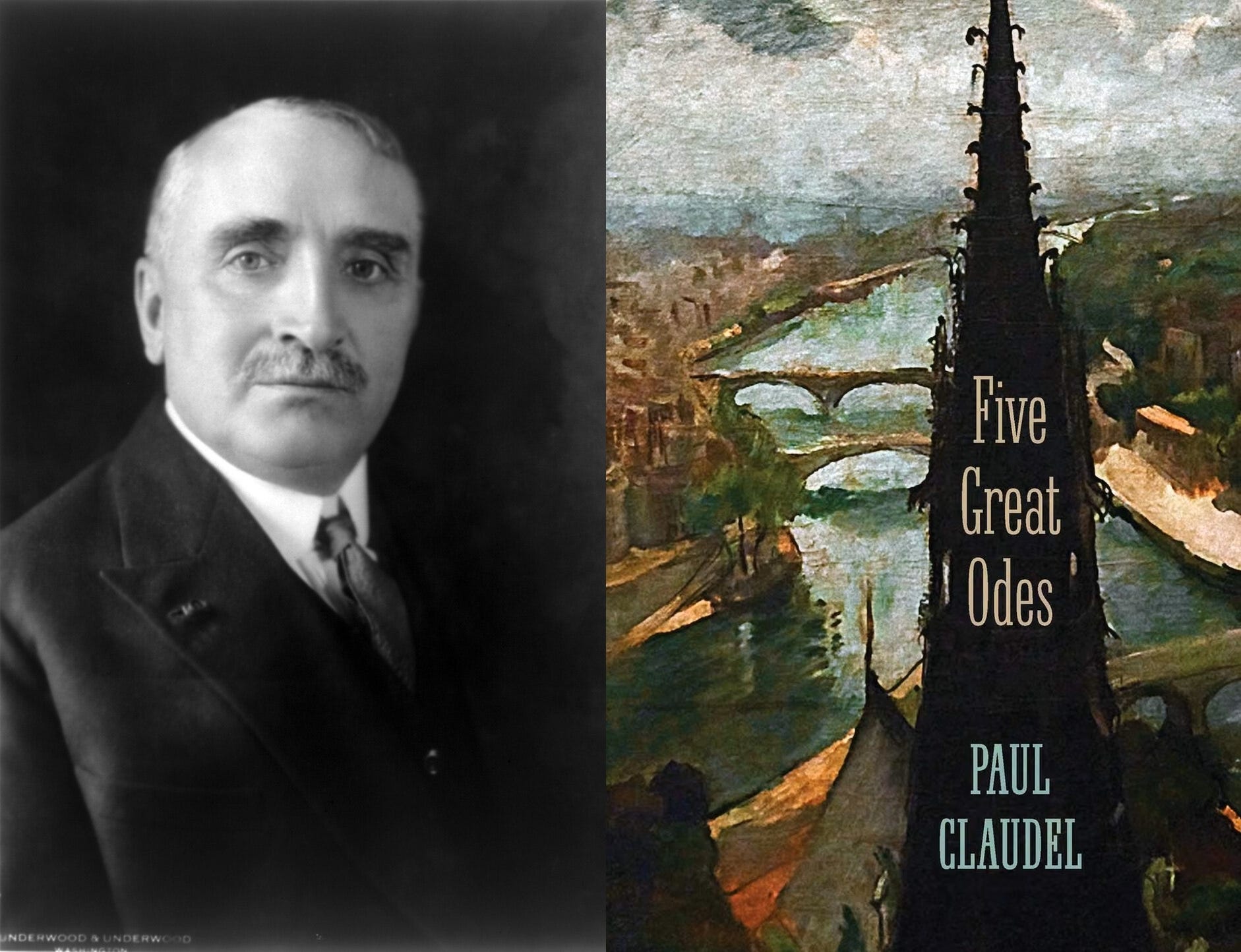
It would be difficult to introduce Paul Claudel (1868–1955) in a few words, but I shall assume that readers of this Substack have already heard of him, and therefore we can proceed directly to his intricate and moving verse. I don’t know how French Catholics would see it, but to me, Claudel is like a French T.S. Eliot: sophisticated, allusive, erudite, lyrical, nostalgic, modern in style but antimodern in sentiment. One of the things that makes Claudel so special, for me at least, is that he was utterly steeped in the traditional Roman rite that played so great a part in his conversion, and, as you will see, his verse is saturated with liturgical allusions. I hope you’ll enjoy these favorite lines that I gleaned from his Five Great Odes, published by Angelico Press (you can find it either there or on Amazon). —PAK
In the silence of silence
Mnemosyne sighs.
Eldest—Memory—this one who does not speak. And yet
the same age as the others.
She listens, she considers.
She feels (she is the inner feeling of the spirit),
pure, simplex, inviolable. She remembers.
She is the weight of the spirit, its density. She is
the ratio expressed in a beautiful figure,
and she is posed in an ineffable manner
on the very pulse of Being.
Interior hour: she is the exhaustless treasure
and the well warehoused source;
she joins with the time that is not time
and is expressed by language.
But she does not speak; she is busy with not speaking.
She coincides.
She possesses and remembers…. (23)
I am an initiate of silence; there is an inexhaustible ceremony,
there is a world to take by force, an insatiable poem
to fill with the growing of grains and every fruit. (33)
I want the life without which everything is dead.
Life itself, for all the rest is mortal and kills me. (39)
As the tree in each new springtime
laboring by its very soul invents
the green, the same which is eternal, creates from nothing
its pointed leaves,
I, human,
know what I make,
from the dust of earth and from this power
of birth and creativity
I make use, as master craftsman,
I am in the world, exercising in all places
my inborn knowledge.
I know each thing and each thing knows itself in me.
I carry to each thing its deliverance.
By my work
nothing remains alone, but is linked
with another in my heart. (42)
And you who are perfect Being itself, you have not failed
to see that I, too, exist!
You see this man that I have made myself into, and you see
this being that I hold from you.
Oh, my God, my being sighs to yours.
Deliver me from myself, deliver this being from contingency.
I am free, but deliver me from freedom.
I can well see the ways I might not be, but there is only one way
to be: that is to be in you, who alone are truly yourself….
What is necessary for me is to remember you. (43)
You are visible in this world as you are in the other.
You are here.
You are here and I can be nowhere save with you. (44)
So hail! world new to my eyes, world now total!
Entire creed of things visible and invisible,
I accept you with a catholic heart.
Wherever I turn my head
I envision the immeasurable octave of creation.
For now the world opens itself to me again, and no matter
how vast its span, my gaze sweeps it
from one end to another. (45)
I do not see you, but I am contained along with
these beings whom you see.
We do not give but what we receive.
And since all things from you
have received being, in time
they return the eternal.
And I,
I have a voice, I listen, I hear the sound
made by what is eternal.
My voice, my breath, is water, such pure water
as nourishes all things, and so all things
fold themselves into my voice.
I mean the voice with which, by you, I make eternal words.
I can name nothing but what is eternal.
The leaf yellows, the fruit falls, but the leaf in my verse
will never wither,
nor the fruit ripen, nor the rose wilt.
Oh, the thing may die, but the name within the spirit,
which is my spirit, no more will die.
This is the escape from time.
And I who make things eternal with my voice—
make me entirely
that voice, a word wholly intelligible.
Free me from the slavery and the weight of inert matter.
Clarify me! Strip me of miserable shadows
and make me at last
only that within me I most obscurely desire. (47-48)
God who baptized the chaos with your Spirit
and who at the Easter Vigil exorcizes, by the mouth
of your priest, the pagan font,
with baptismal water you sow our human
clay, glorious, unsuffering, undying….
As premise contains and desires conclusion,
so the body of glory yearns beneath the body of clay,
as the night
yearns to be dissolved in visibility. (48-49)
Oh my beloved, I am not a god,
And my soul, I cannot share it with you
and you cannot take and contain and possess me. (51)
Open the door, and the Wisdom of God is before you,
like a pillar of fire or like a crowned queen. (54)
Be blessed, my God, who have delivered me from idols,
who have made me to adore you alone, and not Isis or Osiris,
or Justice or Progress or Truth or Divinity or Humanity
or Art or Beauty—
all these abstractions which you have not permitted, nothing—
nor even to adore the Void left by your absence….
These words are sound without voice, name without person,
the unclean spirit is in them which fills deserts
and all empty things.
Lord, you have broken the bonds even
of books and ideas, of idols and their priests,
and you have not permitted Israel to suffer
the yoke of the Effeminate. I know you are not the God
of the dead but of the living.
I shall not honor
phantoms or puppets, whether Duty or Freedom,
nor Diana nor any resplendent god, nor some
sacred cow. (58-59)
Lord, it is not lead or stone or rotting wood itself
you have enrolled in your service,
and no one can fortify herself in the likeness of him
who said, I will not serve. (60)
Savants, epicureans, masters of the novitiate of Hell,
practitioners of the Way of Nothingness,
neither Brahmin nor bonze nor philosopher,
your counsels, Egypt,
your methods, demonstrations, and discipline,
nothing reconciles me, I am living in your abominable night,
I lift my hands in despair, I lift my hands in the trance
and transport of deaf, savage hope.
Who no longer believes in God, no longer believes in Being,
and who hates Being, hates his own existence.
Lord, I have found you.
Who finds you, has no more taste for death. (61-62)
Whoever shares the will of God
must also share his silence.
Be with me wholly. Let us together fall silent to all eyes.
Whoever gives life must accept death.
Be blessed, my God, who have delivered me from myself,
who keeps me from placing my well-being in myself—
in the narrow dungeon where Teresa saw the damned enclosed,
but in your will alone,
in no other good or well-being,
but your will alone.
Be blessed because you have not abandoned me to myself,
but you have accepted me as something that will serve,
good enough for the end you devise.
You have no more fear of me as you do of the rich
and the proud whom you send away with nothing.
You have put your power in me, power which is your humility,
your power to make
yourself nothing for the sake of your works…. (65)
Be blessed because I do not remain unique,
existence has come of me, the quickening of this immortal
child, and because in this image that is forever
real, this soul joined to a body,
you received shape and dimension from me.
It is no lifeless weight of stone I hold in my arms
but a little human being, crying and waving arms and legs.
And here I am reunited with ignorance, with the generations
of nature, and ordered to an end strange to me.
You, newly arrived, I may look on you at last.
You, my soul, at last I can see your face,
like a mirror I’ve just withdrawn from God
and still holding no image but his.
From me has been born something other….
yes, there is born from me something new—
yet with strange resemblance.
To me, and to the deep roots of all my ancestors
a new being is born.
We have been necessary, each in her generation,
it is the special will of God that has prepared
the blood and the flesh of every man and woman.
Who are you, newcomer—stranger? And what will you do
with what belongs to us?
I see, in the certain color of your eyes,
how you position our heart in a certain place. (66-67)
As no man comes from himself, no man is for himself alone. (67)
Seize close the living text, your living God
in this breathing book.
Pluck the fruit that belongs to you, this word
spoken to you alone. (68)
On Joshua:
Idols hold no beauty for him, Satan holds no interest, he knows
there is no being in things which are not.
The humility with which he halted the sun,
the modesty with which he measured the tribes and everything
that was given to him,
that Land of your promise, palpable…. (69)
Evening approaches, stay with me, my Lord!
Do not let me go the way of Voltaire and Renan,
Michelet and Hugo and the rest of the scabrous crew.
Their souls are with those of dead dogs and their books
are fit only for the dungheap.
They are dead, and their names now are no more
than symbols of poison and decay.
For you have scattered the proud and they cannot come
together again,
nor can they understand, they can only destroy and dissipate,
and they cannot create, only assemble things, parts
that do not make a whole.
Let me see and hear all things by the word
and hail each thing by its own true name, with the word
which made and makes it.
You see that earth which is your innocent creature.
Free her of the yoke of the infidel and the impure—
was it not for you that she was made? (70)
I stand here like a priest in golden robes,
upright before the glowing altar,
only his hands and face the color of human skin,
and tranquil he looks, face to face,
in the force and fullness of heart,
at his god in the monstrance, knowing perfectly
you are there in back of the seeming bread. (71)
I say that there is nothing in nature
made without design, or that is not
addressed to the man and the woman,
and like light for the eye and sound for the ear,
so each thing is for intelligence to distinguish, to grasp,
each thing, I say, is continuous with the intelligence
which makes it anew from the element it recovers…. (77)
This is spoken in the name of grace:
I cannot be reached by reason alone and you cannot do
as you like with me. I sing and dance.
And I do not wish you to love any woman but me, me only,
for no other is as beautiful as I.
And you will never be old for me, but always younger,
more beautiful, until you too are immortal, with me. (78-79)
Whoever has bitten into the earth,
he keeps that taste between his teeth. (88)
See how you are no longer free and how you have
let others into your life,
how you are under necessity like a god,
inseparable, without whom you cannot live….
to my soul belongs the necessity of your soul. (93)
Once I knew passion but now, none—save the longing
to know God in his fixity and to find truth by attention….
Whatever makes a racket gets heard, but who will bear
witness to the spirit that thinks? (94)
My God, who have made all things to be given,
give me desire to the measure of your mercy,
so that I may give in turn what is given to me
to those who can receive it. (95)
How shall God enter your heart if there is for him no place,
if you make no dwelling for him? There can be no God
for you without a church, as all life begins from a single cell. (98)
My God, I recall the darkness where we were face to face,
those somber winter afternoons in Notre Dame,
I all alone, low down, lighting the face of the great bronze
Christ with a cheap candle.
Everyone, then, was against us, and I answered
not a word—science, reason.
Faith alone was mine and I looked on you in silence,
like a man who chooses his friend.
I have been down in your sepulcher with you.
And now where are the mighty of this world, who sought
to flatten us?—Just a few obscene tragic masks at my feet.
I have not moved, but the limits of your tomb
have become those of the universe. (98)
Like a man in winter who breaks bread
and crumbles it to feed the littlest birds,
so with the prayers of my rosary in my hands,
I nourish souls in purgatory. (103)
Beginning anew in the dark ages:
A little light overcomes much darkness. Let us not
trouble ourselves with that which lies without.
Let us not judge for fear of being judged,
nor curse the present that is with us, our eternity.
Like the monk returning to his plundered monastery,
and it seems to him as beautiful dressed
in sackcloth and ashes as on the day of its dedication,
when the bell tower, a hundred feet high,
like a great ship’s mast, stood in the sunlight
clearer than wine,
with four bronze bells new and golden and pure like lilies.
For what should he lack there amidst ruin,
so long as he has his book and his abbot to guide him?
See him sit down once more and, having made
the sign of the Cross, set himself to the old task,
he sets the Gospel before him to copy,
he begins once more to draw the large first letter,
gold upon purple. (106)
Veneration of our ancestors:
Shall we be less pious than the pagans,
who did not believe that ever they could cease
to do right by the dead, and the dead by them?
We are not children of dogs and wild beasts,
our forebears were not empty shadows,
but we have come from their real flesh and real souls,
as truth does not come from lies
nor does truth become fantasy or false. (107)
The action of grace has been accomplished,
the mass has been said,
Let us go in the peace of the Lord.
Like a leper whose wounds have been closed,
who is clean now, who walks in new skin,
so is the man who goes in peace, disburdened of his sin.
Like Elias, who walked thirty days to Mount Horeb,
to one of God’s dwelling places,
having eaten strength from the bread
cooked hastily over the ashes,
And like the Hebrews who, staff in hand,
according to the prescribed rite,
eat the Paschal lamb with feet firmly planted,
standing upright,
so we, like the patriarchs fleeing Sodom,
camping in lean-to and tent,
walk onward, for we have no homes,
we have here nothing lasting and permanent.
This morning we have eaten in the house of our father,
few children for such a feast and such fare:
for it is the very flesh and blood of our Lord
in this wine and bread,
who died for us sinners, willingly, as we have read.
Few who remain faithful, but when we will be
fewer still, our faith will not diminish,
For the promises of God do not pass away, though like smoke
upon the wind are the words of men and women,
brief laughter crackling like thorns in the flame.
But we have eaten the flesh and blood of the One
who died and rose up again.
Lord, I am not worthy to offer you shelter,
but you have only to speak and whoever you love is cured.
Now mass has been said, the deep action of grace
has been made over,
so let us go in the name of God, the doors of the church
stand open.
It is hard to leave this place, your tabernacle,
to leave and take again to the old ways, over shifting sands,
through impassable thicket and bramble,
hard to change your eternal words for the mere
rumors of human speech.
Yet we shall adore you, for that is your wish.
Happy, whoever already shares your cup in your holy place,
but the long route, the slow defeat yet remains for us.
Here is the exterior world and our mundane duty,
without despising my neighbor, loving my neighbor
if I can, without violence or passion or iniquity,
Keeping the Ten Commandments better
than I know how to do,
praying morning and night, and giving
to each what he’s due. (109-11)
It is not my duty to understand, but to pray
in love and trembling.
Let me see you, Lord Jesus, with these eyes full of tears,
in the day of your Second Coming. (113)
For you have ordained neither that we should conquer,
nor be deceived,
but that we should keep the deposit of faith intact
which we have received. (115)
I believe without changing one point
what my fathers believed before my time. (118)