


In this month of November, dedicated to the remembrance of All Souls and crowned (in the United States of America) by a national holiday of thanksgiving to Divine Providence, I would like to offer today a tribute to one of the best teachers I ever had, a priest who indelibly marked my life as a disciple of St. Thomas Aquinas—and as a disciple of our common Master, Christ. As befits a public celebration of someone’s life, I have kept this article free. -PAK
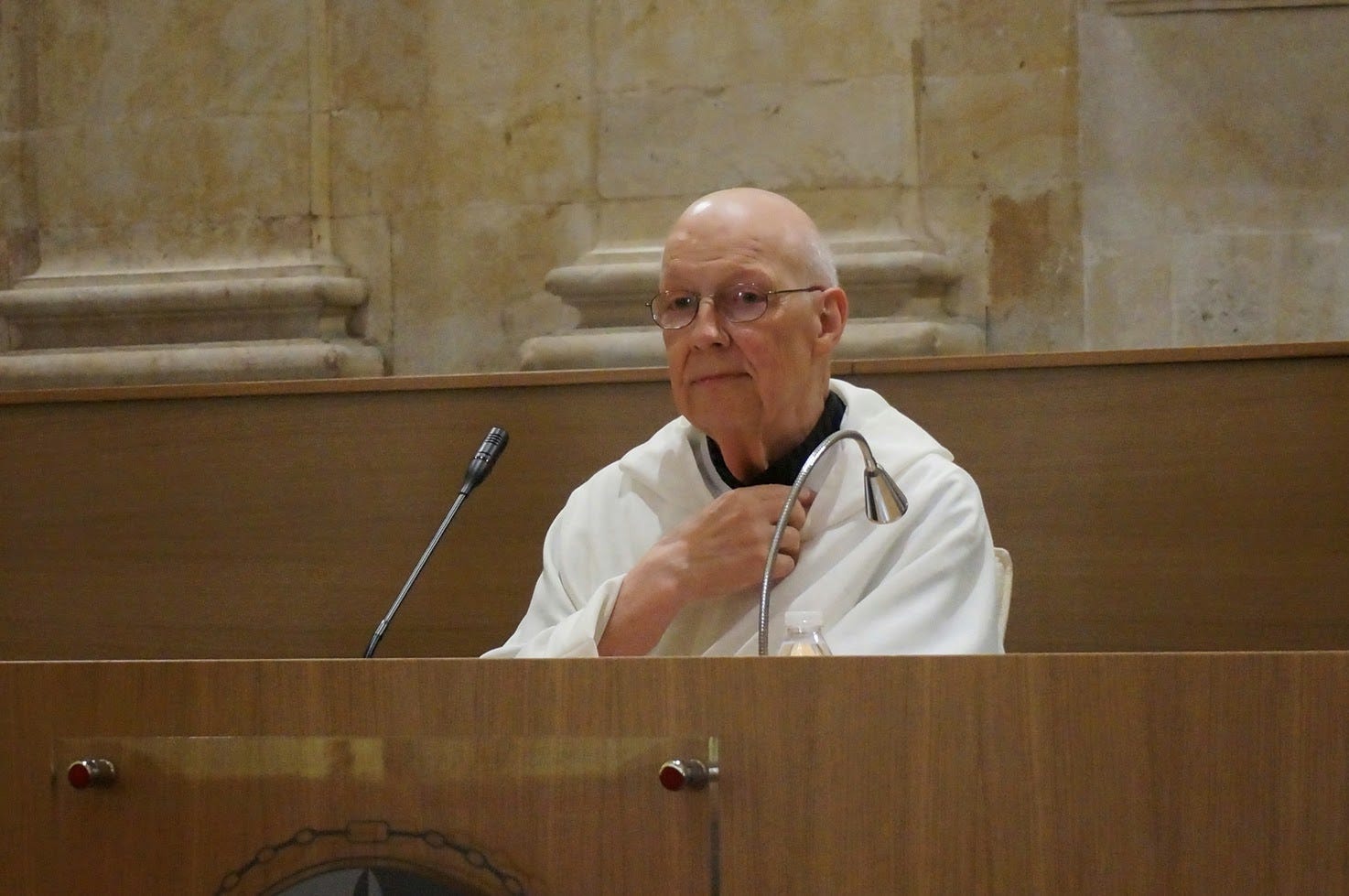
John Lawrence Dewan was born in North Bay, Ontario, in 1932, and took the B.A. and M.A. at the University of Toronto in 1953 and 1955. He did his doctoral work in two stints, 1954–57 and again 1966–67, leading to his dissertation “The Doctrine of Being of John Capreolus: A Contribution to the History of the Notion of Esse” (1967), defended before a committee that included Joseph Owens, Anton Pegis, and Edward Synan. In these years he also studied under Etienne Gilson and Marshall McLuhan.
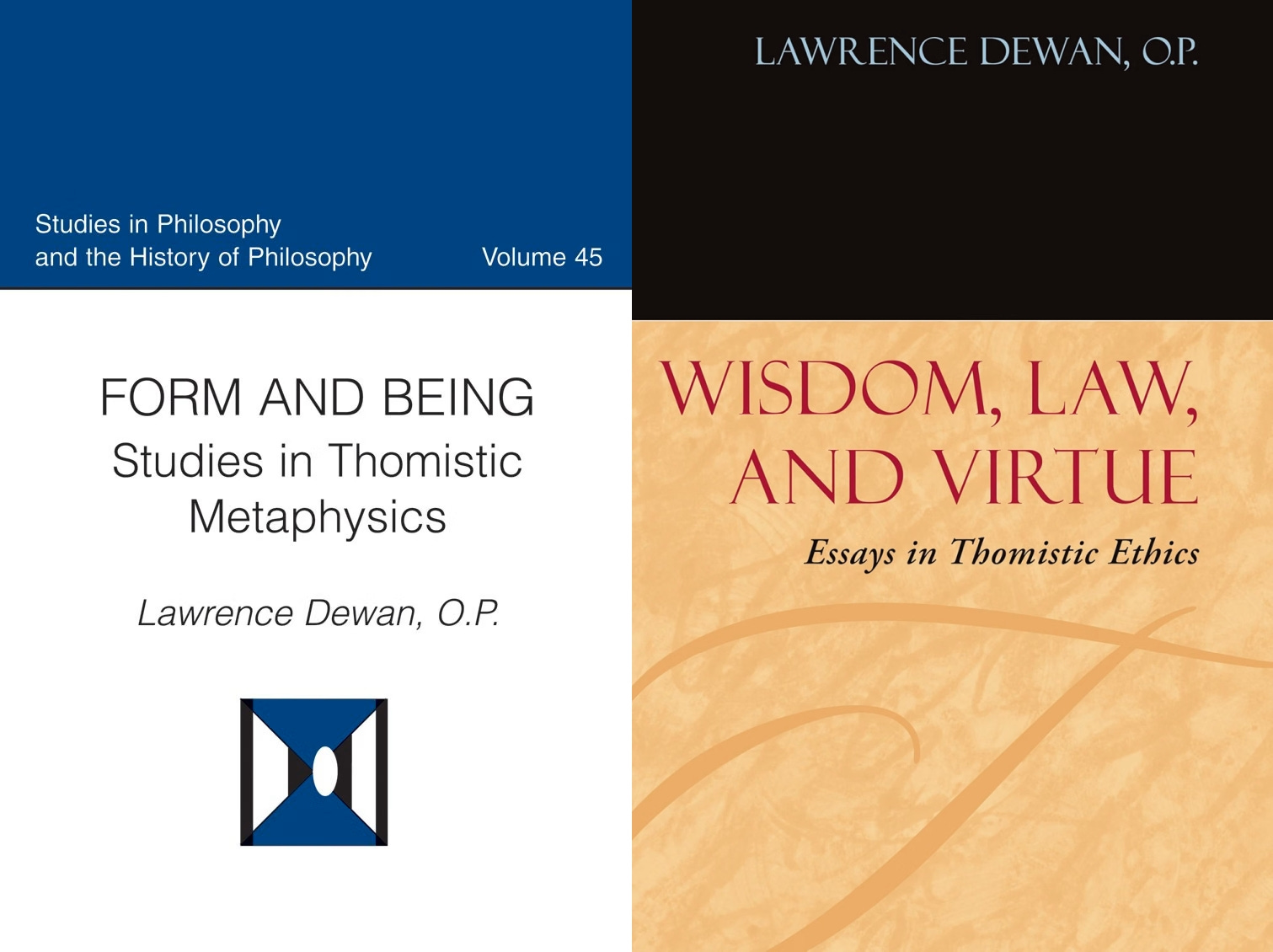
His first published article, “Leslie Dewart and Spiritual Hedonism,” appeared in Laval théologique et philosophique 27 in 1971. Although to my knowledge no one has prepared a complete bibliography of Dewan’s voluminous writings, he published well over 100 major articles, a Marquette lecture, and two collections of the work he considered his best: Form and Being with CUA Press in 2006, and Wisdom, Law, and Virtue with Fordham University Press in 2008. Among his major concerns throughout his career were the doctrine of esse and how it relates to form and substance; the doctrine of analogy in its various theoretical constructions; the interpretation of the Five Ways of proving God’s existence; the relationship of natural philosophy to metaphysics, and the relationship of both to modern science; and the foundations of ethics and political philosophy. He sparred often with fellow Thomists such as Joseph Owens and the River Forest School. While it would be an exaggeration to speak of a “school” of Fr. Dewan, there is no doubt he shaped every facet of Thomism in the past fifty years.
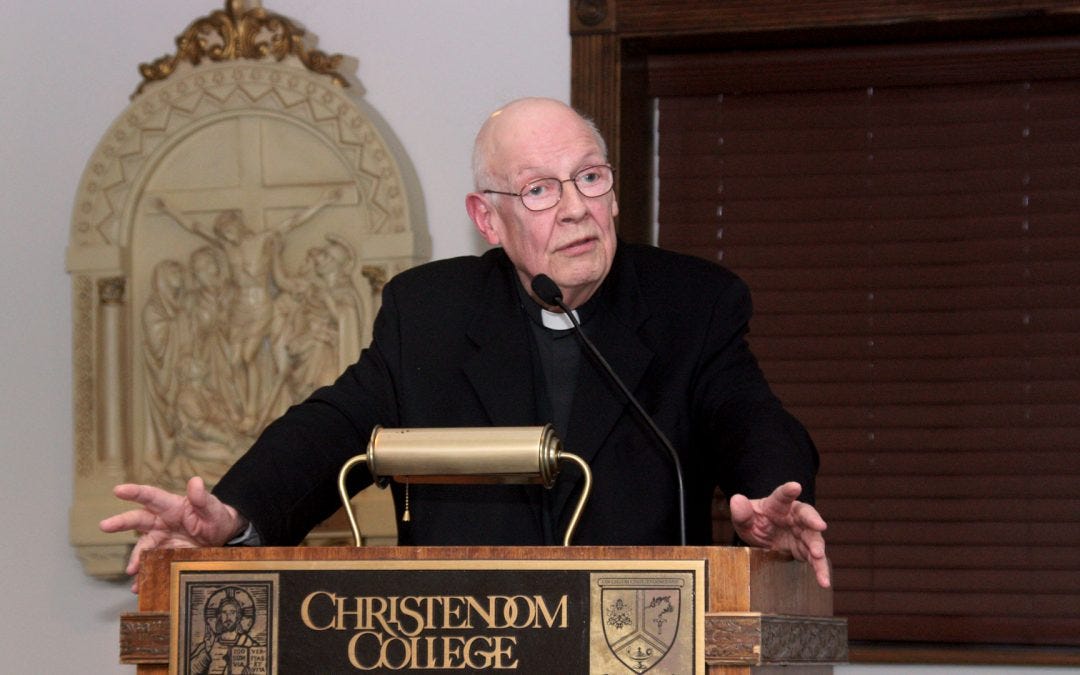
How does one worthily honor the memory of a teacher who made an enormous difference in one’s own life and in the lives of so many friends and acquaintances? There is always something far greater, more abundant and varied in the person and his legacy than any homage can do justice to. For me, Fr. Dewan was three things to the fullest: a teacher who dearly loved his teacher, St. Thomas, as well as his students, all potential Thomists waiting to be actualized; an intellectual who never stopped studying, researching, and writing, constantly advancing the science of metaphysics and probing the rich relationship between modern-day subjects and the perennial insights of Aquinas; and a priest who lived his life not merely as a scholar or professor, but as a genuine disciple of Jesus Christ, walking along the particular path of the Order of Preachers founded by St. Dominic.
I was blessed with many experiences of all three sides of Fr. Dewan. I enjoyed several semesters of metaphysics with him at The Catholic University of America from 1994–1998. Can anyone who attended his classes forget the owl-like eyes that gazed through coke-bottle glasses, the face that lit up with excitement as he engaged the intricacies of being and essence, form and matter, act and potency? I still consult the detailed lectures and collections of texts he handed out at the start of each class, with my own annotations in the margins, based on his improvised commentary. I remember the course on the Five Ways in which he assigned student presentations, and I had the fortune (or misfortune) to choose Gilson on the Third Way, not realizing yet that Fr. Dewan—an ardent admirer of Gilson’s intellectual legacy—was a most severe critic of some of his interpretive moves. Needless to say, my presentation was subjected to the dialectical shredder and ended as a pile of slivers, but in the process I had grown in both knowledge and humility, the indispensable precursor of wisdom.
Towards the end of my time at CUA, I began to realize, in spite of the innate modesty and simplicity of this white-robed teacher, just what a formidable intellectual Fr. Dewan was. In class we always smiled when he looked up from his lecture notes, raised a forefinger, and said, brightening: “I have a paper on this topic!” (meaning a publication), but little did we greenhorns know at the time that he had published article after article on seemingly every question of importance in the field of classical metaphysics, natural theology, physics, cosmology, and philosophical psychology, with forays into logic, ethics, politics, aesthetics, cultural history, biography, and sacred theology (I’m sure the list could be extended). At a certain point I began to collect his work more systematically to deepen and diversify my own grasp of Aristotle, Plato, St. Thomas, and other scholastics devoted to the philosophia perennis. It wasn’t an easy quarry to track, as he published in so many different (often obscure) journals, and, accordingly, it brought me pleasure, relief, and good hope for future scholars when Fr. Dewan decided to put together two collections of his best work. If I could urge an action to be taken, it would be to get and study both of these collections. They are pure gold. (Unfortunately, Fordham University Press seems to be charging pure gold for their volume—$116!)
Beyond these official publications, Fr. Dewan conducted a substantial correspondence with people who asked him philosophical and theological questions. I remember submitting to him some knotty difficulties that arose from a reading of St. Thomas’s treatment of transubstantiation in the Tertia Pars of the Summa theologiae, and he replied with a mini-treatise of his own, making the distinctions I had failed to make. He often sent me papers of his own, either in response to my queries or just to share his recent work. He displayed no “proprietary” attitude over his writings and relished a vigorous debate, never giving the impression that he had heard or said the last word.
As for Fr. Dewan’s religious life and priestly identity, he was a wonderful combination of total transparency and dignified reserve. You knew from the moment he entered the room in his white Dominican habit that he was a Catholic religious, and if you were in the right place at the right time you would see him involved in the celebration of Mass, but he discussed religious topics only when the subject of the class or a student question demanded it, and he neither pietistically mixed theology into everything nor arbitrarily excluded it from consideration—he was too much a son of St. Thomas Aquinas either to blur the lines of discourse or to compartmentalize and thus falsify reality. My warmest personal memories of him come from the semester he spent at the International Theological Institute in Gaming, Austria, where he co-taught a special seminar on Thomistic metaphysics and epistemology, and seemed to leave a gentle mark on the entire community’s academic and spiritual life. My wife and I remember with special fondness the Masses he celebrated in the ITI (Kartause) campus church and how he would bless our little children so lovingly, not in any rush, and with joy lighting up his countenance.
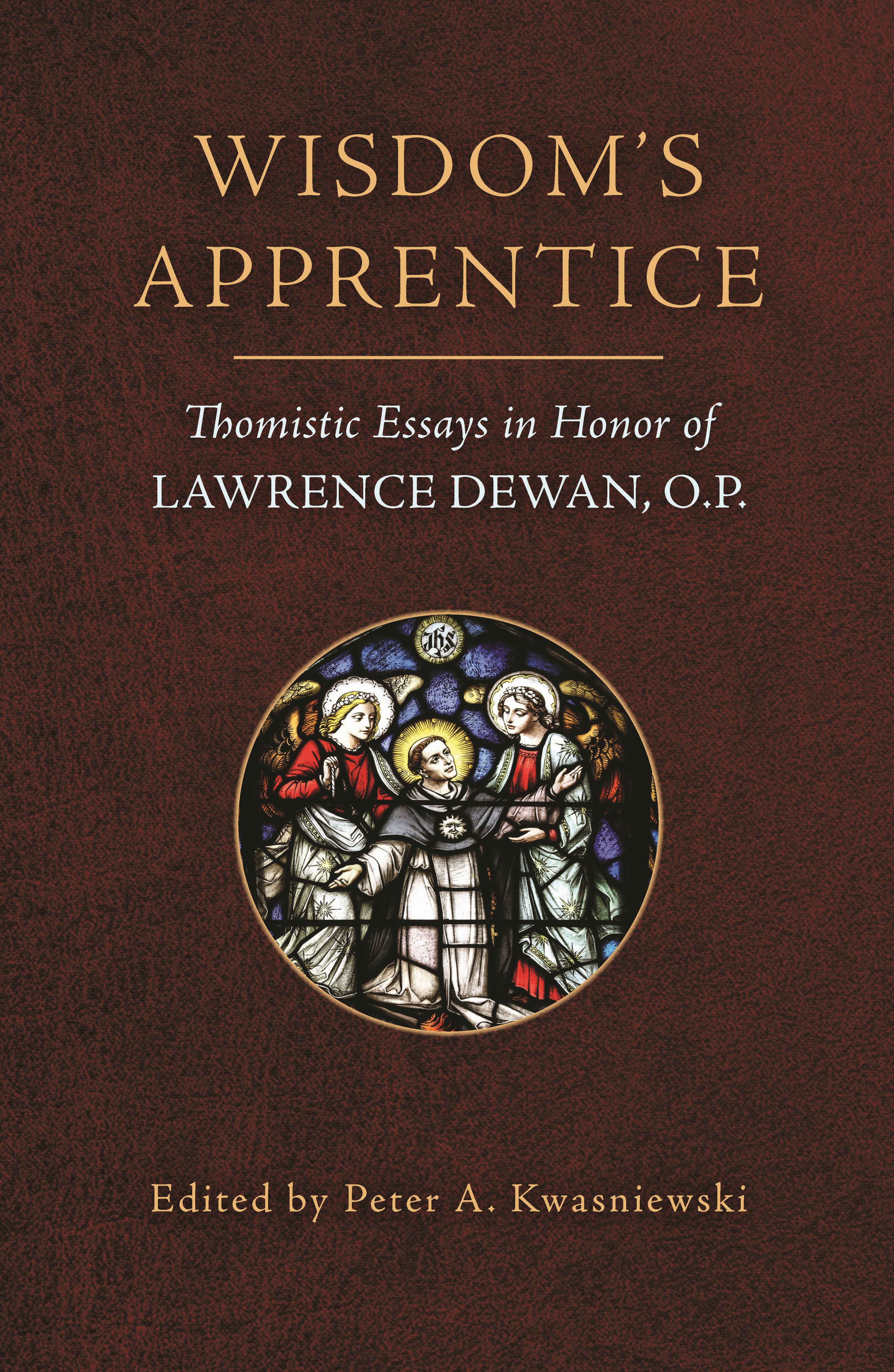
Fr. Dewan’s dedicated students always wanted to show him how much they appreciated him, but it was not easy to find ways to do so with a man who was not exactly a social extrovert. I am glad to have spearheaded the publication with CUA Press of a Festschrift for Fr. Dewan’s seventy-fifth birthday in 2007, under the title Wisdom’s Apprentice (still in print, now from Os Justi Press), which brought together work by twelve authors, several of them students or colleagues of his:
Part I engages fundamental metaphysical issues, Jan Aertsen writing on truth as a transcendental, Stephen Brock and David Twetten on the doctrine of being, and J. L. A. West on supposit and nature. Part II contains essays on natural theology, with Ralph McInerny and Leslie Armour posing questions on the rational basis of man’s knowledge of God and Gregory Doolan showing how deliberately Aquinas integrates divine ideas into his doctrine of God. In Part III natural philosophy comes to the fore: Christopher Decaen expounds the impossibility of action at a distance, Jude Dougherty the relationship between physics and philosophy, and Ralph Nelson the influence of Bergson on an important difference between Gilson and Maritain. The two authors of Part IV address the world of man; Kevin Flannery argues that for Aristotle no less than for Aquinas acts can be good or bad in their very species and Heather McAdam Erb unfolds Aquinas’s views on interior peace, the foretaste of eternal life.
When Fr. Dewan received his copy in the mail, the first thing he wrote to me—altogether typical of this dedicated intellectual—is that he found compelling so-and-so’s argument about the real distinction and couldn’t help but disagree with another fellow on a different point. He received the book simply as a philosopher in search of wisdom, not as a man looking for applause or resting on his laurels. It made me love him all the more.
One can say without hyperbole that Fr. Dewan’s life was dedicated to pursuing truth and handing it on with unstinting generosity. May he now behold the beauty of that truth unveiled.
Postscript. Those days in graduate school at The Catholic University of America were truly blest. What wonderful fellow students I had in my classes! Among them: Gregory T. Doolan, now Msgr. John F. Wippel Professor of Thomistic Metaphysics at CUA; Dave (“D.C.”) Schindler, now professor of metaphysics and anthropology at the Pontifical John Paul II Institute in Washington, D.C.; Christopher Malloy, now Professor of Theology, Department Chair, and Graduate Theology Director at the University of Dallas; Michael Sirilla, now Professor of Theology at the Franciscan University of Steubenville and a fellow editor at OnePeterFive; and so many more. We were all exact contemporaries in the School of Philosophy at CUA.
If you’d like to watch a lecture given by Fr. Dewan, try this:
Reminder
Take advantage of Os Justi Press’s annual Black Friday sale:

Thanks for reading and God bless you! To Him be praise and glory, in Christ and in the Church, now and unto ages of ages, Amen.