
A Young Man Tries a Postconciliar Vocation and Discovers Tradition
The Professor’s Bookshelf #4: The story of a would-be seminarian in Rome in 1993
Henceforth, Saturday posts will be free and open to the public. Unlike Monday and Thursday articles, which always have voiceovers (either me recording the post or another T&S writer), Saturday posts will not have voiceovers.
Preliminary note: Today I am delighted to share with you chapter 8 of Joseph Bevan’s hugely entertaining and very inspiring book Traddy Daddy: Memories and Thoughts of the Father of a Catholic Family. The chapter’s called “A Very Common Story” and tells about Joseph’s friend Jack, who, when he heard that this book was being written, asked if his story, dating from 1993, could be included in it as an illustration of many of the points Joseph dwells on. I’m glad the story’s in there, because it reveals a lot about the situation in the Church and the reasons why many faithful have sought refuge in the chapels of the Society of St. Pius X. Read and see. —PAK
I am from a Catholic family which happily attended the Novus Ordo Mass in our local parish, some five miles away from our home, in Chipping Sodbury. My father regularly played the organ at Sunday Mass and Mum cleaned the church. My two sisters and I helped out with the singing which usually consisted of hymns, English congregational masses and, occasionally, plainsong. Our parish priest, Father Ignatius, had his eye on me from the start as he had noticed a seriousness and a piety which, he felt, pointed towards a priestly vocation. We rarely went to confession or anything like that, but I did notice how I had begun to take my prayer life seriously and started to read spiritual books as I became more involved in parish life.
When I turned eighteen Father Ignatius asked me to “do the readings” at Mass, only the first two, mind, as he himself always read the gospel. Owing to the slight reticence and, how shall I put it, reluctance on the part of the thinning congregation to help out during the services, we were left with me and my family singing, serving, and doing the readings.
I was usually called upon to do the “bidding prayers,” which Father Ignatius, who was trying to introduce changes, asked me to compose and which he quickly checked before the start of the Mass. He encouraged me to mention in the prayers anything which was topical, and much was made of any worldwide wars and famines in Africa. During these conversations I had with the priest, I couldn’t help noticing his annoyance at being compelled by the bishop to make the liturgy more “dynamic.” In the summer months, I would announce from the lectern: “Let us pray for all those who are away on holiday at this time...” and also: “We pray for Bishop Jim, who will be received in audience by the Holy Father next week.” After each request, Father Ignatius would intone: “Lord, hear us!” and the reply would be muttered by all present: “Lord, graciously hear us!”
One Sunday, Father read out the latest pastoral letter from Bishop Jim, which was on the subject of vocations. The bishop quoted a short passage written by a nun who recommended the religious life because “it was fun!” After reading out this last sentence, Father visibly winced and afterwards preached a sermon on how he wasn’t surprised at the lack of vocations, which, he maintained, was caused largely by the search for “fun” on the part of those who generally trivialised the religious life.
An Interview
Encouraged by the parish priest, with whom I had long interviews, I decided that I should meet the diocesan director of vocations to see if I had the requisite disposition to study for the priesthood. This was duly arranged and one day, I think it was a rainy Tuesday morning in July, I took a bus to the diocesan offices in Bristol. I sat for a while in a sitting room with a cup of coffee and studied back numbers of the Tablet until I was approached by a man in a tracksuit who held his hand out for me to shake. The letter inviting me to the interview was signed “Terry Dowding (Fr)” so I knew this was a priest and yet, as he stood before me, there was no physical clue as to his clerical state.
“Hello, Jack!,” he said, “my name’s Terry Dowding, good to see you. Come into my office and we can have a chat.” His room was light and airy, but I was overwhelmed by the odour of tobacco. When we had sat down, he behind a large oak desk and me in a folding chair, facing him, he pulled out a packet of cigarettes and offered me one. I declined, being a lifelong nonsmoker.
“Before we get down to business, Jack, I want to ask you, have you ever been involved with the Tridentine Mass or any such thing?”
“What is that?” I asked, mystified.
“Oh, you know, some people call it the Latin Mass, or the Old Mass. Surely you know about all that, don’t you?”
I thought for a moment. “Well . . . ” I started. Father Terry sat bolt upright, his eyes widening. “Yes?”
“I’ve read news reports about Latin Mass people disobeying the Holy Father, but otherwise I have had no personal experience of any of that sort of thing.”
The priest relaxed. “Well, thank the Lord for that! I thought we would just get that out of the way first.”
Father Terry took a last deep drag of his cigarette and, as he blew out the smoke thoughtfully and crushed it into his saucer, he studied me.
“Jack, tell me, what exactly do you think the job of a priest is?”
I was expecting this question and had prepared my answer, thanks to some prior coaching by Father Ignatius.
“To save his soul and the souls of his flock.”
Upon hearing this, Father Terry smiled, and this developed into a kindhearted guffaw, followed by coughing and spluttering, common amongst heavy smokers.
“You don’t really think that, do you?,” he choked. “Someone’s told you to say that, haven’t they. Now tell me what you really think, Jack.”
I pondered my reply, worried that my next answer would produce even more merriment, so I decided to play safe.
“I would love to hear your own views, Father, that’s why I’ve come.”
“Forget all this ‘Father’ nonsense, call me Terry.” Terry fished out another cigarette, lit it and blew out more smoke. My eyes were beginning to water. “Jack, you can’t do any good in the Church unless you address the real problems faced by real people who are in your care. Only after you have gained their trust and respect will they be prepared to open up and receive spiritual help. What’s the use of telling a single mum, who is worried about paying her electricity bill or her rent, that she’s not to worry because Jesus will save her? The life of grace and the striving for perfection is of no use to someone in prison for murder when you visit him.” “But how can I, as a parish priest, God willing, improve the lives of anybody?,” I asked.
“You have to get involved in their lives. You do this by meeting as many people as possible, chairing committees, raising funds for the local school, marriage advice . . . the list is endless. You have to establish a public profile. Then the religious side will follow.”
I was confused: “But I have no skills in all the things you’ve mentioned, all I can do is pray and study.”
He was ready with his answer: “That’s what they will teach you at seminary. Nowadays at least half of your training will be spent outside the college, and you’ll be placed in a thriving working-class parish in a big city. After that, you will be bubbling with enthusiasm for your future work as a priest. Theology and canon law count for very little these days. Your priestly mission is ten percent knowledge and spirituality, and ninety percent people.”
“I’m sorry to admit this, Father, but I’m naturally a very shy person.”
“The seminary will teach you people skills, such as public speaking, how to deal with confrontational issues, and how to develop your personality. Seminaries nowadays place a lot of emphasis on psychology, and they even explore your inner sexuality. Have you ever slept with a woman, Jack?”
I was taken aback. “Certainly not!” I replied.
Quick on the uptake, Father Dowding was ready with his next aphorism: “I ask you, Jack, how can you love God if you’ve never loved a woman? You’re not gay by any chance, are you?”
I was shaken by this question and, although I opened my mouth to reply, no words came out.
“Don’t get me wrong, though. I wouldn’t have minded if you were. It’s just something the seminary has to be aware of. Of course, you’re not homophobic, are you?”
“No, of course not!”
“Oh, that’s good. We have to show love and tolerance towards people of all sexualities these days. When you go to seminary, they will carry out full psychosexual profiling for you, just to make sure that we have no skeletons in the cupboard.”
Father Terry suddenly stood up and pushed back his chair. That was obviously the end of the meeting. I asked him what happens next, and he said that someone from the vocations department would write to me in due course and that I was not to worry as I was definitely “in.”
Jack Goes to the English College
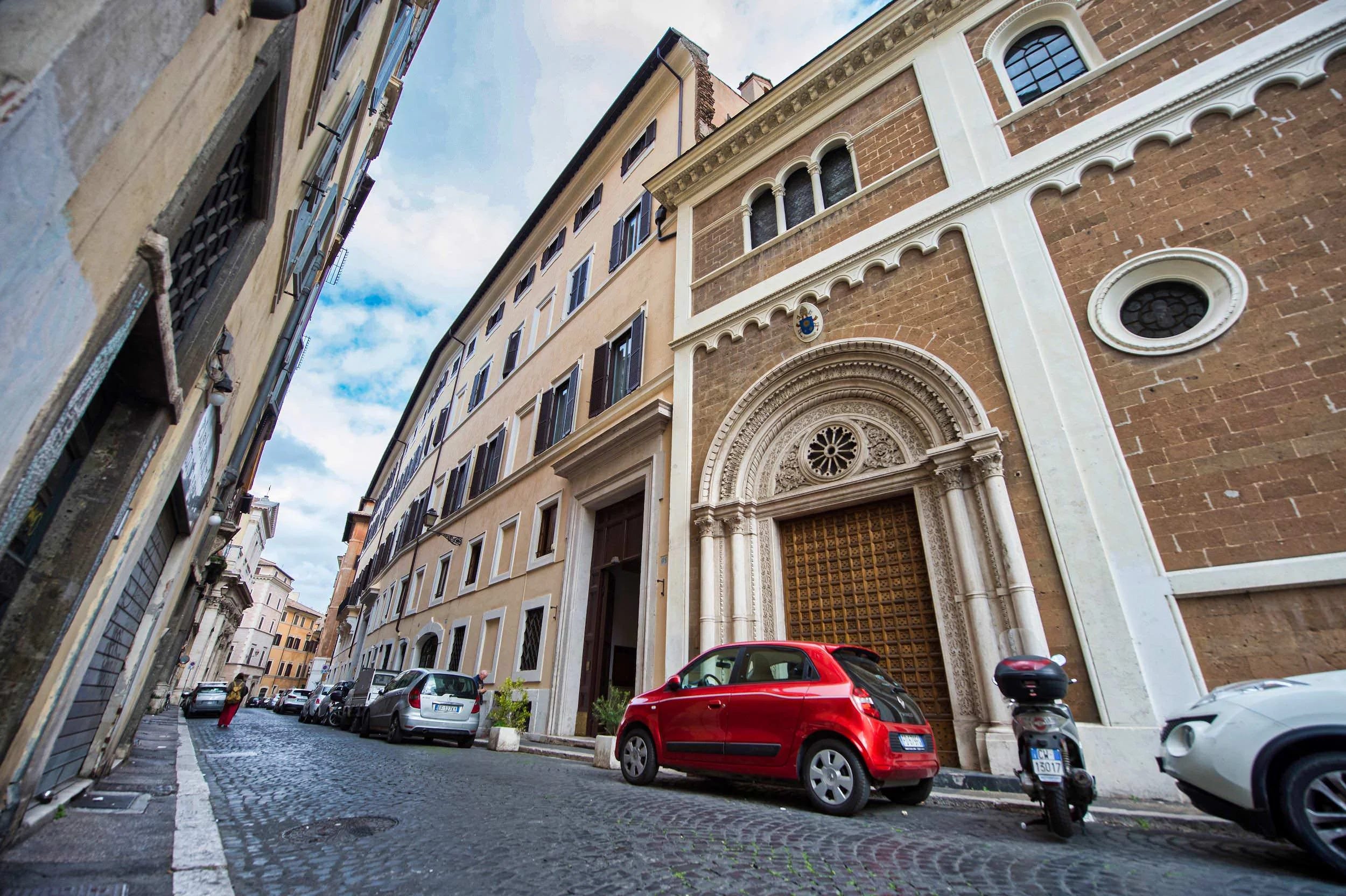
On the tenth of September, I alighted from the taxi at Via di Monserrato in Rome and lugged my heavy trunk to the ornate door of the Venerable English College. I rang the bell, which I could hear echoing inside. After waiting for a few minutes, I rang again and nobody answered, so I tried the latch, and the large oak door swung open. Upon entering I could see that there wasn’t a soul about, in spite of my calling out, and so I sat on a bench and waited. After about ten minutes, I heard the sound of loud cheering and thumping and finally a door at the end of the hall was flung open and a crowd of young men emerged, all shouting gaily at the tops of their voices. One of the men approached me and exclaimed: “England won the rugby!” I made some gesture of acknowledgment, and he said: “C’mon, I’ll show you the chapel.”
As we entered the church, the first thing I noticed were two electric guitars which had been left on the back pew in perpetual adoration. Underneath the altar, really a table, was a mysterious gold box. I was told that it was time for “holy hour” and I was shown to my place where I sat down. I was wearing a dark suit but, as they wandered in, I noticed that most of the other young men seemed to be wearing shirtsleeves and jeans. There were about twenty young men, which was very few indeed, I thought. There were a few older men who were wearing clerical garb, but I saw no one in a cassock. I assumed that these men were the college professors. At supper later that evening, I noticed that there were about twelve round tables, nine of which were empty and lacked coverings, and I guessed that the number of students was relatively small. The holy hour consisted of some readings, a meditation and, finally, a student crooning at a microphone whilst strumming a guitar.
In spite of the small numbers of residents rattling around in a huge building designed to accommodate at least a hundred, I found the noise levels generally intolerable as pop music, which I loathe, echoed around the place and people seemed to talk in loud voices. At 10pm we were told not to make a noise, but the authorities seemed to have no problem with the students listening to their music on headphones. It was a very noisy place and the opportunity for quiet prayer and recollection was almost nonexistent and, if anything, discouraged. My parish priest, Father Ignatius, was here in the 1960s and he had described to me the seminary life in his day, suggesting that nothing had changed since then. The priest had warned me about “custody of the eyes,” which meant that one normally went about one’s business in a state of recollection and avoided looking other people in the eye. That custom was now nowhere to be seen. In actual fact the whole institution must have undergone such huge changes since his day that I was often left wondering whether it was really a seminary at all. The reason I say that is because great emphasis was laid on psychology, hours and hours of it, and often these sessions were supervised by a silvery-haired lady in a cardigan, who we were encouraged to address as “sister.”
As the weeks went by, I befriended a seminarian who, like me, appeared to be disenchanted with the priestly training and our friendship started when he caught my eye during Mass, for as the guitar group had struck up with “Lord of the Dance,” I definitely saw him rolling his eyes and smirking furtively. His name was Anselm and after holy hour one evening, Anselm invited me to his room for what he termed “a quick snifter.” I was assured by him that it was perfectly okay for students to visit each other in their rooms and have a drink together. I wasn’t so sure about this but didn’t dare ask anyone about it.
“Have you ever attended a Tridentine Mass?” He asked lightheartedly, as we sipped our glasses of Limoncello in his bedroom. I said that I certainly had not, and he admitted that he, and a few others, occasionally sneaked off for a Friday evening Mass at Via Urbana, about half an hour’s walk away. “You’re welcome to come with us, but for God’s sake, don’t tell anyone!”
I shuddered at this idea as I wouldn’t dream of being disobedient. But I was curious. Why was that the first thing Father Terry had been obsessed with during my interview? Surely it cannot be that bad. “Think about it anyway,” Anselm said. “I’m sorry to say this, but the truth is that a few of us can’t stand the goings-on at the English College. So, rather than complain and get chucked out, we prefer to keep our heads down and hope to get ordained. Once that happens then they’ll all be in for a huge shock! We are a growing number now, but we have to keep everything deadly secret. Almost like the life of a recusant priest in England during the sixteenth century.”
“What else do you get up to, then?” I enquired.
“Usually, we meet up most evenings and pray the rosary or the breviary together.”
“Breviary?” I asked. “What’s that?”
“It’s regarded as the heart and soul of priestly life. Before it was modernised and now fallen into disuse, every priest was obliged to say his breviary every day on pain of mortal sin.”
“Mortal sin?” I exclaimed. “Never heard of it.”
“Ho-ho!” exclaimed Anselm. “You’ve got a long way to go, haven’t you? Have you never read a catechism?”
“You mean the Catechism of the Catholic Church?”
“No, I do not! That book is a watered-down sales manual for Vatican II. I’ll lend you my Catechism of the Council of Trent if you like.”
I hesitated at this, my friend adding: “Oh . . . never mind!”
I said: “My director of vocations in my diocese told me that the life of a priest is ten percent spirituality and ninety percent people.”
“He said that, did he? The truth is that it’s the other way round.”
“How does that work?”
“Well, the purpose of seminary training is to fortify and prepare yourself spiritually for your priestly life through the grace of God. You do believe in God, I suppose?” he chuckled.
“Of course I do!” I exclaimed, reacting badly to his attempt at sarcasm.
“But do you love God?”
“Well . . . love is too strong a word . . . ” I allowed my built-in English reserve to kick in; we are far too sophisticated to use such language.
“To be a priest you must not only love God, but you must also be in love with Him.”
“How can I do that?”
“If you follow our routine of prayer, meditation, daily rosary, and the breviary, God will grant you the gift of love. But you must ask for it.”
“How will I know when I’m in love with God, as you put it?”
“That’s difficult,” he replied. “I can assure you of one thing though. If you really love God, you will develop a horror of sin and . . . also . . . you’ll hate the Novus Ordo Mass! There! I’ve said it!”
I was anxious. “I’m not sure I signed up for all that. I thought a priest was meant to make the world a better place by helping people.”
“You sound like an ordination candidate in the Anglican Church. Perhaps you don’t really have a vocation then.” He replied gloomily. “Anyway, we’ll see.”
I had never met a “traditionalist” (as my father called them dismissively) until now and I can see why Father Terry was so cautious. Was my friend right, though? If so, then what am I doing here? I went to bed that night in an anxious state and, just before closing my eyes, there was a soft knock at the door. In walked Anselm, who chucked something onto my bed.
“This is a rosary plus a leaflet which will tell you how to say it. Goodnight!” And he was gone.
I was in a such a state of turmoil and indecision that I blurted it all out to the spiritual director who had been allocated to me. I was careful not to mention what my friend had labelled “hot topics.” He was an elderly priest with a kindly twinkle in his eye, and he had no hesitation in his advice:
“Look here, Jack. You’ve not been here for five minutes and you’re beginning to have doubts. That’s all very normal and even healthy. We shouldn’t take anything for granted. Just join in the life of the seminary with more commitment. Offer to do the readings at Mass, for example.”
I left the spiritual director’s room with a heavy heart. The “seminary life” to which he referred was becoming repellent as students vied with each other to be more and more progressive. Anyone showing reserve risked being labelled a “traditionalist” and could eventually be ejected. I assume this is why a number of the secret trads started to develop beards, grow their hair, and dress more shabbily, so as to establish their progressive credentials.
That night, and for no particular reason, I knelt down by my bed and, with the help of the leaflet, recited five decades of the rosary. As I did so, I meditated on the scenes of Our Lord’s passion, as instructed by the paper in front of me. I slept well, having been overcome by an inner peace which I had never experienced before. The following morning, when I awoke, my mind was settled, and I knew what I had to do. After breakfast I sought out my friend Anselm and told him that I wished to attend their prayer meetings in his room. I also stated my intention to accompany his group to the Tridentine Mass on the following Friday evening. I could see that Anselm was elated, although he quickly adopted a serious expression.
“In God’s name, not a word to anyone about this. If we’re discovered, that will be the end of us,” he whispered as he cast his eyes around, checking for eavesdroppers. From then on, I wholeheartedly participated in daily seminary life, being as helpful as possible. I even allowed a growth of stubble on my face so as to avoid suspicion. The craziest thing of all was that the more rebellious I became, in terms of objecting to any conservatism or promoting radicalistic ideas, the more the authorities approved of me and smiled on my deceptions. One of the hairier of my fellow students agreed to teach me how to play the guitar, and this met with universal approval on the part of the professors.
I can only imagine how an American citizen must have felt to enter a “speakeasy” for the first time during prohibition in the 1930s— that feeling of dread mixed with thrilling excitement as he took the plunge and broke the law for the first time. I had identical sentiments as I entered the Society of St Pius X chapel in Via Urbana that Friday evening. There were four in our little group, and we sat at the back. There were a few old ladies in front of us, who were praying the rosary out loud before Mass, and a mother struggled with two noisy toddlers. As I took my place on the wooden bench and looked up at the altar, I experienced a surge of happiness and relief. I had “come home,” and yet, I had no idea until then where or what “home” was. All the nonsense, contradictions, worries, and doubts which had accumulated in my head over the years seemed to simply evaporate. I knelt down, or rather I collapsed down on my knees, a bell tinkled and in walked the priest with a young man wearing a black cassock and a cotta. No “good evening!” He started Mass facing the altar and was answered in whispers by the server. I was utterly overcome by the reverence and simplicity of the rite and when I rose to receive communion, I felt a touch on my elbow. I glanced at Anselm, who was next to me, and he said: “Not this time, I’ll explain later.” Not going to communion— why not? I was mystified because I was always told that not going to communion was a bit like being invited to a meal and refusing to eat anything.
As we emerged from the chapel into the street and made for a nearby bar, I noticed a man astride a stationary bicycle, who was watching us closely from inside the porch of a building nearby. He was bearded and I recognised him as one of our fellow students at college. I said nothing about this to my companions but had the certain feeling that the game was up for all of us.
You can guess the rest! We were summarily dismissed from the English College without even receiving the courtesy of an interview with the rector, which was a relief. We found on our return a note for each of us requesting that we vacate the building first thing the next day and, in the meantime, we were “excused” all activities.
The one thing I had learned from my short stay at the seminary was that I did not have a vocation to the priesthood. To be more specific, I knew that I was not called by God to the “sacrificing priesthood,” which would make huge demands upon me, but rather my short life at the English College was preparing me for something completely different. The whole seminary system was designed to produce a generation of “ecclesiastical salesmen,” like the Anglican ministry, and as I sat in the plane as it lifted off the runway at Rome airport, I knew that the whole idea of becoming a priest in the Novus Ordo Church had sunk with all hands. The effect of my first visit to the Tridentine Mass, though, was to clear my mind and banish all my lingering doubts, and for that I am eternally grateful to my confreres.
When I left seminary, I decided to qualify as a Chartered Accountant and went to live in London. I established contact with the Fathers of the London Oratory, who were most welcoming, and, finally, ended up going to Mass regularly with the Society of St Pius X.
(The end of Jack’s account.)
The foregoing was taken from this book:


