
Anarchy or Unity, Politics or Peace
Why Catholics weary of fighting fall in love with an unchanging liturgy
An exasperated friend of mine, talented at singing chant, once sent me this note:
Latin has been banned at my parish, though the pastor says it won’t be forever. For now I am prohibited from singing the communion proper in Latin. Our Latin-haters and tradition-haters carry a lot of weight locally, and some have the bishop’s ear. How long I survive there, even just singing in the choir, remains an open question.
Think about it: I sang the Vivaldi Gloria the first year I moved here—but had to do it at the Methodist church. I sang Resonet in laudibus at Christmas—but I had to do it at National City Christian. Sang with that choir too when they did Mozart’s Ave Verum, transubstantiation message and all—best I’ve ever heard it sung anywhere. Though they don’t have communion every Sunday, were I Lutheran, Anglican, Methodist, or Presbyterian I would still have the option of taking communion at the rail.
So, Protestants welcome the sacred music that was born in the Catholic Church and is now shunned by it. Some Protestants will let you freely kneel to “take communion,” while there are priests or bishops who want to re-educate people only to stand—for the sake of “unity” or whatever other bogus slogan they trot out. I’m tired of it, and don’t know how much longer I can stand it.
In the postconciliar world, every traditional element of the liturgy—every single one—has become politicized. If you sing in Latin (or prefer to hear such singing), it’s political. If you kneel for communion, it’s political. If you wear a veil, it’s political. If you wish the priest would face east with everyone else and focus on God, it’s political. The supernatural is sucked dry in our tiresome, never-ending, insoluble political battles.
If you long to see continued the 3,000-year-old Jewish and Christian tradition of only men exercising liturgical ministries—now that’s a mega-political issue. The tradition has all the substantive theological arguments on its side (as I show in my book Ministers of Christ), but apparently we can’t have the tradition anymore because “feminism, liberalism, democracy, active participation” or whatever other lame-brained modern prejudice is uppermost on the liturgy committee’s mind.
That’s the sign of a Church that has ceased to swim against the tide of modernity and is just floating down it like a dead fish.
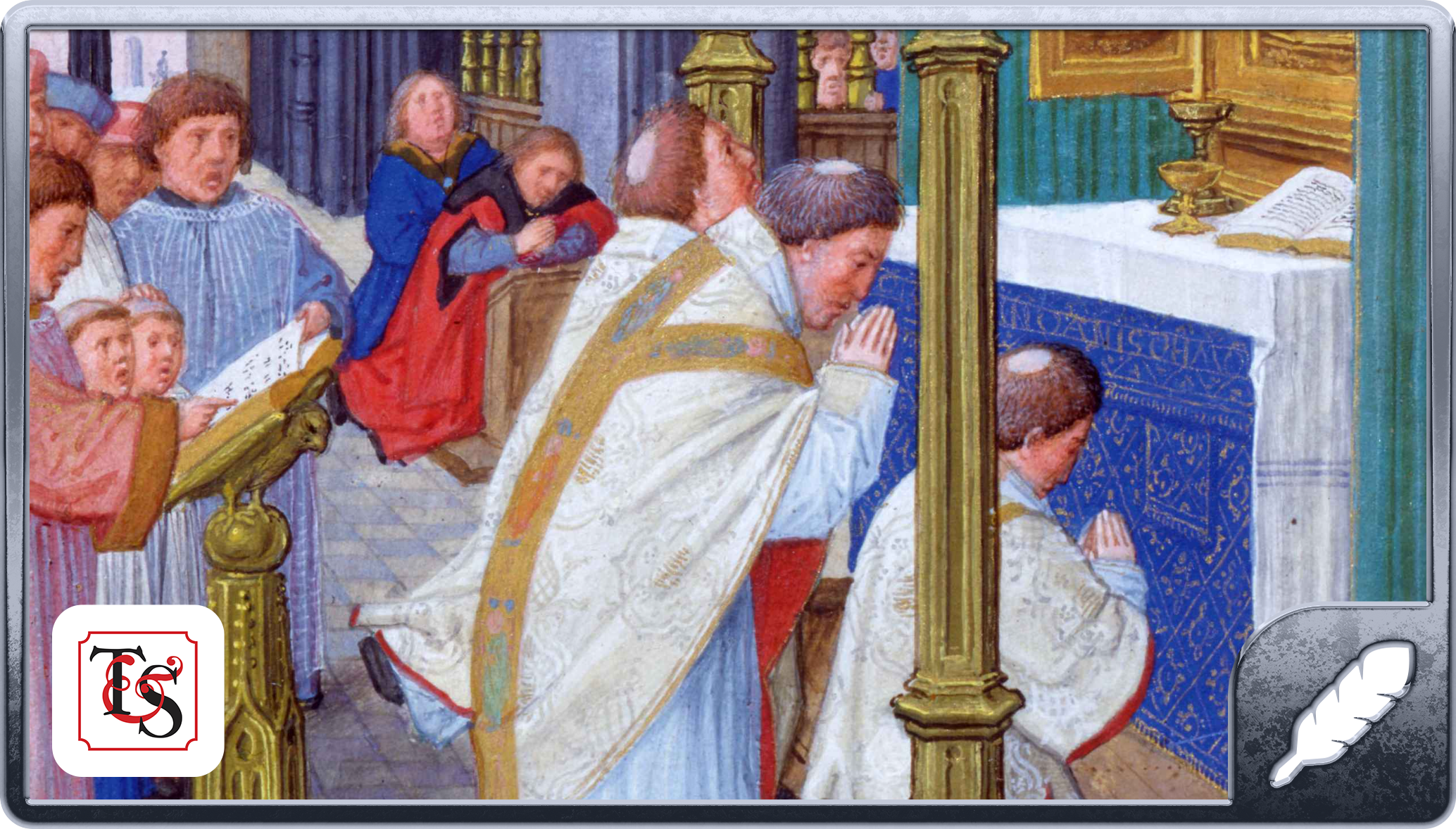
Meanwhile, at a traditional Latin Mass, everyone kneels for communion, peacefully, unselfconsciously. We all face eastward. Only men serve in the sanctuary, and only the ordained distribute the Body of Christ. Women wear veils. We sing and pray in Latin. It is all completely natural because it is just the way things are. Those who experience it taste what it’s like—perhaps for the first time—to surrender oneself to divine worship, to be in the flow of a liturgy that precedes you, carries you, transcends you. Petty battles are left at the door and we walk into a timeless domain.
This atmosphere is created by several things, but among the most important is the wealth of detailed inflexible rubrics and conventions, which smoothly guide the action, and are ever the same, week after blessed week. No adaptations. No accommodations. No accompaniment. No curveballs. No options. No extemporaneous interjections. Just the Mass, in every one of its prayers, and only its prayers, said exactly as prescribed, by a priest who is more a “living tool” than a personality.


