
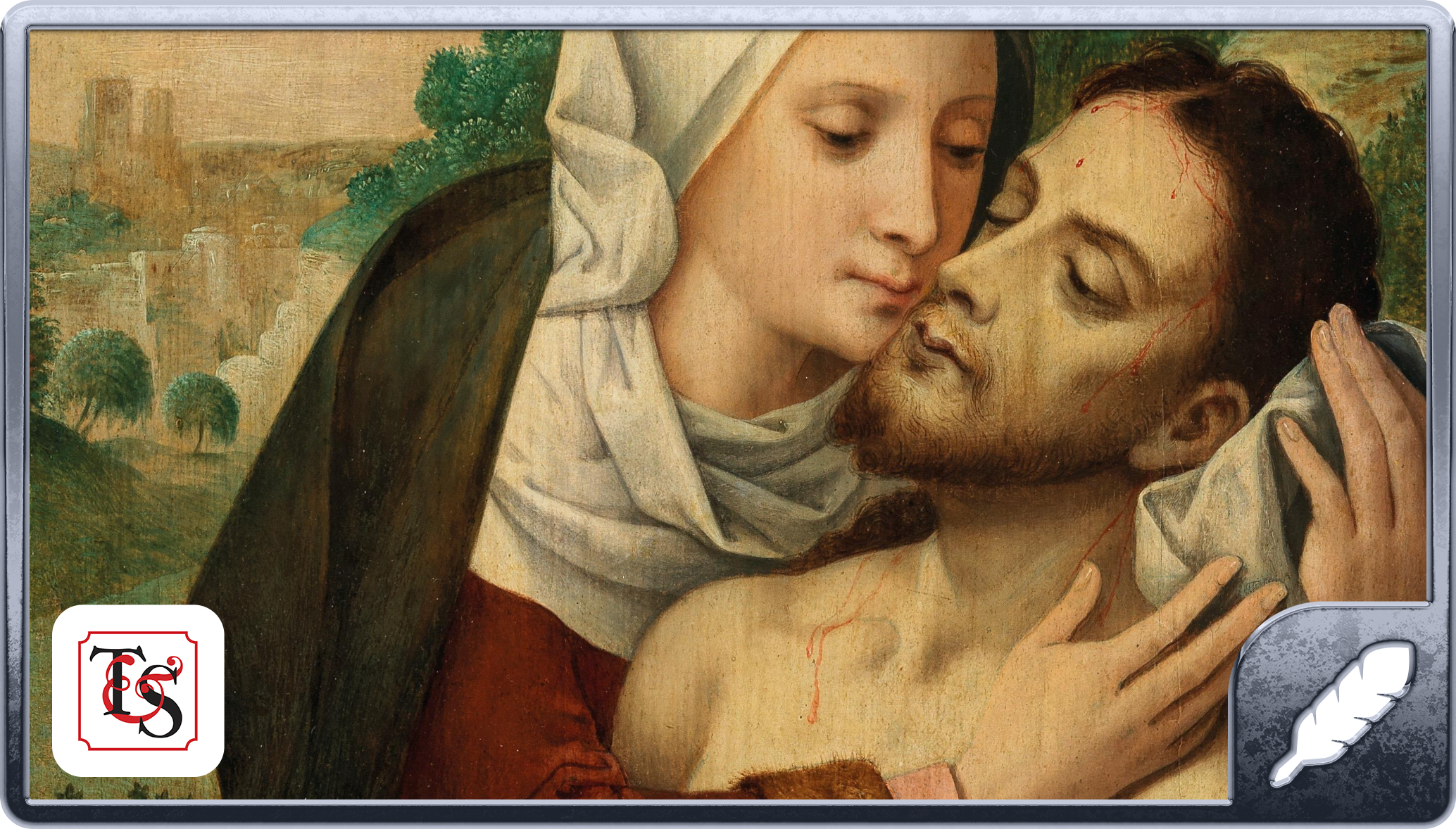
Behold Thy Mother: Meditating with the Stabat Mater
This poem set to music by Gregorian chant, Josquin, Charpentier, and Haydn
In his Treatise on the Love of God, St. Francis de Sales meditated on the perfect union of holy love and sorrow at the foot of the Cross. Enraptured with the greatness of Our Lady’s Immaculate Heart, he wrote:
The sweet Mother, who loved more than all, was more than all transfixed with the sword of sorrow…. Now this maternal bosom, being thus wounded with love not only did not seek a cure for its wound, but loved her wound more than all cure, dearly keeping the shafts of sorrow she had received, on account of the love which had shot them into her heart, and continually desiring to die of them, since her Son dies of them, who as say all the Holy Scriptures and all Doctors, died amidst the flames of his charity, a perfect holocaust for all the sins of the world.1
In his praise of the Sorrowful Mother, St. Francis de Sales echoes the great chorus of saints and artists who have filled the Church with loving tributes to her most painful hour, recorded by the eyewitness, St. John: Stabant autem juxta crucem Jesu mater ejus, et soror matris ejus, Maria Cleophae, et Maria Magdalene.
By the late 14th century, the famous poem inspired by St. John’s testimony, Stabat Mater Dolorosa, was set as a sequence and as a hymn in Franciscan missals; in 1727, it was inserted in the Roman Breviary and the Missal for the Feast of the Seven Sorrows of the Blessed Virgin Mary (the Friday after Passion Sunday). The poem contains 20 stanzas divided into two distinct parts. In the first part (stanzas 1-8), the anonymous narrator meditates on the affliction of the Virgin as she gazes upon her dying Son. In the second part of the poem (stanzas 9-20), the speaker petitions the Blessed Virgin to transform his heart to be like hers, and to save him by her prayers.
From the time of their original composition, the liturgical texts have inspired the great musical artists of Christendom with reverent awe and admiration. Thus, the Stabat Mater has become a priceless gem in the crown of Heaven’s Queen, and each unique musical setting reflects the mystic hues and fires of her wounded heart.
In addition to Lenten prayer, fasting, and almsgiving, traditional Catholics may also commit themselves in this holy time to the renewal of mind enjoined by St. Paul in Romans 12, verse 2. Exploring the rich variety of settings of the Stabat Mater provides a simple way to elevate our thoughts, as we enter into the pure and peerless soul of Our Lady in her sorrows. Here is a brief introduction to four musical settings of this beautiful hymn for your enjoyment and devotion.
Gregorian Chant: The Spirit’s Sacred Indwelling
Of the many musical settings of the Stabat Mater, the Gregorian sequence and vespers hymn remain in a superlative category of their own, because Gregorian chant is not merely music, but Sacred Liturgy, that is, prayer of the highest form. In his series of conference lectures “Reflections on the Spirituality of Gregorian Chant,” Dom Jacques Hourlier wrote, “Gregorian Chant does not simply inculcate in us the feeling or sense of who God is. It actually makes us holy, and enables us to participate in the life of God. And thus, it acts as an authentic means of sanctification.”2
While the hymn melody is better known among the laity, the sequence melody also contains a wealth of spiritual and artistic grace.
Please note that today’s voiceover contains generous musical excerpts from the Gregorian sequence, Josquin, Charpentier, and Haydn, to illustrate what the author is discussing. Don’t miss it! ~Dr. K


