
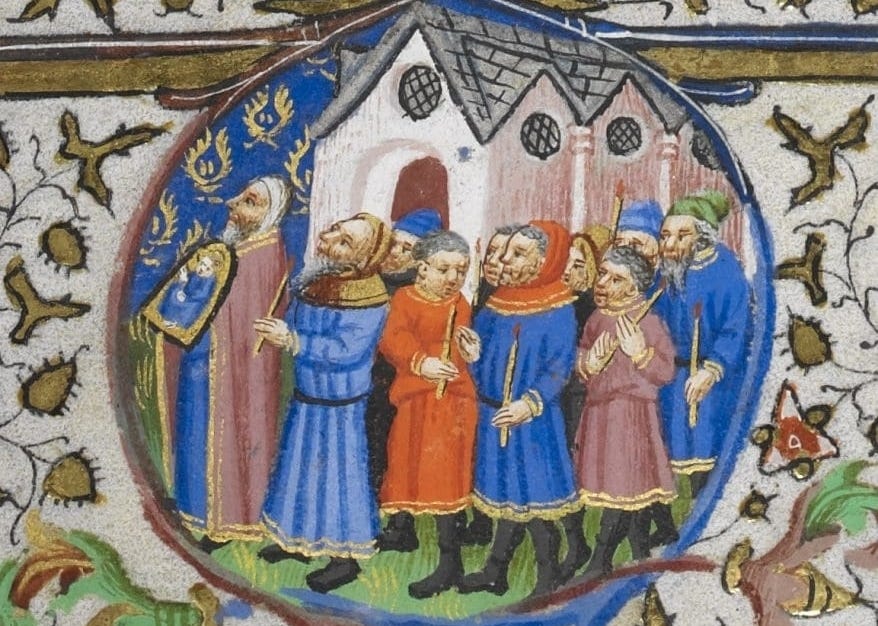
Candlemas and the Marian Miracle of Constantinople
How Divine Deliverance from Plague Boosted a Beloved Feast
A restless shadow loomed over the glistening domes of Constantinople. Italy lay ravaged by barbarians in the West, and the Persians threatened from the East. Amid the turmoil of ceaseless political and ecclesial intrigue, the great Justinian had made the restoration of the Empire his life’s ambition, after the pattern of his forebears Constantine and Theodosius. Victory and the dream of a united Christendom loomed within his grasp, but his chances stood upon precarious financial strain and a heavy burden of taxation.
Then imperceptibly, amid Justinian’s titanic struggle to reunite the Empire, the air grew colder and darker. Famine set in, as the engines of conquest ground on and the Monophysite heresy raged.
War, famine, and atmospheric disturbance: these are the forerunners of plague, that pale horse whose appearance signals the wrath of God and His chastisement of the nations. Out of Ethiopia and into the Egyptian port of Pelusium came the dreaded buboes in the year of Our Lord 541, carried by rats that infested the all-important grain ships; from Egypt the ships sailed to Constantinople, and from Constantinople the disease spread to the furthest reaches of the Earth.
The chroniclers of the time paint a vivid nightmare landscape that is immune to the dismissals of modern scholars. Constantinople, the crown jewel of all the East, with its impregnable walls, its streets filled with the scent of roses, and above all, its glorious Temple to Holy Wisdom, became a suffocating charnel house. The historian Procopius recorded supernatural terrors seen in the city, infernal ghosts that visited those doomed to die, so that many would not even open their doors to friends or family.

The disease claimed its victims in no discernible pattern. Recorded symptoms varied wildly, baffling physicians both then and now. Eamon Duffy writes:
At first the authorities stationed officials at the city gates and the harbours to count the bodies, but when the count reached 230,000, it was abandoned. To begin with, a combination of hygiene and piety had prompted the city authorities to provide free burial and religious rites for the corpses of the poor, who lay where they had died in the streets and houses. But as the mortality rates mounted, the dwindling numbers of clergy could not cope, and the overwhelming priority anyway became simply to rid the beleaguered living of the murderous presence of the dead. Panic stashing of corpses in the guard towers around the city walls filled Constantinople with the stench of death. Every available form of transport was mobilized to get the mountains of dead out of the city. The corpses were heaped along the seashore in piles of up to 5,000, then loaded onto ships and dumped at sea or on unpopulated shores as far away as possible.1
Contemporary accounts recorded up to 10,000 deaths a day, and enormous burial pits that held 70,000 corpses. Eyewitnesses from the vast corners of the Empire lamented that half the world had been carried off, and Duffy notes: “[John of Ephesus’] haunting evocations of abandoned villages, domestic herds turning feral, and whitening crops standing unharvested in an eerily empty landscape, burned themselves into the literary imagination of late antiquity, and would resurface in many later accounts of epidemics.”
Then Justinian himself fell victim to the dreaded swelling, and declined to the point of death. The rule of war-torn Rome fell into the fractious hands of his wife, the Empress Theodora. The words of a sacred chant from another plague time may well describe the feeling that must have consumed the living:
Media vita in morte sumus
quem quaerimus adjutorem
nisi te, Domine,
qui pro peccatis nostris
juste irasceris?
Sancte Deus,
sancte fortis,
sancte et misericors Salvator:
amarae morti ne tradas nos.
In the midst of life, we are in death;
Of whom may we seek help,
but Thou, O Lord,
Who for our offenses
Art justly displeased?
O God most Holy,
O Holy and Mighty
O Holy and Merciful Savior
Give us not up unto bitter death.
NOTE: As has always been the case with Tradition & Sanity, Monday articles are paywalled, so you will need at least a Basic Membership to Pelican+ to read the whole of this wonderful article or to listen to its voiceover. Thursday & Saturday articles, in contrast, are free, as long as you have a user name and password, which you can obtain for free at Pelican+. Visit our platform and find out what you might be missing!


