
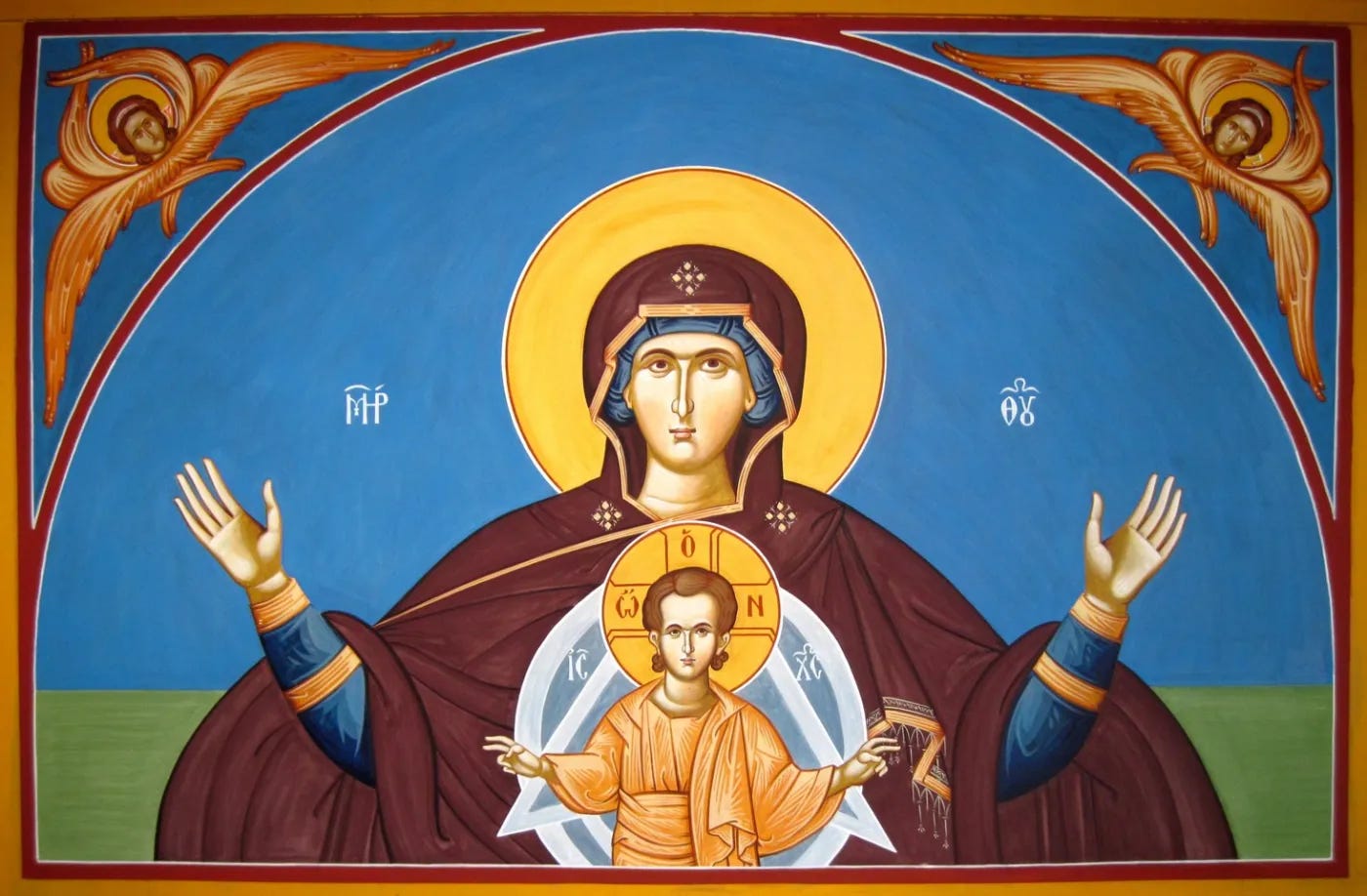
Does St. Paul Teach Us About Mary as the “New Eve”?
An important but strangely overlooked teaching in 1 Corinthians 11
The fact that the Blessed Virgin Mary should be honoured as the new or second Eve is certainly a part of sacred tradition. St John Henry Newman, Doctor of the Church, observed from his deep patristic knowledge, that this title of our Lady has a certain primacy over all others. In his justly celebrated Letter to his Anglican friend Edward Pusey—recently republished under the title The Virgin Mary as New Eve—Newman posed the question: “What is the great rudimental teaching of Antiquity from its earliest date concerning her?” By “rudimental teaching”, he explained that he meant “the aspect under which she comes to us, in the writings of the Fathers.” He answered his own question very simply: “She is the Second Eve.”
This leads naturally to another question. Do we find this same theme, of Mary as the second Eve, in the written teaching of the apostles, that is, the New Testament itself? Certainly, we don’t find it there in plain words. St Louis de Montfort held that Mary, in her humility, asked God that she might not be mentioned in the Scriptures any more than was necessary to manifest her Son. Yet this does not mean that we do not find this teaching in the New Testament at all.
Newman himself found it in the last book of the Bible, the Apocalypse of St John. In chapter 12 of that book, we have the vision of a woman, her male-child, and a dragon. The dragon is identified as that old serpent, who is called the devil and Satan, while the woman is described as the mother of the one who was to rule all nations with an iron rod, a phrase used to describe the Messiah in Psalm 2. Although the figure of the woman allows of more than one interpretation, none of which excludes the others, on its most natural reading it is the Blessed Virgin, the mother of the Messiah. And, as Newman observes: “Such a meeting of man, woman, and serpent has not been found in Scripture, since the beginning of Scripture, and now it is found in its end.” In other words, the Apocalypse all but explicitly presents Mary to us as a second Eve. Since St John as the beloved disciple was given the privilege of assisting her after the Lord’s ascension, who was more suited than he to reveal this truth to the world, albeit with prophetic discretion?
I want to suggest, though, that this same truth is also to be found, again discreetly, in the writings of St Paul. This will probably surprise some readers, since it is often said that the only reference to our Lady in St Paul’s epistles comes in Galatians: When the fulness of the time came, God sent forth his Son, born of a woman, born under the law (Gal. 4:4).
On the other hand, if this theme was part of the apostolic preaching, there is good antecedent reason to expect to find it in St Paul.


This resonates deeply… the way the New Eve is hidden yet present throughout Scripture, waiting to be found,
Hidden yet essential. Like the womb itself… unseen, but where life begins, and through Mary’s yes, the New Eve’s yes, salvation brought forth.
Such depth to dwell in.
Newman's observation is striking: "Such a meeting of man, woman, and serpent has not been found in Scripture, since the beginning of Scripture, and now it is found in its end."
This framing invites a question rarely explored: how does the Serpent himself perceive this Woman? Genesis 3:15 announces enmity. Apocalypse 12 shows her crowned, clothed with the sun, the moon beneath her feet — and the dragon raging against her.
I'm currently writing a novel called Non Serviam on Substack, narrated entirely from Satan's perspective. In Chapter 1, Part 2, I explore exactly this: the Adversary's vision of the Woman — "a queen in her palace, crowned with stars, clothed with the sun, the moon beneath her feet" — and his metaphysical revulsion at seeing a creature of clay placed above him. The same chapter depicts his horror at the Incarnation: the Logos descending into flesh, becoming embryo, infant, corpse.
The "New Eve" doctrine isn't just Marian devotion — it's the answer to "Non serviam."