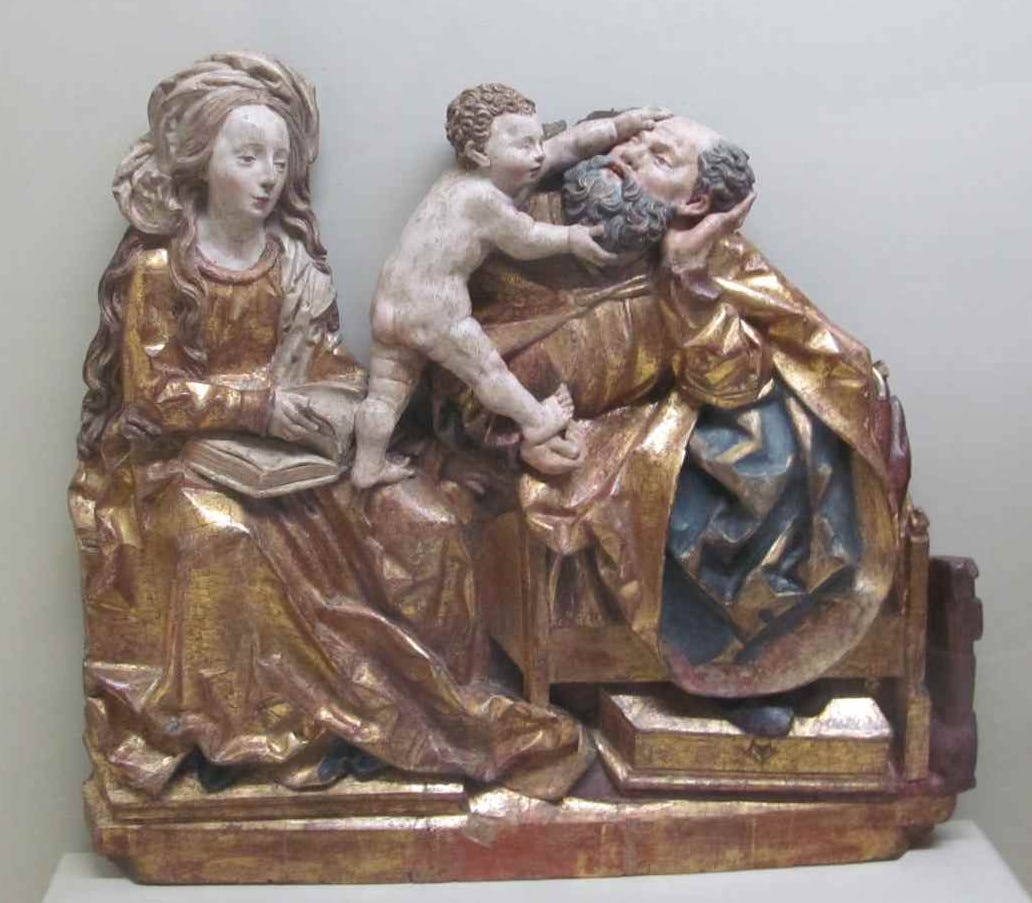
Dr. K’s Weekly Roundup, January 10, 2026
Additional thoughts on AI; Major new book on Pope Francis; Cardinals in Rome; Duluth vs. Charlotte; Spiritual topics; and more

Additional thoughts on AI
My article from Thursday, “How AI Diminishes Our Humanity—and Our Honesty” (PLEASE NOTE: that article can be ready FOR FREE by anyone who simply signs up for Pelican, no fee—as is true for any of my articles on Thursdays and Saturdays!—Dr. K) has, not surprisingly, generated a lot of comments and questions.
I appreciate and welcome this kind of engagement, as I am not so deluded as to think I have “all the answers.” Thus, I received this note from a reader:
In the last six months or so, I have used ChatGPT to assist me in my work in drafting emails, letters, and legal documents. I wonder if you might have a spare moment to briefly comment on this particular point: “If it concerns intellectual or creative work on the basis of which one will be rewarded either academically or economically (or both), it would be a form of injustice that should be taken to the confessional.” Since there is economic reward in receiving a salary for professional work, would you say that the use of AI in the context of drafting emails, letters, and legal documents should be taken to the confessional?
This is a challenging question for me, as we are in uncharted waters with all kinds of new ethical conundrums. I probably should have qualified my statement to some extent; currently it reads in too absolute a manner. I do believe, for the reasons given, that people should try to write their own materials, and if a person is so busy that he couldn’t possibly keep up without using AI, I’d say perhaps he’s just too busy and is trying to do the work of more than one man!
But it’s unclear to me where the line of authorship must be drawn—if you wrote 50% of something, could you call it your own?—and also, what specifically counts as creative and intellectual work. I think legal documents are neither (sorry, I don’t mean that to be offensive to lawyers!). What I mean is, if you have ChatGPT write an academic article and then submit it to a journal, that seems clearly unethical—and apparently everyone still agrees about that. And if you have it write a short story and submit it to a literary contest, again that seems clearly unethical. But to have it write a police report? Or run a job estimate? Or furnish a tax overview? Or generate a legal template?. Those don’t seem at all like the same kind of thing as the academic article or the short story.
Another friend wrote to me:
(1) Would you say using a (human) ghost writer is immoral? If not, how is that different in your mind (morally speaking) from using AI as a “ghost writer”?
(2) How much AI would you say is okay to use when writing? For example, many writers use AI much like we used to use Google, for research. But some go further than just research, asking AI to help craft sentences, etc.—i.e., actual writing help. What level do you think is acceptable for Catholics?
I would also caution you against the use of AI detectors, which I’ve found to be very unreliable, giving wildly different results.
Ghost-writing is an accepted practice where one human author can work for another. The origin and result is still man-made. I don’t see it as at all similar to the AI situation. Think of it this way: Would you want a pope to issue an AI-written encyclical? Why or why not?
I don’t know where to draw the line, but what I can see is that every line we make is slippery and porous. I believe this is the kind of thing we should say a firm “no” to, precisely so that it doesn’t unseat and dissolve millennia of intellectual habits the human race has tried to develop and that our greatest philosophers have considered true perfections of the soul—though I pessimistically realize that an attempt will be made to force technology down everyone’s throats whether we want it or not.
In a book I was reading yesterday—Brian Keeble’s Art: For Whom and For What? (pp. 102-3)—I came across a very striking passage:
He [man as homo faber, i.e., maker] is a responsible creature, an instrument of creation, an instrument by means of which that is made which cannot be made otherwise. Responsibility does not only imply a burden imposed; it also implies a power to bring gifts. It is his power of willing response that gives to man his unique responsibility. And that response is primarily of the mind. Therefore it is that our industrialism, as such, is to be condemned; for it reduces the workman to a subhuman condition of intellectual irresponsibility.
Now, re-read that, replacing “industrialism” with “artificial intelligence.”
I researched the various AI detectors and found that experts ranked them from very reliable to totally unrealiable. GPTZero has, in my experience, never failed to detect a fully human-written text or a fully AI-generated text. One thing I’ve noticed in recent months is that AI-generated “prose” has very notable characteristics. It is “too perfect”: the sentences are all about the same length, mathematically balanced, with a never-failing aptitude for vocabulary, no curveballs, no interesting variations in rhythm, syntax, or style. It always indulges in cheap imitations of Chestertonian paradox. It uses “punchy” formulations that sound like advertisements. Once you have a nose for it, you can see that what GPTZero marks as fake actually reads like a fake.
Again, the pessimist in me thinks that over the next few years, so much prose will be AI-generated that human beings, sadly, will start imitating it in their own writing, as if they should strive to sound like a machine!
Latin Mass pilgrimage to the Holy Land
Those who are looking for a TLM pilgrimage to the Holy Land, look no further. A Regina/St. Charles trip taking place a little less than a year hence—November 30 to December 10, 2026—will feature:
daily High Mass with our wonderful chaplain, Fr. Pablo Santa Maria;
for which I will serve as the cantor for the Gregorian chant;
with the great John Sonnen of Liturgical Arts Journal as our tour manager;
and, as our local guide, Amer Shehadeh, one of the best and most experienced.
Altogether a very rare combination of “forces”! More details here. We will have a Zoom information meeting on January 13 at 8 pm ET that anyone may join via this link.
Major new book
Os Justi Press’s first release in 2026 is sure to make waves (and already has been making them).
The problem of Pope Francis, so far from disappearing with his death, has only just begun, for his appalling legacy must be dealt with head-on, theologically and canonically. The definitive tool for this unavoidable work of evaluation, critique, and rectification has now been published: Dominic J. Grigio’s The Disastrouus Pontificate: Pope Francis’ Rupture from the Magisterium.
Spanning the breadth of sacred doctrine over its nearly 900 pages, The Disastrous Pontificate (which takes its title from Cardinal Pell’s “Demos” memorandum) rigorously contrasts the teachings of Pope Francis with Sacred Scripture, Sacred Tradition, and the perennial Magisterium.
The modern world has a short attention span and a poor memory. But the pontificate of 2013-2025 must not be forgotten or packed away in platitudes. Like that of Honorius—only much worse—it must be openly, officially condemned for all of its ruptures. Os Justi offers this work as a solemn act of fidelity to the apostolic charge on all the faithful: to preserve the integrity of faith and morals for the sake of the salvation of souls.
The Disastrous Pontificate has been warmly endorsed by experts known for their courageous defense of the Faith: Rev. Gerald E. Murray, J.C.D. • Dr. Edward Feser • Dr. Eduardo Echeverria • Philip F. Lawler • Dr. John Rist • Dr. Michael Sirilla • Dr. Claudio Pierantoni • Dr. Josef Seifert.
To read their full endorsements, the Table of Contents, and the Introduction, visit this link, and click on “look inside.”
Pastors of souls, theologians, canonists, and concerned laity will find this book a crucial resource. There is nothing like it in print; it will shape study and conversations for decades to come. Available in hardcover, paperback, and ebook from the publisher or from any Amazon outlet.
To read free posts at Pelican+, you’ll simply need to create a user name and password, as you needed to do for Substack.


I have begun the book. Thank you for the recommendation!
