
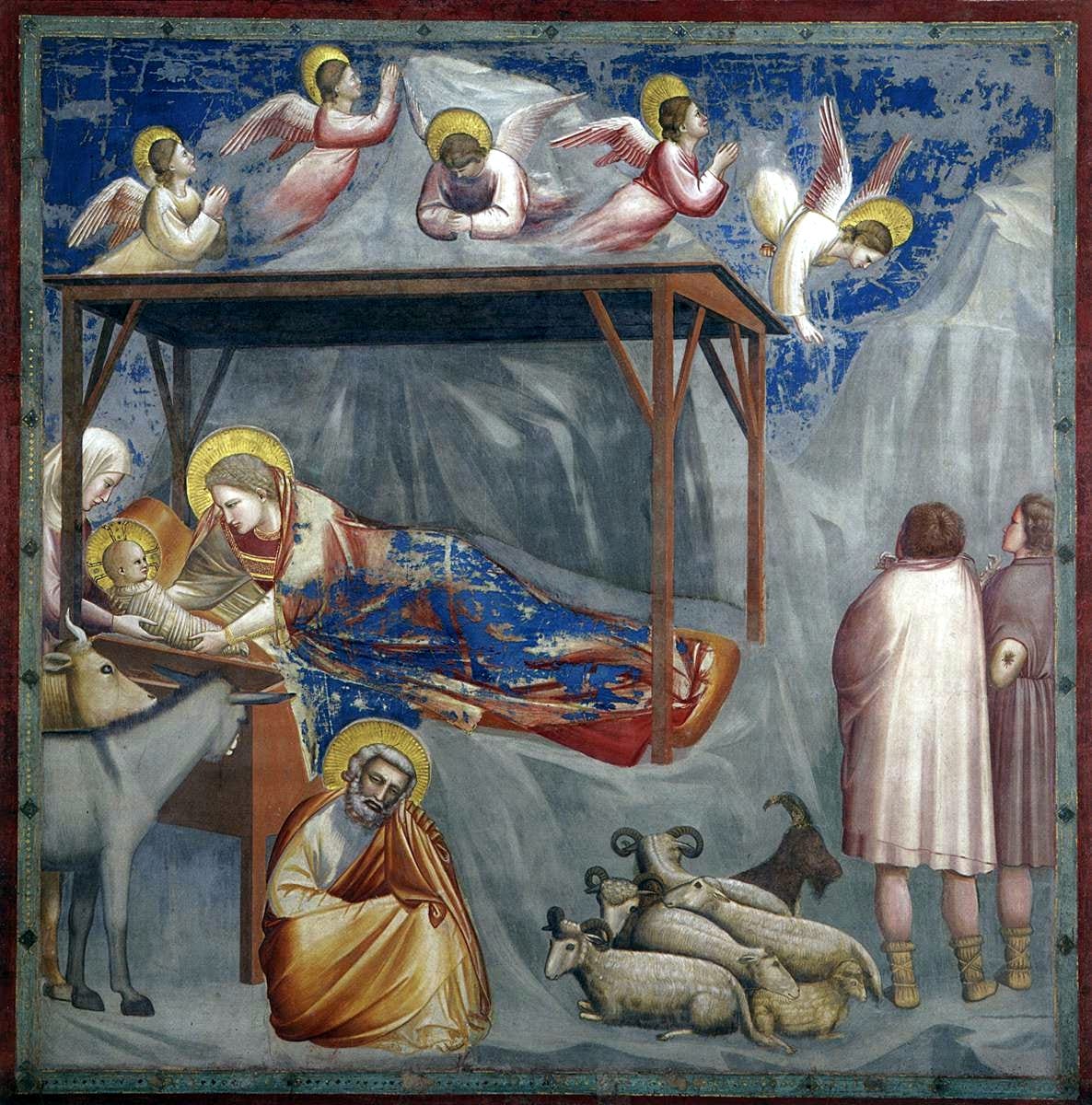
Giotto as a Guide to Christmas Light and Darkness
Giotto di Bondone (ca. 1267–1337) holds a front rank among the great painters of the Western tradition. Giotto’s work shows a mastery of form, color, volume, spatial arrangement, dramatic appeal, emotional expressiveness, and spiritual depth. Although his influences are obvious (e.g., Cimabue and the Assisi circle), the alchemy he performs with them is, like Suger’s St. Denis in Paris, a miracle of transformation.
Giotto and Fra Angelico are often mentioned in the same breath as artists in whom one sees a marvelous confluence of medieval luminosity, Byzantine formalism, and a new awareness of naturalism and perspective. The resulting whole is greater than the mere sum of its parts. Giotto’s work stands poised at a magical moment when the naïve innocence of medieval art and the stable, hieratic framework of the icon are still the order of the day, but when artists have acquired a new eye for shading, nuance of brushstroke, and depth of human psychology.
In the image above—a detail from one of the many scenes painted on the walls of the Scrovegni or Arena Chapel in Padua—we see Our Lady holding the Christchild with tender love and reverent awe. Her serene face tells us that she has not suffered the pains of childbirth, while the bright eyes of her Son and His preternaturally upright head tell us that He is no ordinary mortal boy, but the Promised One who fully knows Who He is, whence He has come, and whither He goes. As in Byzantine icons, He is wrapped in swaddling clothes that hauntingly suggest burial linens; He is about to be placed in a manger that anticipates His tomb.


