


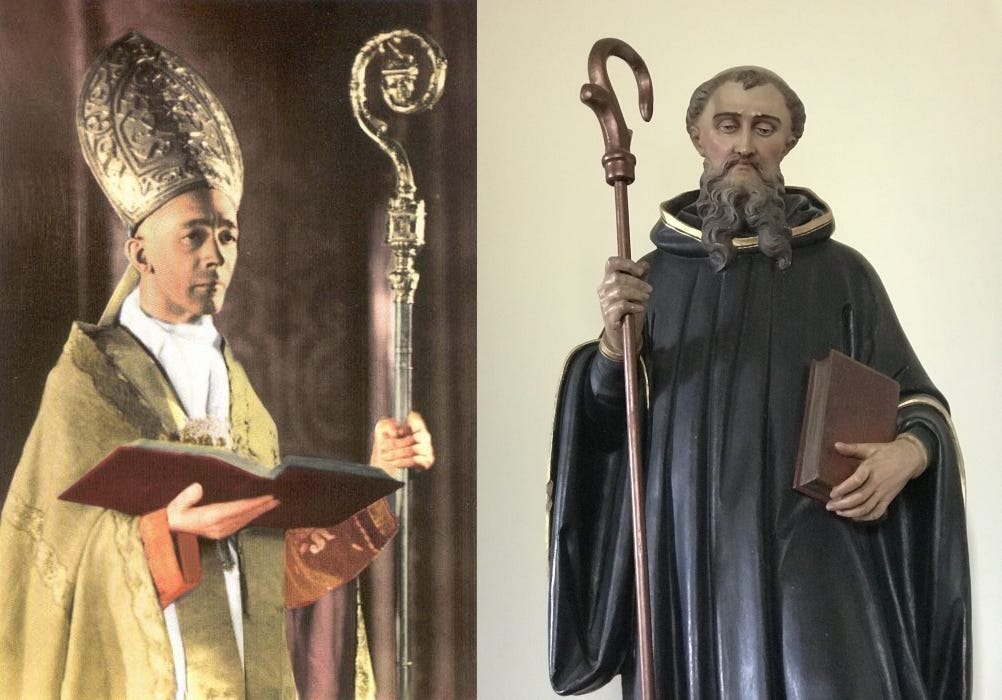
Beatified by John Paul II on May 12, 1996, Alfredo Ildephonso Cardinal Schuster (1880–1954) was one of the giants of twentieth-century Benedictine monasticism and liturgical studies. The author of the impressive five-volume commentary on the Roman Rite—The Sacramentary (Liber Sacramentorum), again in print from Arouca Press—Cardinal Schuster was abbot for Saint Paul Outside the Walls (1918–1929), then Archbishop of Milan (1929–1954). Pope Pius XI created him cardinal in 1929. During his tenure as archbishop, Schuster ordained 1,265 priests and consecrated 22 bishops.
He was a giant in a time of giants, and an intensely prayerful man, in love with the traditional liturgy, whose reputation for sanctity led to a modest but abiding devotion to him after his death. It is extremely ironic that he was succeeded as archbishop of Milan by none other than Giovanni Battista Montini, who, as Chiron relates, would do such a poor job in the same position, and who, as pope, would both allow monasticism to castrate itself, and defile the liturgy Schuster so dearly loved.
Today, I would like to share some fine passages from Cardinal Schuster’s precise and profound Commentary on the Holy Rule of Saint Benedict, a first-ever English translation of which was released by Angelico Press in 2023. While no commentary can ever surpass Dom Delatte’s, Schuster’s is impressive in its own way, and definitely belongs in the collection of anyone who is interested in monasticism or eager for Benedictine spirituality. The following taste will be more than enough to convince you of its quality.
(I am happy to say that Schuster demonstrates that Benedict must have been a priest, contrary to the revisionist history so popular among liberal Benedictines.)
As usual, I will occasionally offer comments when introducing a particular quotation. Numbers in parentheses refer to page numbers.
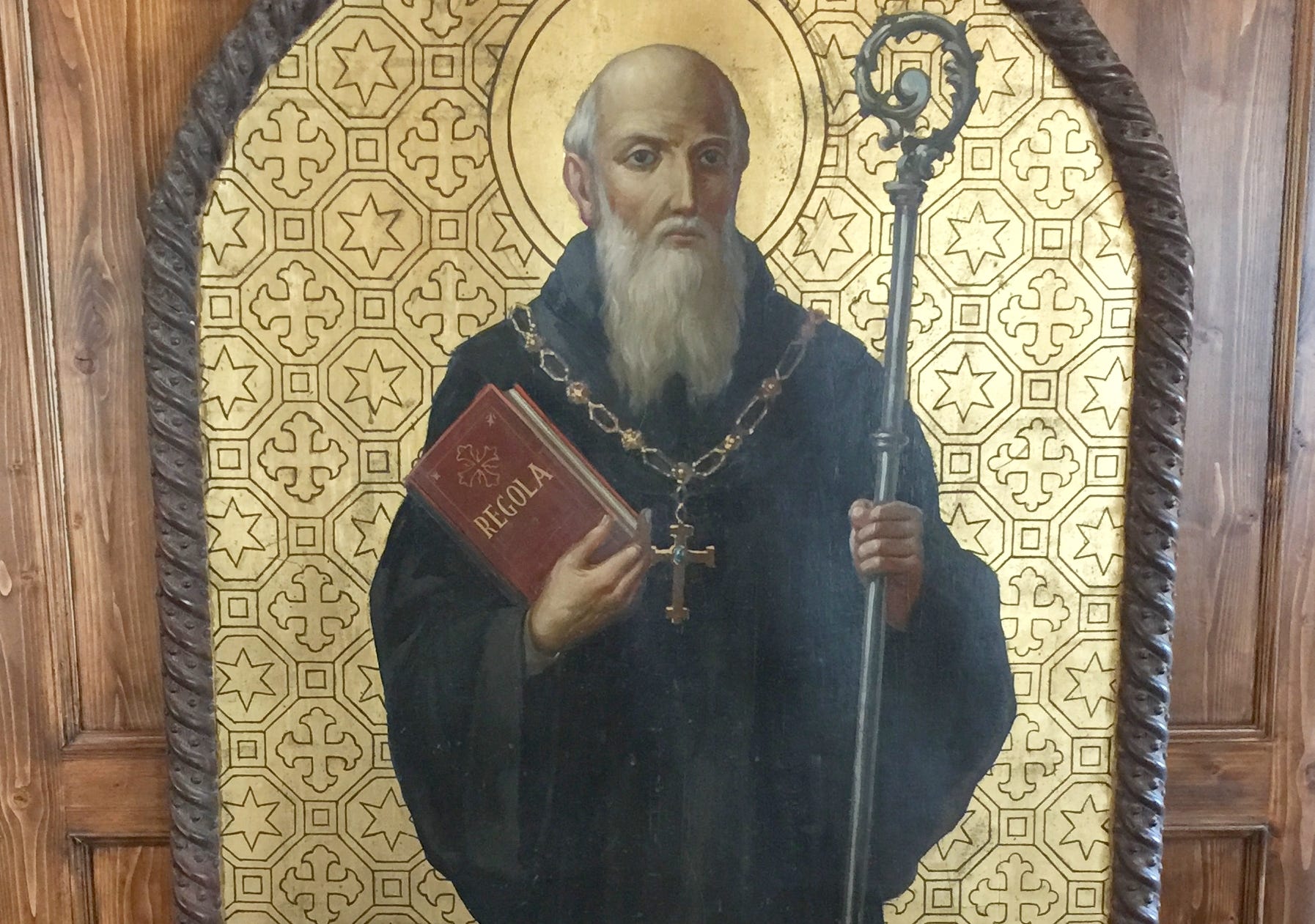
I have no peace in the thought that a book [the Holy Rule] by which so many generations of giants of sanctity were formed is today, outside of the cloisters, almost no longer known, even by the clergy. Of course, in all the history textbooks there is discussion of Benedictine monasticism and its merits of old. But no one then takes the trouble of getting to know the manual that formed for the Church and for European society the character of these popes, apostles, doctors, pontiffs of the various churches, and abbots of the innumerable medieval abbeys that then adorned the garden of the Catholic Church. (xvii)
The most ancient ecclesiastical writers, beginning with the Holy Evangelists, sought above all the praise of being faithful witnesses of the Christian tradition, sacrificing to this criterion their personality, their own genius, and their own intellectual speculation. (xxi)
When the flame of divine charity shall have consumed and destroyed in us the spirit of selfishness, that is, the typhus superbiae (delusion of pride) in its various swellings described by the Holy Lawgiver in his mystic ladder of humility, then the monk will arrive at that fullness of Christ in the flame of divine charity that ought to reign supreme in the soul. Then indeed we will sing with the Apostle: The charity of God has been poured out in our hearts, thanks to the Holy Ghost Who has been granted to us (Rom 5:5). Such is the goal of the monastic life. By means of the practice of the evangelical counsels, one removes from the heart whatever is opposed to this fullness of God in the soul of the just: ut impleamini in omnem plenitudinem Dei (that you may be filled unto all the fullness of God). When the soul shall have reached that twelfth degree of humility, at the top of Jacob’s ladder, she will feel herself to be dead to the world and will experience a great nostalgia for Paradise. Then indeed will she say like St Monica to Augustine: “As for me, O son, nothing any longer detains my heart here below.” (37)
Seventy-five instruments or canons of spiritual life seems a great number, and one might become discouraged in the contemplation of his own weakness. Add to that the external tribulations and various vicissitudes of life. Hence St Benedict comes at this moment to lift our courage with the thought of God’s immense goodness, ending his litany with the conclusive final axiom: Et de Dei misericordia numquam desperare. The phrase seems to derive from the Eucharistic Anaphora of Holy Thursday, still in use today among the Ambrosian churches: Haud quid desperare de tua misericordia possumus (In no way can we despair of your mercy). Formerly, this Anaphora must have been in use in various churches of Italy. Whoever doubts that he can observe all the preceding spiritual instruments, let him cling at least to this last one, as to the plank of salvation in the shipwreck.
As the saint was writing these words, the Roman world was being buried under its own immense ruins. From Monte Cassino, St Benedict himself could behold in the plains below the passage of the enemy hordes that had invaded Italy. These marked their path with the trail of the flames and smoke of cities burned atop their slaughtered or enslaved populations. At that time, the poor peasants, despoiled and ill-treated by the Lombards, must have come running every day to Monte Cassino to seek safety, just as St Gregory describes them for us in his Dialogues. And yet, St Benedict composes the Rule in confidence and serenity, not showing in any way the anxiety of that dreadful hour the world was then passing through.
How does one explain such an unshakeable state of serenity in a soul? The last canon of his Syntagma of the spiritual craft reveals his secret to us: Et de Dei misericordia nunquam desperare. God does not abandon into another’s hands the government of the world, whose tempora vel momenta Pater posuit in sua potestate (times or moments the Father hath put in his own power). All will be for the best, since it is God Who governs. (38)
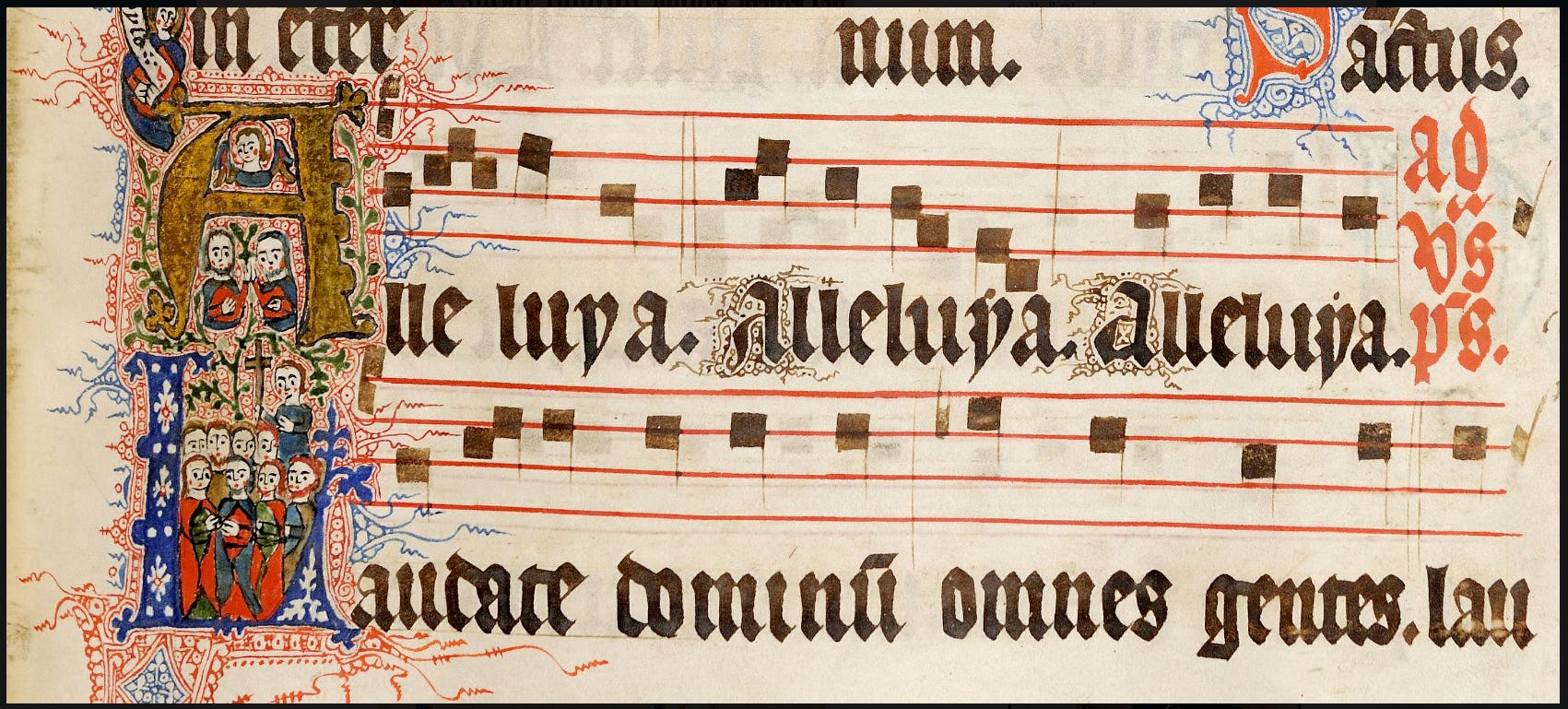
The Laudate Psalms (148–150), which give the hour of Lauds its very name, were recited as a unit from ancient Hebrew times—Our Lord Himself would have prayed them every morning—down to the breviary reform of Pius X in 1911. Hmm…
There follow the Benedictiones of the three young men in the furnace of Babylon, used on feasts. This practice, too, is almost universal. The Ambrosians, in fact, have the Hymn of the Three Children sung even on the solemn afternoon of Good Friday! Last come the true Laudes (Praises), that is, the three last psalms of the songbook of David, Psalms 148–150: Laudate Dominum de caelis (Praise ye the Lord from the heavens), etc. The tradition of these Laudes at Dawn is truly primitive and universal. In the various Eastern and Latin liturgies these are never omitted, not even in the Offices of the Dead, not even on Good Friday. This was also the case for the Roman Breviary before the reform of Pius X. (79)
The origin of singing “alleluia”:
The origin of the singing of the Alleluia represents, in a certain way, the history of the spirituality first of Israel, then of the Catholic Church. This acclamation possessed for the Hebrews such an hieratic character that, as a rule, it accompanied certain specified psalms in the temple, and it formed part of the Passover chants. The apostles themselves transmitted its use to the churches. For the sake of greater respect, no one ever dared to translate it into Greek or into Latin; so much so that certain authors have even suggested the possibility that, together with the Alleluia, there were also passed on to the Church certain Syriac melodies that adorned it in Solomon’s temple, or in the various synagogues of the diaspora. In the mind of the early generations of Christians, the Alleluia was the Paschal chant par excellence. According to St Gregory, it seems to have been St Jerome who induced Pope Damasus to prescribe its singing on every Sunday outside of Lent, in honor of Christ’s Resurrection. (87)
We are such wimps compared to our forefathers:
At Milan, still today, the Psalter is distributed into decades [groups of ten]. While during the day, at the minor Hours, Psalm 118 is repeated daily, for the nocturns, on the other hand, there is assigned one decade per night. Since, however, Saturday and Sunday are considered by the Ambrosians as festivals, and either the prophetic odes, or again Psalm 118, are recited, therefore to complete the entire series of the Psalter requires a full fifteen days!
St Benedict, perhaps, did not have direct knowledge of this very ancient distribution of the Ambrosian Psalter, which turns out to be much heavier than the monastic one. Hence, he brands it as nimis inertem devotionis suae servitium. How “lazy” this devotion was, however, can be seen by the fact that, in reality, the Milanese, repeating the same chants daily at the minor Hours and at Compline, end up reciting in the week at least two hundred Psalms. Then he says nothing about the solemn Vigils, which, up to the time of St Charles, were celebrated [at Milan] on the night preceding certain special feasts of apostles and martyrs. In these, the whole Psalter in its entirety would actually be recited, divided into three sections of fifty psalms each.
After each section a scriptural passage was read and a responsory followed. When the Psalter was finished, the final Litanies were sung and the vigil Mass was celebrated. Let the sons of St Ambrose, then, guard their liturgy unaltered—a liturgy that boasts now a tradition of at least seventeen centuries and has been so many times praised and recommended by the Holy Apostolic See. In homage to this tradition, throughout all the Middle Ages, even the numerous abbeys of Milan followed the special cursus of the region instead of the Benedictine one. (99-100)
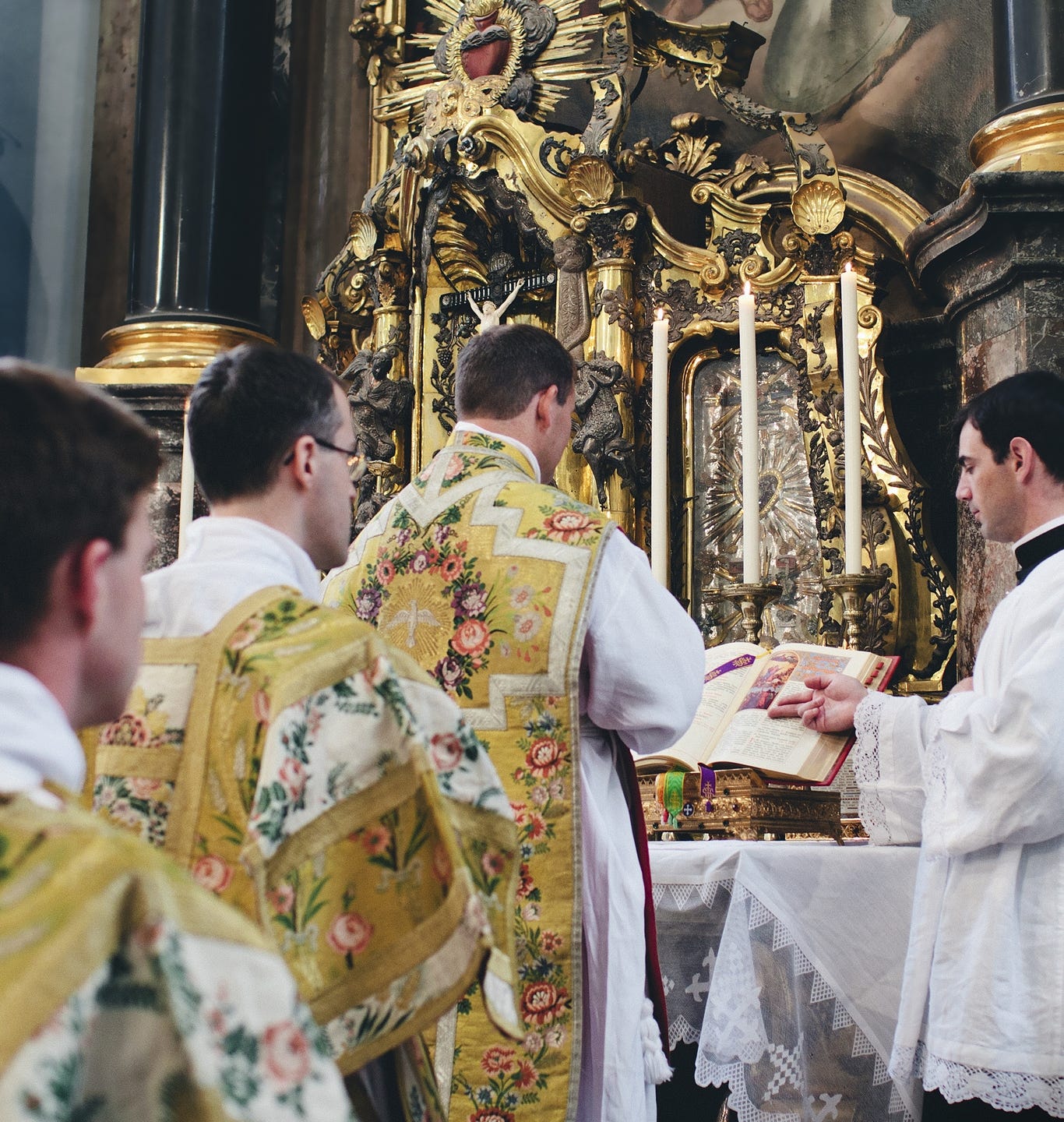
The importance of awe and reverence. Note how gently Schuster expresses his disagreement with the liturgical reformers, who were already revving their engines in his day. I can’t imagine what he would have thought had he lived another ten or fifteen years (he died in 1954)…
God is omnipresent, and the Holy Ghost Who dwells in us lifts us on high to converse with our good Father in Heaven. We begin our prayer, therefore, renewing our act of faith and placing ourselves spiritually in the divine presence, as creatures before the Creator, as sons before the Father, as members of the mystical Body of Christ joined to Him Who is the Head of the Church and Who, by means of the Paraclete, prays for us with unutterable groans. This is what Abraham did when he said: Loquar ad Dominum meum, cum sim pulvis et cinis (I will speak to my Lord, whereas I am dust and ashes). This is what Moses and the Prophets were accustomed to do when, in the presence of God or of His Angel, they prostrated themselves face down on the earth. This is also what St Benedict did when, in the silence of his Roman tower that rose as a lookout post over the gate of the Arx Cassinensis, he prayed with tears and sighs, as St Gregory relates to us, and he prostrated himself on the ground on a simple mat: in psiathio in quo orare consueverat (on the rush mat on which he was accustomed to pray).
The ancient liturgy, with its dramatic apparatus of rites, sacred ministers, prayers, and chants, was most suited to nourish in the faithful this sense of respect and of divine fear in the presence of God and of His awesome mysteries. The more modern sensibility, on the other hand, prefers to simplify, and would rather try to minimize and reduce the rite to the bare essential forms. The Church sometimes finds herself persuaded to adapt herself to the diminished faith of modern society, but this is not to say that these liturgical simplifications, from the pastoral point of view, always represent a true gain for the spiritual formation of souls. […]
The social character that the liturgy had among the ancient peoples, foremost among them being the Greeks and the Romans, had contributed to the creation of marvelous ceremonials, and ones that must have deeply impressed the minds of the people. Even now, for example, the basilicas of the Roman Forum and the stupendous bas-reliefs of the Ara pacis Augustae at Rome, with the representation of the sacrifice offered by Octavian for the peace restored to the world, force the observer to stop and reflect before these relics of a truly heartfelt and exquisitely religious art. As soon as the Church emerged from the catacombs and became, after a century, the religion of the Empire, the Christian liturgy, too, could not fail to assume very imposing and solemn forms that beautifully expressed the essential religiosity of the ancient state, whose orientation was now turned from Jove to Christ the Savior.
There is, however, a great difference in outward expression between the classical piety of the ancient peoples and modern piety. For us, it is individuals above all who treat their wounds with the balm of prayer. For the ancients, on the other hand, the individual could even be absent and stand outside the temple. It was above all the Polis, the State, which by means of its official representatives, the priests, in dependence on the Pontifex Maximus, rendered to the local or national Divinity its tribute of cult in a solemn, official liturgy, worthy of Ceres, of Rome, or of Athens. This explains, too, the pomp and also the length accorded to the liturgy all throughout the early Middle Ages. It was a religious service with a civic or national character, and so it mattered little if it required one to invest half a day in processions and sacrifices.
In the ancient Christian liturgy, too, at Jerusalem, at Rome, at Milan, at Ravenna, we see that bishops, popes, metropolitans, and clergy would pass a great part of their day in going in procession from one church to another, carrying out the stations, and singing psalms. By good or ill fortune, at that time there were no industrial establishments and machines to make people hurry! The people followed their pastors, and passed the better part of their time in celebrating religious functions. In this privileged position accorded by Christianity to the solemn liturgy, the Church did nothing but continue the ancient Etruscan and Latin tradition that had completely permeated the entire social life of those peoples with religion and cult. (102)
The title of chapter 19, De disciplina psallendi, seems to indicate more the external bearing of the monk when he is present in choir and carries out the whole series of ceremonies, genuflections, and bows that are prescribed. It treats, then, of a true disciplina, to which the spirit of faith makes us submit with exactness and a devout attitude. It is thus that they recount of Basil the Great that he celebrated the Divine Mysteries with such majesty that, assisting at them one day, the heretical emperor Valens was stunned with a salutary terror. In the Vatican Basilica there is a beautiful altarpiece that represents this scene. (104)
In fact, not every prayer is pleasing to God. There is, for example, a prayer of the wicked, mentioned in Scripture, which actually increases their fault, according to the word of the Psalmist: Et oratio eius fiat in peccatum (And may his prayer be turned to sin). (105)
What would Schuster have said if he lived to see the reign of Paul VI??? And don’t tell me about the document “Sacrificium Laudis.” It was a dead letter before the ink was dry, as Montini immediately caved in to the pressure applied on him by Joseph Bernardin, as the latter openly states in his memoirs.
For the sons of St Benedict it would not be licit—nor would the Church permit it—to sacrifice the traditional choral celebration of the Divine Offices for the sake of more convenient and modern forms of prayer. (108)
A fine discussion of religious poverty:
The vow of poverty is so essential to the monastic state that the Cassinese Patriarch has considered it superfluous to mention it explicitly in the Rule. He has always assumed it, so much so that he does not state it even in the formula of profession. The synthetic mentality of the ancients sometimes lacked the scholastic precision of the juridic formulas of the more recent canonists, and considered things from the simple point of view of the Catholic conscience and the common meaning of the act. In Christian antiquity, to take the monastic habit, to become a monk, to place upon the altar the cartula (charter) of Profession together with one’s own head of hair, were so many valid ways to commit oneself irrevocably before God and before the Church to the observance of the monastic Rule.
The complete dispossession of material goods was precisely the first condition posed by Christ to the young man in the Gospel who asked Him about the various ways of perfection. Vade, vende quae habes, et da pauperibus, et habebis thesaurum magnum in caelo: et veni, sequere me (Go, sell what thou hast, and give to the poor, and thou shalt have treasure in heaven: and come, follow me). The poor Christ, Who had not even anywhere to lay His Head during the night, was the model and the norm of the apostles when they too left their boats and their nets and dedicated themselves to following Him: Ecce nos reliquimus omnia et secuti sumus te (Behold we have left all things and have followed thee). The example of the holy apostles, pillars and teachers of the first and most ancient Christian churches, caused their successors, the first bishops, the holy virgins, the ascetics, the “philosophers,” as Tertullian, St Cyprian, Clement of Alexandria, St Catherine, St Eusebius, St Ambrose, etc., then called themselves, to give up their substance to the poor or to the Church, so that each of them, nudus et expeditus ad Christianam Philosophiam (naked and made free for the Christian Philosophy), could give himself to the study of sacred letters and the discipline of asceticism.
There had not yet arisen the monasteries and the religious orders, but the ascetical state, based on the evangelical counsels of perfection, taking its origin from the teaching of the Savior and of the holy apostles, was already established and held in honor. The Holy Fathers rightly observe that for the souls of religious and for the cenobia themselves the observance of the vow of poverty constitutes the guarantee of the observance.
We should meditate well on these words of St Gregory:
Cognovi enim quia idem Constantius peculiaritati studeat. Quae res maxime testatur eum cor monachi non habere. Stude . . . monasterium a tali peste mundare . . . ; quia si illic peculiaritas a monachis habetur, neque concordia, neque caritas in congregatione eadem poterit permanere. (For I have learned that this Constantius is intent upon his personal property. This fact most especially bears witness that he does not have the heart of a monk. Be intent . . . to cleanse the monastery of this plague . . . for if personal property is held by the monks there, neither concord nor charity shall be able to abide in that community.)
When God is no longer enough for the soul, then no more are all the riches of the entire world enough for her: greed creeps in, the striving after material comforts, quarrels, discords among brethren. Monastic history sadly confirms this truth. As long as poverty was held in honor in the monasteries, discipline and holiness kept her good company. On the other hand, the day that poverty went into exile from the cloisters, the other virtues too, her companions, had to take the path of exile. (145-46)

Schuster explains how the refectory is an image of the church. Our forefathers thought of everything, and connected all of life to the feast of heaven.
Leaving, then, the office of the kitchen to the lay brothers charged with it, the service of the tables, on the other hand, remains reserved to the monks, excluding no one. According to the medieval tradition, in numerous abbeys still today the abbot serves at table on Holy Thursday, while the deacon in the pulpit, with a white stole over his shoulder, sings the last discourse given by the Lord in the Cenacle of Jerusalem. It is an excellent thing to preserve all these ancient liturgical traditions, with which the Holy Fathers sanctifi ed the Christian agape, elevating the simple meal of the community to the loftiness of a sacred function. (157)
The old medieval tradition made episcopal dining halls and Benedictine refectories to be like so many basilicas, where the dinner represented the ancient Christian agape; the bread of the soul was the Sacred Scripture, the ministers of the banquet the monks, among whom were the deacons and the priests, who served their brethren in joyful charity and humility. At Monte Cassino, in the kitchen, is still seen the drum of the cupola, with the remains of the mosaics that Abbot Desiderius caused to be executed there in the eleventh century. At Rome, in the Lateran there still remains the apse mosaic that decorated the dining hall of Pope Leo III. In general, the ancient refectories of the abbeys preserve the grand appearance of a church, with the lavabo in the atrium or narthex, the Crucifix above the abbot’s place, the marble ambo for the spiritual reading. […]
The service of the tables recalls in some way that of the original deacons, among whose obligations was precisely that of ministrare mensis (serving at the tables). For this reason St Benedict, following the authority of Cassian, orders that the servers on duty should begin and end their week in church with a brief liturgical function of blessing or of thanksgiving. This rite should be carried out at Dawn on Sunday—post matutinos hymnos, says Cassian, precisely at the hour at which sacred ordinations were accustomed to be celebrated. (157-58)
The ancient tradition of the Christian agape has been preserved in the refectory of the abbeys, where the food, consumed between the singing of the psalms and during the reading of the pages of Sacred Scripture, takes on still today almost a liturgical character. Even the blessings of the table have a certain Eucharistic perfume: Mensae caelestis participes faciat nos Rex aeternae gloriae (May the King of eternal glory make us partakers of the heavenly table); or: Ad coenam vitae aeternae perducat nos Rex aeternae gloriae (May the King of eternal glory lead us to the supper of eternal life). (170)
Why does St. Benedict specify having a drink of water after communion?
Are these two distinct reasons, or rather is there one reason: respect for the Holy Eucharist? Some authors maintain that the reason for the mixtum is twofold: one takes a little water and wine, as do the servers of the table, also in order to avoid that, in singing or emitting saliva, any particle of the Holy Communion should be scattered. From ancient times we notice this precaution, so much so that at one time the communicants were accustomed to take the ablution: a little wine or a little water in the church itself. (171)
Why fast on Wednesdays & Fridays?
From Pentecost onwards, during all the summer season, which in central Italy is usually reckoned until the middle of September, the monks’ fast is limited to Wednesdays and Fridays only, as the common tradition of the faithful maintained at the time. The origin of this twice-weekly fast goes back to the Synagogue, whose Pharisee in the Gospel boasted because Ieiuno bis in sabbato. According to the Didache, the Hebrews were accustomed to dedicate Mondays and Thursdays to fasting, while The Tradition of the Apostles, in contrast, introduced the fast on Wednesdays and Fridays (n. 8), so that it would not coincide with that of the hypocrites. There is a fast on Wednesday because on that day the Sanhedrin resolved on the capture and the condemnation of the Divine Savior. There is then added the Friday fast because on that day the Lord died and the ancient Church in the East would prepare for the solemnity of the Sabbath. (181)
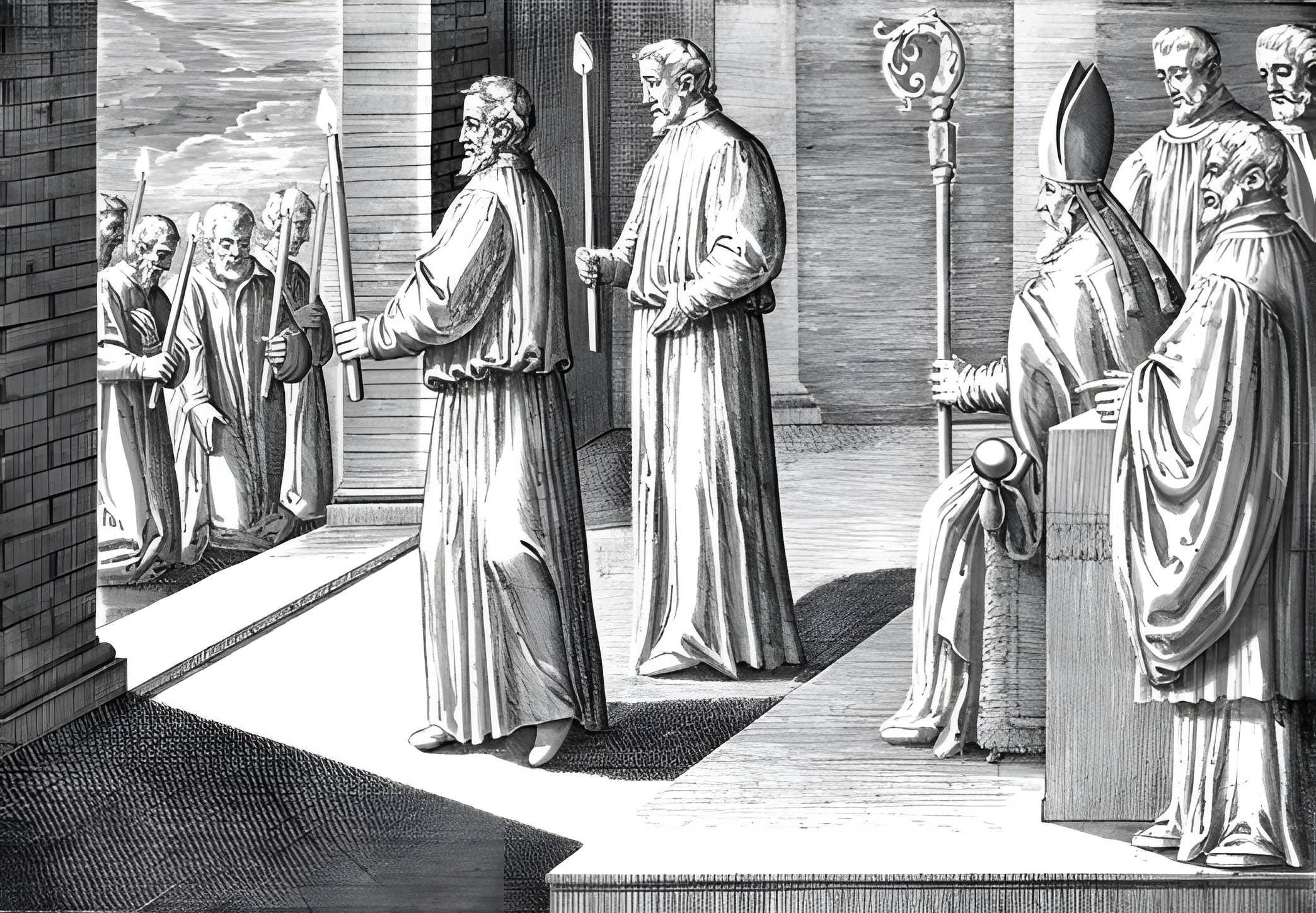
How penance was done in ancient times. We can’t even imagine today how seriously sin—and therefore penance for sin—was taken in the early church. Funny that none of the proponents of a “liturgy like the early Christians had” ever suggests reviving the whole of it…
In Rome, public penance did not last, generally, more than one Lent, and the reconciliation was completed on Holy Thursday. The rites described by Tertullian for the reconciliation of penitents in the time of Pope Callistus are almost the same ones that St Benedict imposes for the absolution of the excommunication. Here are two very significant outlines:
Et tu quidem poenitentiam moechi ad exorandam Fraternitatem in ecclesiam inducens, conciliatum [sic] et concineratum . . . prosternis in medium ante viduas, ante presbyteros, omnium lacinias invadentem, omnium vestigia lambentem, omnium genua detinentem, inque eum . . . bonus pastor et benedictus papa concionaris, et in parabola ovis capras tuas quaeris, tua ovis ne rursus de grege exiliat. (And thou, indeed bringing him into church to beseech the Brotherhood for penance for adultery, dost have him, reconciled and covered with ashes . . . lie prostrate in the middle before the widows, before the presbyters, seizing the hem of everyone’s garments, licking everyone’s footsteps, grasping everyone’s knees, and him. . . . O good shepherd and blessed pope [papa], thou dost address, and with the parable of the sheep thou dost seek thy she-goats, lest one of thy sheep should once again become an exile from the fold.)
Collocavit in vestibulo poenitentiam secundam, quae pulsantibus patefaciat . . . . Itaque Exomologesis prosternendi et humilificandi hominis disciplina est . . . de ipso quoque habitu et victu mandat, sacco et cineri incubare. . . . Cum ergo te ad fratrum genua protendis, Christum contrectas, Christum exoras. Aeque illi cum super te lacrymas agunt, Christus patitur, Christus Patrem deprecatur. Facile impetratur quod Filius postulat. (Thou hast established in the vestibule a second penance, which will lie open to those who knock . . . . Therefore, confession [exomologesis] is a discipline of prostrating and humbling a man . . . it commands also regarding even his attire and food, that he should lie in sackcloth and ashes . . . . Therefore, when thou dost cast thyself at the knees of the brethren, thou dost grasp Christ, thou dost beseech Christ. Likewise, when they shed tears over thee, Christ suffers, Christ beseeches the Father. What the Son asks is easily obtained.) (192)
On the importance of liturgical law:
With a meager spirit of faith, it is not easy to understand the importance of the liturgical laws before God. Nonetheless, when one is dealing with an infinite majesty, all is majestic, all must be supremely fitting. In the Old Law, the divine flame devoured those ill-advised priests who dared to fill their thurible with unholy fire. It is thus that the Holy Church, even for the lesser ministries in God’s temple—for the ringing of the bells, for the tidiness of the church, for the closing of the doors of the sacred building, for the refurnishing of the lamps—instituted from ancient times a corresponding number of special ministers, with vestments, with rules, and with most holy rites. We read of the holy Curé of Ars that he used to sweep his church wearing the cotta, because he said that he was exercising one of the ecclesiastical orders. (196-97)
The Holy Church shares in this supernatural mentality, reserving the sounding of the consecrated bells to a particular ecclesiastical order: that of the Porters. (202)
The exactness of the horaria reminds the Holy Lawgiver of another necessary provision, regarding the succession of the choir monks in their turns as antiphoners, lectors, cantors, etc. The proverb says: Serva ordinem et ordo servabit te (Keep order and order will keep you). One of the characteristics of the works of God is that they are all done in mensura, numero, et pondere (in measure, number, and weight). Nothing, therefore, in choir, in the refectory, in Chapter, etc., ought to be left to private initiative. Thus there will be lists of turns; but he urges that these lists be drawn up with sound criteria, in such wise as to exclude those who sing out of tune, those who do not know how to make themselves understood when they read, and lastly those who are not content to carry out their service cum humilitate et gravitate et tremore, as St Benedict prescribes. (203)
This second type of prayer at the end of the Divine Office—as we note also from St Gregory’s account of the wandering monk, drawn out of the choir by a little devil—is exactly what moderns call mental prayer. St Benedict designates it by the name of secret or mystical prayer, secretius orare, and he says that it is carried out in lacrymis et intentione cordis. It is more fully described in chapter 20, where there is already mention of puritate cordis et compunctione lacrymarum (purity of heart and the compunction of tears). […]
The importance given by the saint to prayer both by his teaching and by his example should leave its impression on all his sons. Without this life of adoring union with God, of prayerful confidence, of unceasing conversation with Him in Whom we live, work, and are, one cannot even make sense of the prolonged choral Office, and not even the Sacred Liturgy proves to be truly lifegiving. The Benedictine monk, precisely because he is consecrated to the extended choral Office, absolutely needs the exercise of daily meditation, in an atmosphere of silence, of recollection, of hieratic order. (222)
If a religious family does not have novices, it is a sign that God does not consider it worthwhile to send them to it. “Purify the nest”—an outstanding ecclesiastic said to me one day—“and then you will see that the doves will come.” (249)
All this crashed and burned. “Libido delendi”: the lust for destruction. Once you start, you can’t stop.
Today, there is an entire portion of the laity that shows itself bitterly disillusioned by the various systems of man and of Protestant individualism, and has a strong nostalgia for God and the things of God. Often it looks to the Benedictine abbeys as to oases where, under the wise guidance of the Church in her Catholic liturgy, one breathes in the supernatural and senses better the unity of the Mystical Body of Christ. Mini-retreats, Spiritual Exercises, Liturgical Weeks, and Weeks of Ecclesiastical Culture in Benedictine monasteries find an ever more eager throng of participants. The spiritual fruit is generally ample, especially for the educated classes. I consider this form of liturgical apostolate as one of the very important functions that Divine Providence reserves in our days to the family of St Benedict. It is necessary, however, that the abbeys be made ever more worthy and more suitable for this form of apostolate, which demands of the monks an edifying regular observance, a dignified sacred Office, an outstanding interior spirit, places suitable and well furnished for the retreatants, gentlemanliness in welcoming and treating them. (280)
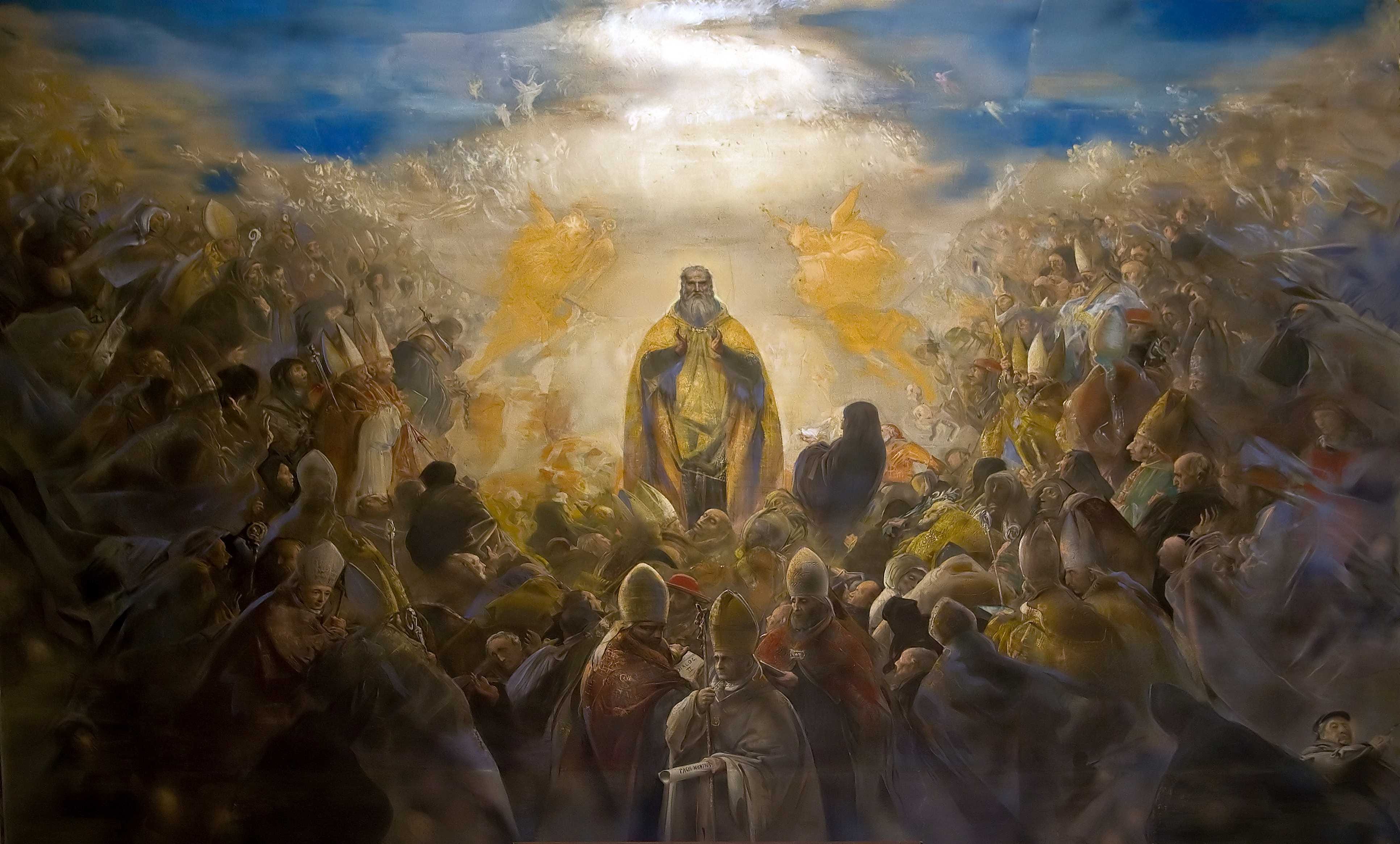
The greatness of the family of St. Benedict. May it flourish again!
One day, St Gertrude in contemplation considered St Benedict under the symbol of a rose garden all in flower. First some buds sprouted on the ground, as in spring around the feast of St Benedict. Then, multiplying and interlacing their branches, these in turn were bedecked with flowers; so that at the end all the great rose garden seemed to her an immense bunch of roses, which brought joy to Heaven and surrounded the Holy Patriarch with a particular glory.
The Benedictine family can indeed glory in the Lord that it has given to Heaven an incomparable throng of saints, while on earth it has supplied Christendom with a multitude of Supreme Pontiff s, apostles of nations, martyrs, doctors, bishops, priests and monks, who have planted and watered the garden of the Church with their own blood and their sweat. In this regard, the daily reading of the old Benedictine menologies and martyrologies of the seventeenth century cannot but prove extremely useful for the formation of the spirit of young monks.
A legend of the late Middle Ages relates that one of the Avignon pontiff s, having done the necessary research in the pontifical archives, verified that the Order of St Benedict had given to the Catholic family thirty popes, several hundred cardinals, several thousand bishops, with about 30,000 saints—or more—canonically inscribed in the Church’s register. The Pontifical Archives do not contain anything to justify such statistics. Yet it still remains true that, at the time when such numbers were repeatedly published and believed, it was commonly known among the wide public that the Order of St Benedict, across its fourteen centuries of existence, had really produced and formed a great number of giants of sanctity, of science, of the progress of Christian civilization.
One year, on the feast of St Bernard, while the Introit In medio Ecclesiae of the Mass of Doctors was being sung, it seemed to St Mechtilde that the Lord said: “This center of the Church—In medio Ecclesiae—is the Order of St Benedict; not only because it preceded all by its antiquity, but because all the others that arose afterwards derived many things from the institutes of the Benedictine family.” (316-17)
How sad. It was Vatican II that shattered this, not twenty years after Schuster penned these words:
To judge by our meager human standards, We see a happy future traced before the family of St Benedict, when the period of rebuilding follows after the universal cataclysm of the war. It is in our abbeys—and the people know it—that there has always been kept burning the twofold lamp of liturgical piety and knowledge of God. Our age seems especially oriented towards these two currents of Christian life. It is to be hoped that, disillusioned by everything that has, for so many years, fed human pride, flattering it that it could do without God, if not actually rebel against Him, the postwar generation will return, as in the Middle Ages, to seek God in the Dominici schola servitii. (318)
Today, the only places where one will experience something like this are the traditional monasteries such as Norcia, Le Barroux, Fontgombault, Clear Creek, Silver City, and a few of the conservative Solesmes-influenced ones, which are trad-adjacent. But from such seeds are already springing new trees, as healthy monasteries are repopulating abandoned or senescent ones.
Today’s post has presented excerpts from Blessed Ildefons Cardinal Schuster’s Commentary on the Holy Rule of Saint Benedict.

These words, read carefully, transport the soul back to the pre-modern devout spirit of the Catholic Church, so thoroughly expelled in the wake of Vatican ll.
I felt both the pang of loss and also the wonder and joy that this devotion will never be lost in eternity but is forever reborn and can even be witnessed today.
I imagine taking a place at table in what is described as a basilica-like refectory designed and built purposely to invoke the beauty and order of heaven where sustenance is divine, the whole ocasion eucharistic yet not a replacement for the Holy Mass.