


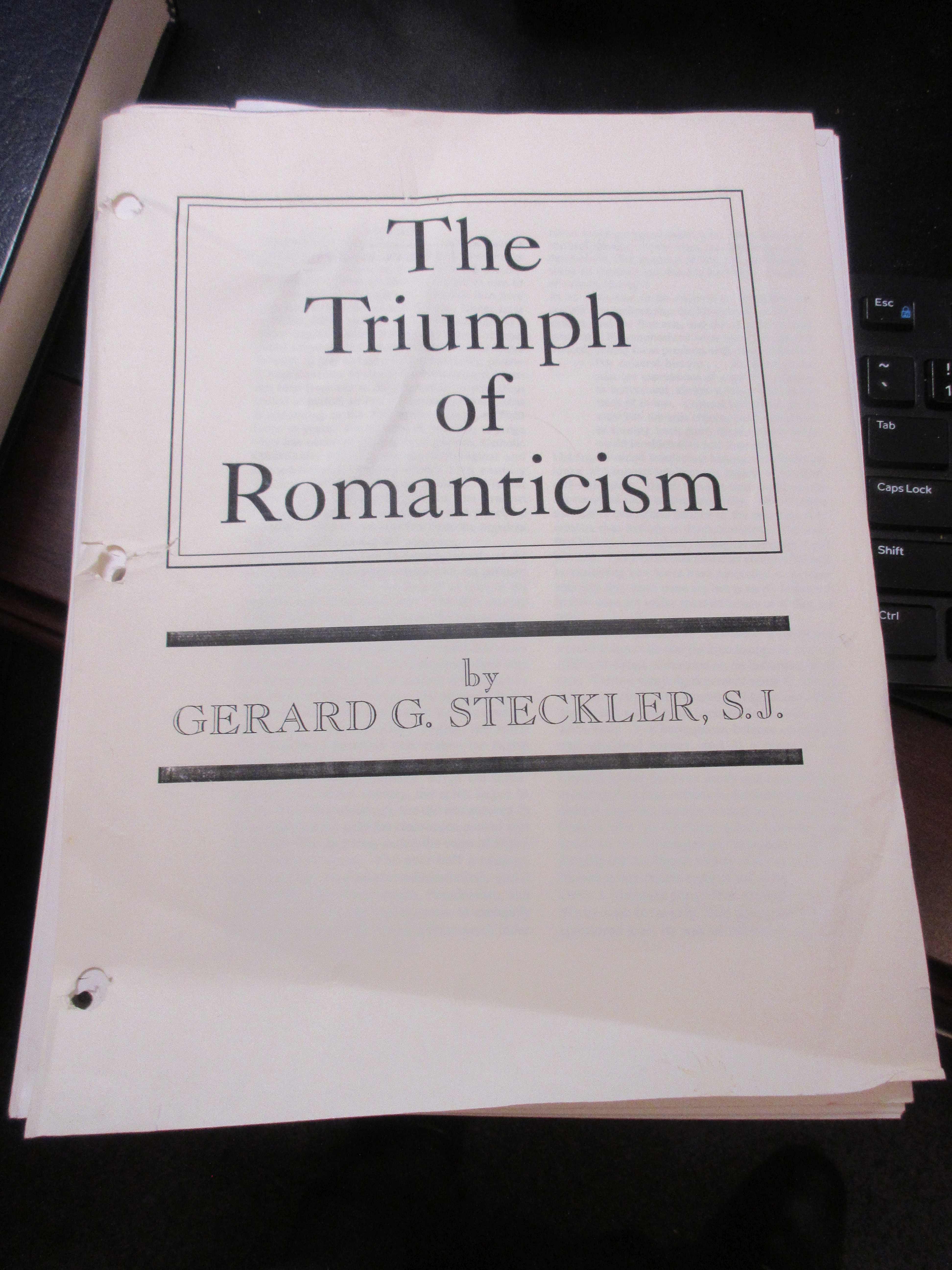
Fr. Gerard G. Steckler, S.J. (1925–2015) is a priest known to relatively few people. He was a beloved chaplain at Thomas Aquinas College in California from 1982 to 1993, where I got to know him well as my spiritual director between 1990 and 1993. During that period he gave me an unpublished manuscript he had written, bearing the title The Triumph of Romanticism.
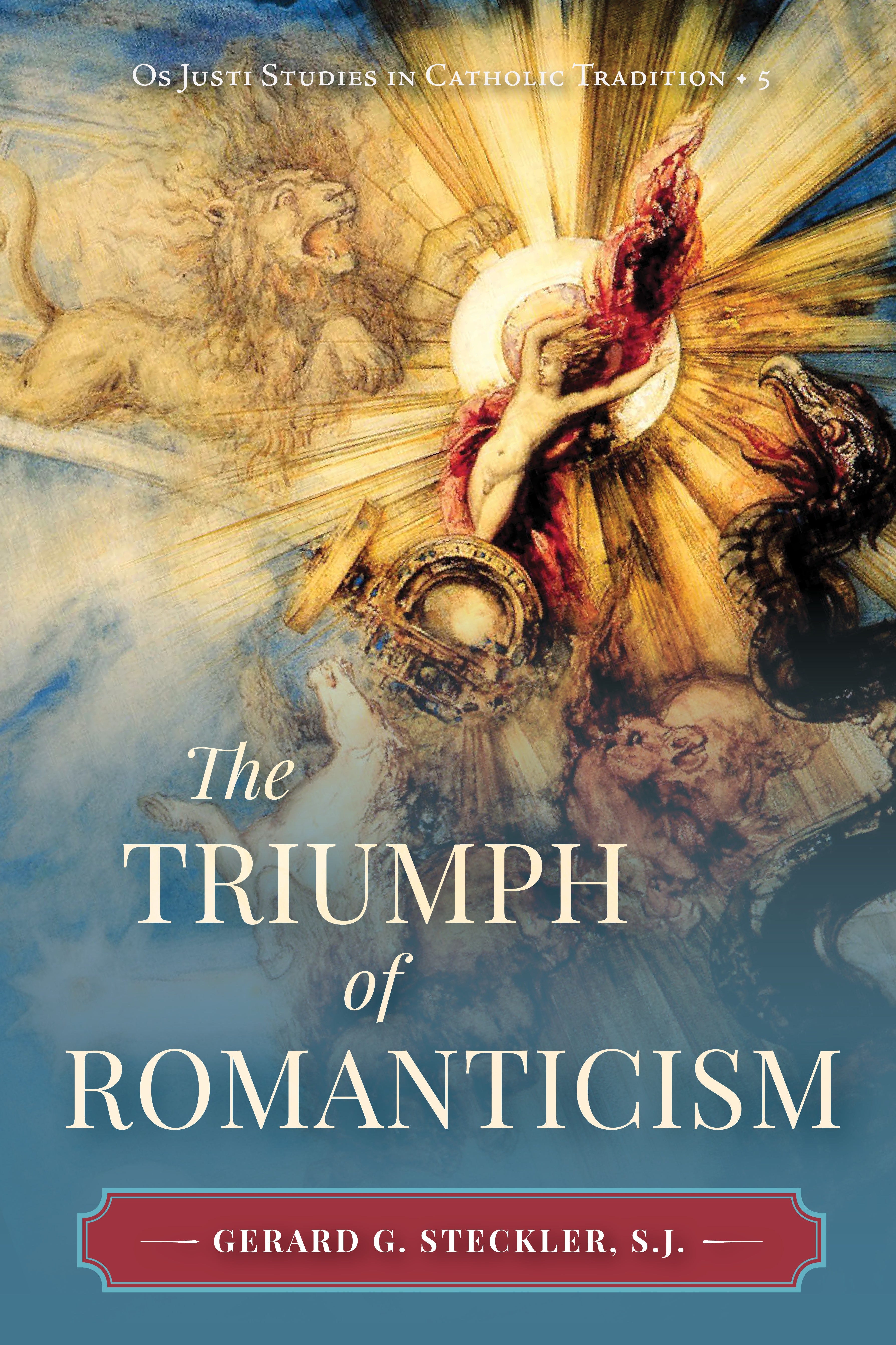
Years later, in one of the countless letters we exchanged in a longlasting correspondence, he told me to edit the work for publication. It took me a long time to fulfill that request but finally, I published the book with Os Justi Press; I considered this action to be the joyful repayment of an old debt.
Today, in this first episode of the Professor’s Bookshelf, I will share some of my favorite passages from this eminently quotable book. We’ll start this week and finish up next week. As I read the words, I can hear them coming from Fr. Steckler himself—a tall, wiry man with a shock of white hair and a half-smile, half-scowl on his face, chomping on a cigar, and thinking ten steps ahead to his next wry remark. He had a dry wit and did not suffer fools lightly. His learned opinionatedness, combined with his unshakable fidelity to the Lord and to the Catholic Faith, made him an unforgettable specimen of the old-school Jesuit. It was a privilege to know him.
As I read the following, I’ll mention the page number at the end of each passage, then pause before reading the next.
Voltaire endowed his modern man with an ability to understand all that was understandable, but he was almost as pessimistic as Aristotle about producing intellectuals who could know as much as he did. [page 2]
The November Revolution in 1917 was the overwhelming event as Tsarist Russia became the communist U.S.S.R. Lenin was arguably the most significant political figure since Charlemagne. For all that, the Russians remained the same: manipulators of men, expansionists, Janus-faced, that is, too skeptical (the result of an exaggerated rationality) and too mystical (the fruit of an exaggerated revelation that they were divine). [9]
The ideologues of the age of realism were Auguste Comte, Karl Marx, and Charles Darwin, none of them as intelligent as Mill and therefore more influential for an uncritical age. [53]
Intellectuals later questioned the sweeping claims of progress built on science, but the common man never wavered in his belief that, all evidence to the contrary, materialist progress is as certain as evolution. [54]
The nineteenth century culminated in an optimism that was Comtean, Darwinian, Bergsonian—in a word, total. So Europe continued to ripen for the slaughter. [55]
Exemplifying his schema, he [Taine] pointed to the religious music of a Protestant church. Protestants liked “grave and monotonous melodies” as manifesting their idea of the sort of worship man must give to God, worship “which has modeled the architecture of the temple, thrown down the statues, removed the pictures, destroyed the ornaments, curtailed the ceremonies, shut up the worshipers in high pews which prevent them from seeing anything.” In turn, this kind of relationship between man and God stemmed from a more general cause, the emphasis on the personal approach each must take toward his God: “It is this which has enthroned doctrine and grace, lowered the clergy, transformed the sacraments, suppressed various practices, and changed religion from a discipline to a morality.” [60]
Whatever else Charles Darwin was, he was certainly, by his own admission, one who, not possessing the power of abstraction, could not use it. He was one of an increasing tribe who pontificated on realities beyond their mental actuality and therefore had no business speculating on the nature of natures or on divine beings…. Charles Darwin fathered the many whose expertise in the knowledge of facts about one subject merits them the sobriquet of “expert” and therefore encourages them to pronounce on anything about which they are questioned or about which they wish to speak. [69–70]
Natural selection from accidental variations which leads to new species was a pseudo-reasoning interpreted in turn by minds consonant with the age as “progress without purpose.” The optimism of the age fitted in well with such a meaning. Not much extrapolation was required to form an ideology called Darwinism, the belief that if no purpose and design reigned in the universe, neither were there any fixed moral values. All kinds of conveniences and terrors have flowed from this. The seventeenth-century scientific revolution may have dethroned man from the center of the universe, but at least—exulted Blaise Pascal—the thinking reed that was man had discovered that. Darwin metamorphosed man from a thinking reed to the unthinking product of random variations. Arthur de Gobineau had said, “Man may not have descended from the apes, but he is rapidly getting there.” [71]
Darwinism killed spiritual man made in the image of the divine Trinity. Darwinism decisioned God a generation before Nietzsche’s dramatic knockout. [73]
Doubtless, dialectical materialism was the unique “contribution” of Karl Marx to the potpourri of ideas he tried to plaster together. The physical was the metaphysical, and it was deterministic! “Why” it was deterministic he did not need to answer, for what he said had to be true! He attempted to reconcile positivistic determinism and the free activity of insightful men like himself by saying that the sharp-witted could know which way history was going, and indeed sometimes had to give it a helping hand. Here certainly was a clever combination of activism and determinism…. Christians did not know what God had in mind, but Marx knew what predetermined road matter was taking! [75]
If Christ had come to give men bread from heaven, Marx proffered them bread from the bakery. The wonderful always gives way to fantastic mental fornications when humans try to improve on the intelligible nature of reality. [76]
Lenin knew his master well enough to be selective about which of his statements were true! Hebraic and Christian in his ancestry, his attitude was triumphalist. In utilizing an inheritance from an ancient and supernaturalist past, he was the giant of the intellectual thieves of his time. [78]