


The High Middle Ages
The high Middle Ages can be called, without fear of contradiction, the Golden Age of Catholic Europe, the “Age of Faith.” Even if one may not wish to go so far as the Catholic historian James J. Walsh who dubbed the thirteenth “the Greatest of Centuries,”1 it would be hard not to swoon with admiration at the persons, events, and accomplishments of this magical century—a century of lofty Gothic cathedrals and Summas of theology, bustling universities and public debates, law schools and hospitals, flourishing monasteries and convents, dynamic new religious orders (especially the Franciscans and the Dominicans), steady population growth across Europe, technological and scientific discoveries,2 exquisite mastery of arts and crafts such as stained-glass window production and manuscript illumination, the spread of troubadours, lyric poetry, and epic poetry (El Cid, legends of King Arthur and of the Holy Grail, the Nibelungenlied, the Romance of the Rose, the Divine Comedy), the code of chivalry, an unprecedented status accorded to women, widespread religious devotion among the people and their rulers. It was the century of St. Francis and St. Dominic, St. Bonaventure and St. Thomas Aquinas, St. Louis IX and Dante. One could go on and on.
For our purposes, the most noteworthy feature of the period was its radiant, confident synthesis of human and divine wisdom. It was not accomplished without many difficulties, some of them severe, but it did happen in the end.
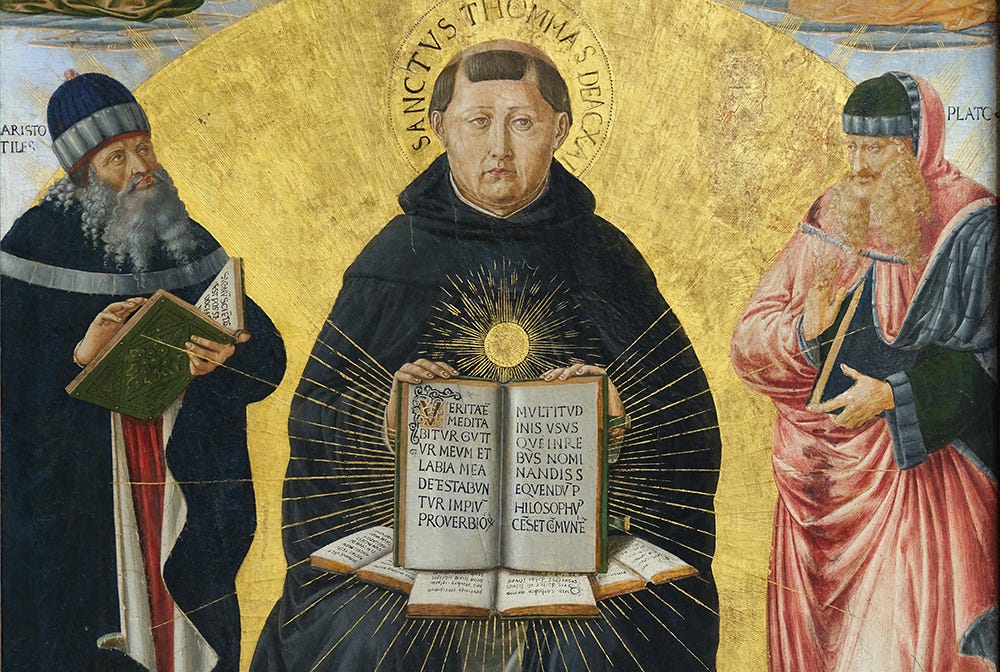
Without a doubt, the most momentous intellectual event of the high Middle Ages was the rediscovery of Aristotle in the West. It wasn’t as if the name or writings of Aristotle were entirely unknown.3 But up until the middle of the twelfth century, men had only some of the logical works of the one whom they called “the Philosopher”—the logica vetus, made up of the Categories and the Peri Hermeneias plus Porphyry’s Isagoge and Boethius’s Divisions and Topics, and a few chapters from the Ethics.
Starting in the twelfth century and peaking in the early thirteenth, the university cities were inundated with new translations of many major works of Aristotle hitherto unknown—the Prior and Posterior Analytics, the Topics and Sophistical Refutations, the Physics, On the Soul, On Sensation and the Sensible, On Generation and Corruption, Parts of Animals, The Motion of Animals, On the Heavens, the Metaphysics, the Nicomachean Ethics, the Politics, and others, too. From our vantage so many centuries later, we can hardly begin to imagine the confusion this caused at first, and the revolution it ultimately brought about in Western thought.
A former professor of mine suggested the following thought experiment. Imagine that you were merrily going along with Einsteinian relativity as your basic paradigm for physics (and were priding yourself on how far you’d come along since the classical mechanics of Newton). A physicist discovers in a desert cave a stash of manuscripts. They are carefully examined and translated. The realization occurs: these manuscripts contain a working-out of physics far in advance of anything we have ever dreamed of—they go further beyond Einstein than Einstein goes beyond Newton. We don’t even have the vocabulary to make sense out of them yet, let alone the conceptual tools. Suddenly, in a matter of years, everything in the world of science has been turned upside down, and everyone is scrambling to make sense of it all. Some are so excited about the new physics that they simply throw out the old and become one-track minds. Some are so attached to the old physics and so anxious about the effects of the new that they try to get the new ideas prohibited or banned. Others are confused and can’t make heads or tails of the situation. Finally, there are a few who seek harmony and integration between the old and the new. In all cases, there is a flurry and a bustle and a sense of tremendous excitement and trepidation, with colossal paradigm shifts beginning to occur.
Well, this is more or less what happened with the influx of Aristotle’s writings into medieval Europe via the Arabs, during the lifetime of St. Thomas Aquinas. At the University of Paris in 1210, the works of Aristotle on natural philosophy were declared off-limits for public lectures. This prohibition had no parallel at Oxford, which is why initially the English had an advantage in coming to grips with his thought.