


There is a strange tendency nowadays to think that the external aspects of a thing matter very little, while the “inside” is all that counts. For example: as long as you’re “a good person on the inside,” it doesn’t matter what you look like, how you dress, how you speak, what music you listen to, or even (taken to an extreme) what religion you profess.
There is a grain of truth in this view: one’s height or build or skin color, for instance, are not moral qualities; sinners and saints come in all colors, shapes, and sizes. The problem is rather that we are too quick to forget how the outside wells up from within, how it often reveals to us just what is in the heart. A good person will dress modestly, speak respectfully, and listen to music that builds up a noble character instead of assaulting it—and all this, because of dispositions in the heart, invisible to men’s eyes but visible to God’s. The profession of a religion, while obviously done with external words and gestures, is rooted in the deep soil of the soul, and shows outwardly what a man’s most intimate worldview and priorities are.
The British philosopher Roger Scruton comments:
There is truth in Oscar Wilde’s quip, that it is only a shallow person who does not judge by appearances. For appearances are the bearers of meaning and the focus of our emotional concerns. When I am struck by a human face this experience is not a prelude to some anatomical study, nor does the beauty of what I see lead me to think of the sinews, nerves and bones which in some way explain it. On the contrary, to see “the skull beneath the skin” is to see [merely] the body and not the embodied person. Hence, it is to miss the beauty of the face.
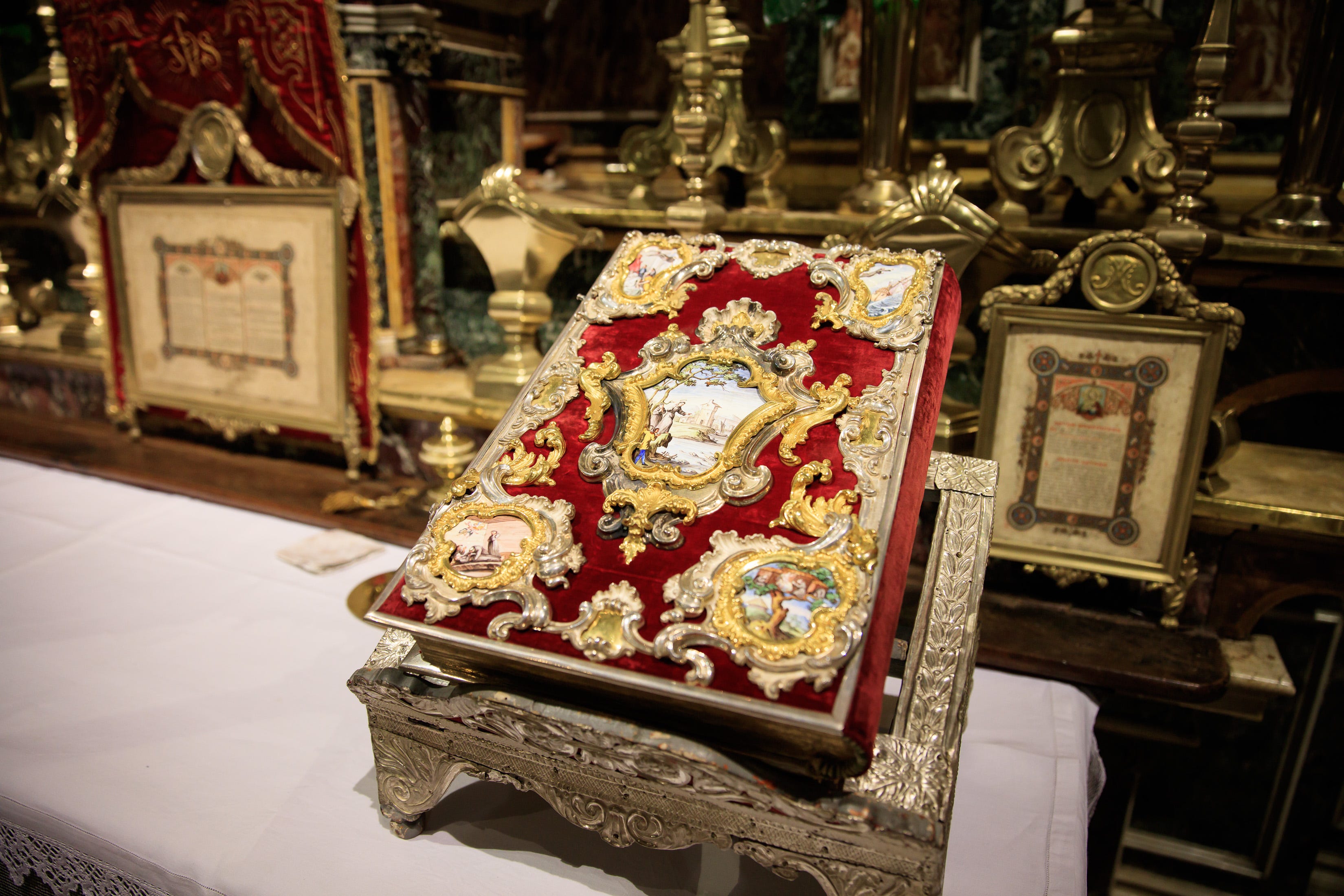
With perfect consistency, therefore, our medieval forebears would never have agreed with the platitude “you can’t judge a book by its cover.” For they spent enormous sums of money on Evangelaries or Gospel books with heavy bindings of gold, silver, and jewels, so that it was perfectly obvious that this book held the very words of God Himself, and deserved our utmost veneration.
The sacred liturgy, too, holds the very words of God—indeed, astonishingly, the Mass holds God Himself, the Word made flesh. It is utterly inconsistent with its inner content that the outward form of it should be anything but glorious, majestic, beautiful, solemn, reverent. We should be able to judge this book by its resplendent cover, that is, the Mass by its appearances, musical, textual, ceremonial; we should be able to see the heart in the actions. We should not “miss the beauty of the face.”
Nowadays we hear a lot of emphasis on not paying too much attention to externals in the Mass but just remembering that “Jesus is present.” To lapse into a bit of slang: Sorry, this ain’t gonna cut it.