



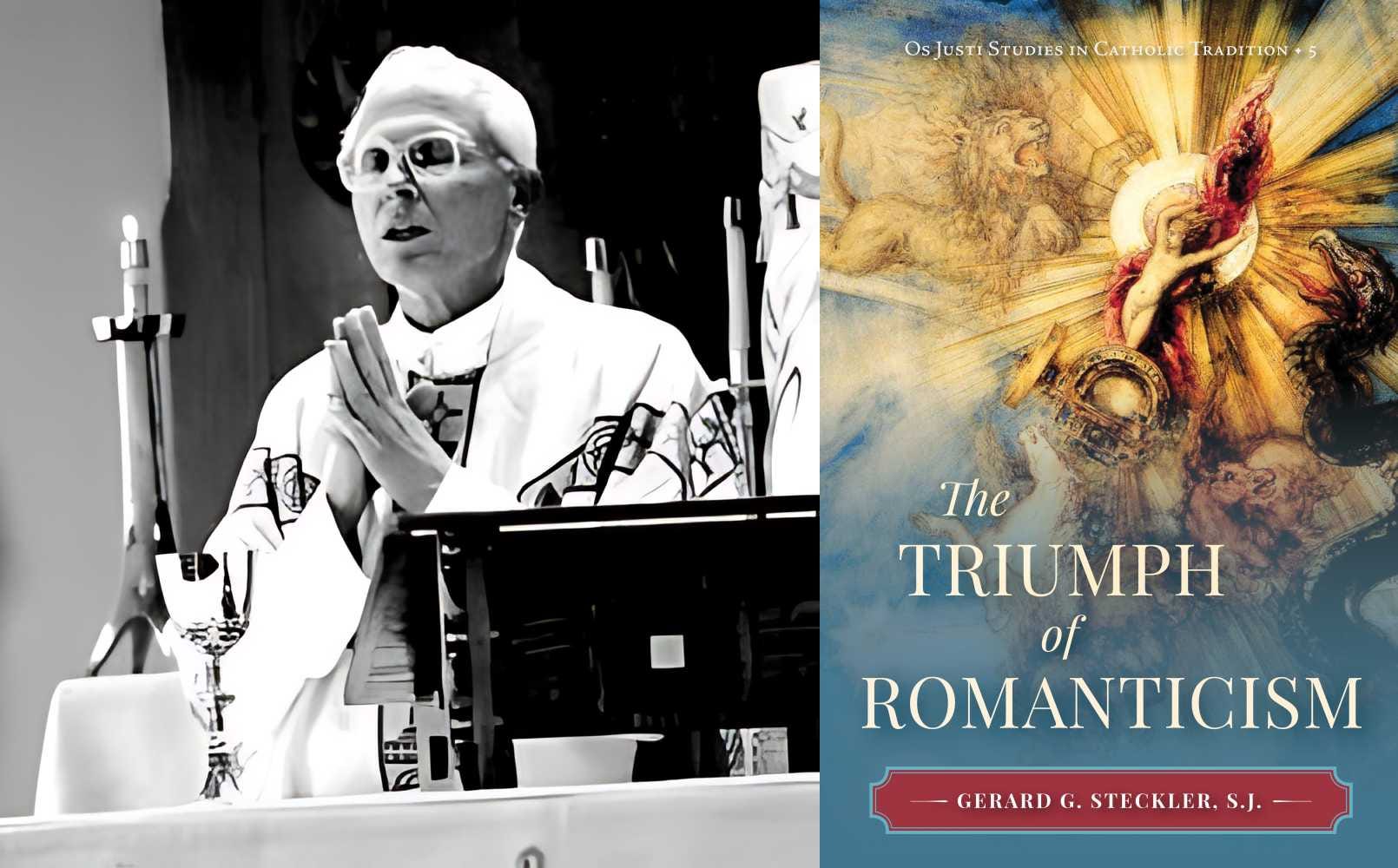
Last week, I read my favorite passages from the first seven-eighths of Fr. Gerard Steckler’s book The Triumph of Romanticism. But there’s a lot of wonderful content in the final eighth of the book, rather like a fireworks show in which the finale packs the grandest punch. While I would encourage you to read or listen to last week’s installment, and, of course, to read the entire book (the whole thing’s entertaining and enlightening), you can also simply start with this post, as it stands by itself. As before, I will read the passages, and mention at the end of each one the page number or range, in case you’d like to look it up in a copy of the book.
On Tillich and modern Protestant thought
[Paul] Tillich influenced the course of modern theology in many ways. Since his writings, Christianity has engaged in dialogue with the cultural situation of the day. Christianity now criticizes its own historical embodiment as a particular religion in an effort to seek the ultimate in ultimate concern. He calls religion the “depth of culture,” failing to see the essential distinction between the two because of his refusal to accord a revelational dimension to religion. His views on secularism and “religious socialism” were intended to meet the original Marxist criticism of the bourgeois capitalist society as producing estrangement. Through grace, he believed, men are united to the divine and to one another in a free association called religious socialism (thus agreeing with the religious nature of socialism as proposed by our anonymous Soviet dissident). Hereby he evidenced a remnant of the traditional doctrine of the Mystical Body of Christ, a fraternity of Christians made intelligent and holy by Christ their Head. In typical Protestant fashion, he argued that since the Church was in no way closer to than further removed from the sacred, neither was the world of the secular. Tillich managed to think that, with such a claim, he had successfully sacralized the secular. In reality, Luther’s principle that one should work out one’s salvation “in the world” ended in the total secularization of the secular, not its sacramental elevation. [247]
[Quoting Tillich directly:]
“Religion cannot come to an end, and a particular religion will be lasting to the degree in which it negates itself as a religion. Thus Christianity will be bearer of the religious answer so long as it breaks through its own particularity. The way to achieve this is not to relinquish one’s own religious tradition for the sake of a universal concept which would be nothing but a concept. The way is to penetrate into the depth of one’s own religion, in devotion, thought and actions. In the depth of every living religion there is a point at which religion loses its importance, and that to which it points breaks through its particularity, elevating it to spiritual freedom, and with it to a vision of the spiritual presence in other expressions of the ultimate meaning of man’s existence.” [247-48]
If Tillich believed all the nonsense he proposed, there is no evidence for it. He consoled himself in homosexual activity. [248]
Why self-knowledge is impossible apart from living in God
Atheistic existentialism has a faulty notion of the subject or existent; it initially errs in making the individual subject play the central role in its reflection. But man can know subjects only by making them objects. One cannot know himself as a subject by reflecting on himself. (Such was Descartes’s mistake.) Subjectivity is intuited, felt, and therefore is not a form of philosophic knowledge. A subject is ineffable and unknowable. One does not know oneself by reflecting on oneself. Only one can really know the self as subject: God, whose essence is to exist, and who is therefore perfect. “God’s being includes in itself life and wisdom, because nothing of the perfection of being can be wanting to Him who is subsisting being itself.”
God is the transcendent subjectivity to which all subjectivities are referred. To be known by anyone other than God is to be known imperfectly. To be known by God is to be known as subject. God has no need to objectify the individual human person. The hidden recesses of one’s subjectivity are obscure to one’s self. To God alone is the self uncovered: “If I were not known to God, no one would know me. No one would know me in my truth, in my own existence. No one would know me—me—as subject.” Scripture confirms: “Your Father who sees what no man sees will repay you . . . your Father who sees what is hidden will repay you” (Mt 6:4–18).
Without God no one would give me justice. To be known by God is to be understood, for God alone knows all the travail and the wounds and the unrequited love and impulses of good will that mark each individual’s earthly odyssey and trial. The deep knowledge possessed by God is therefore a loving knowledge: “To know that we are known to God is not merely to experience justice, it is also to experience mercy.” No matter, consequently, what people are, single men and women in the world, married, celibate in religious life or clerical life or in secular institutes, they must first cultivate their garden (as distinct from the gardens proposed by Voltaire and implied by Rousseau) so that they can have a basically right attitude toward those entrusted to their care. They will never know their husbands or their wives or their children or their friends or their counselees or their parishioners until they know God who is their self, their transcendent subjectivity, Him in whom Christians “live and breathe and have their very being” through Jesus Christ the incarnate Word. All men must deepen their interior lives sufficiently in order to realize their humanity.
The New Testament has confirmed this: “I live, now not I, but Christ lives in me.” “For me to die is gain, to live is Christ.” “Live in my love as I live in my Father’s love.” “I am the Vine; you are the branches.” “What you hear whispered in secret, shout it from the housetops.” “If anyone love me, he will keep my word, and my Father will love him, and we shall come to him and make our home with him.” “The Spirit of Truth . . . is with you, he is in you.” God is the higher subjectivity of the subjective person, he is the personal basis of the personal subject, he is the trigger for the personality of the individual. God is the self of the self (one’s real self) that allows one to really become the self. Far from any pantheism in this, each human is created being, participative being, totally contingent. Only the saints have real personalities, and even theirs are at best constantly improving.