


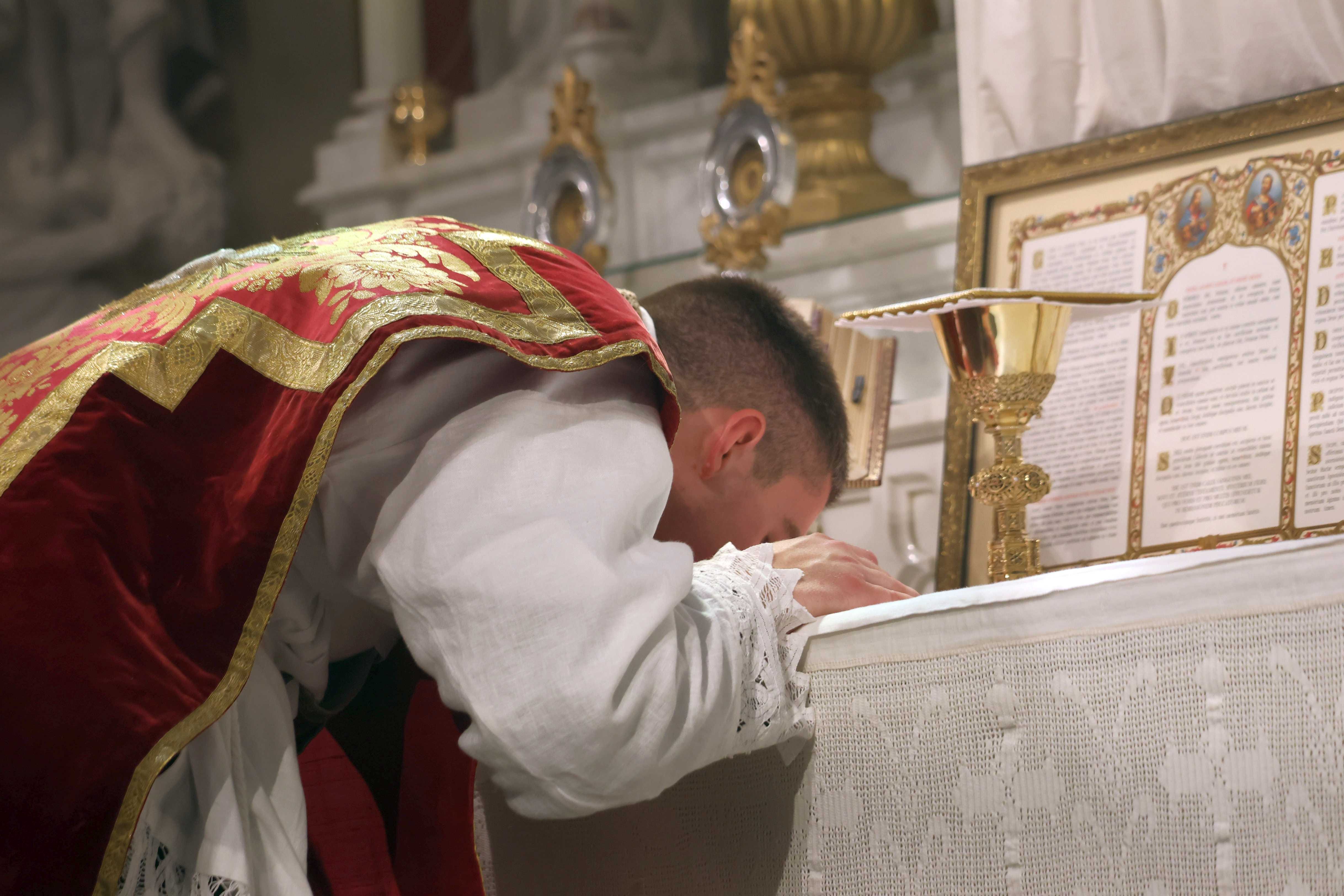
A person I was corresponding with once wrote that he was “wrestling within himself about what is the right attitude to take toward tradition.”
I replied: “Perhaps you were speaking rhetorically; for surely it is obvious that tradition is to be preserved unless there is a demonstrable corruption in it? And by that, I mean something like a typographer’s error in a printed missal (as happened commonly enough in the Renaissance period), or a legitimate custom distorted past recognition due to the superstition of a group of enthusiasts somewhere.”
The fact that in this post-Vatican-II period we tend to view tradition as problematic, as something to be “wrestled with” until we figure out what to do with it, is not a sign of our sophistication but a sign of our decadence.
Of course, tradition presents us with many challenges, and to that extent it should prompt us to wrestle with our own interpretation of events, symbols, and ideas. But tradition as such is something we should humbly stand before and learn from. We let it challenge us; we do not decide whether it should do so.
Piety and meekness
Fr. Matthew McCarthy, FSSP, once preached:
If we extend Augustine’s notion of piety to include not only [accepting] the Scriptures but [accepting] the whole Catholic tradition, the pious do not condemn what they do not yet understand and thus render themselves unteachable, but rather offer no resistance—are meek—and thus can be formed by that tradition. And note the order: it is not on account of understanding that one embraces the tradition: rather, the meek and pious must first be formed by the tradition to come to an understanding of it: understanding and wisdom are the highest and last of the gifts, preceded by piety….
Then, speaking of those who lack this piety, who set themselves up as judges over tradition, Father said, again citing Augustine:
They are not without influence in the highest levels of the Church. They are “rendered unteachable” and thus “venture to condemn that which seems absurd to the unlearned.” Masters of sophistry, dishonouring millennia of tradition, they set aside [in the new lectionary] not only the words of St Paul, but even of Our Lord Himself. As one commentator asked: “Do these men not fear God?”
We must combine piety toward our forefathers with meekness toward our inheritance, which excludes any revolutionary overthrow:
Meekness and piety are two facets of stability. On account of piety, the tradition directs successive generations to that perpetual and stable inheritance: and meekness, stability of desire, prevents being diverted from that end.
Choosing the island over the mainland
In his treatise Against the Donatists, St. Optatus of Milevis writes:
The Church is rightly called Paradise, but it belongs to the wide world. Nor do I pass over the fact that you have said openly that the Church is (as we believe) a Paradise—a thing which without doubt is true—a garden in which God sets His little trees. And yet you have denied to God His rich possessions by compressing His garden into a narrow corner, claiming without reason everything for yourselves alone. Surely the plantations of God, through different precepts, have different seeds. The just, the continent, the merciful, the virgins are spiritual seeds. Of these seeds God raises little plants in His Paradise. Grant to God that His garden be spread far and wide. Why do you deny to Him the Christian peoples of East and North, also those of all the provinces of the West and of innumerable islands—with whom you share no fellowship of communion—against whom you—few in number and rebels—are ranged, in isolation?
The attitude of the modern liturgist, who cuts off the witness and practice of Christian peoples of many centuries and provinces, choosing only his isolated narrow corner of modernity and claiming superior judgment over them, is in this respect identical to the Donatist’s attitude criticized by Optatus. Both the ancient Donatist and the modern liturgist are ecclesiological separatists, confiners, compressors, deniers.