


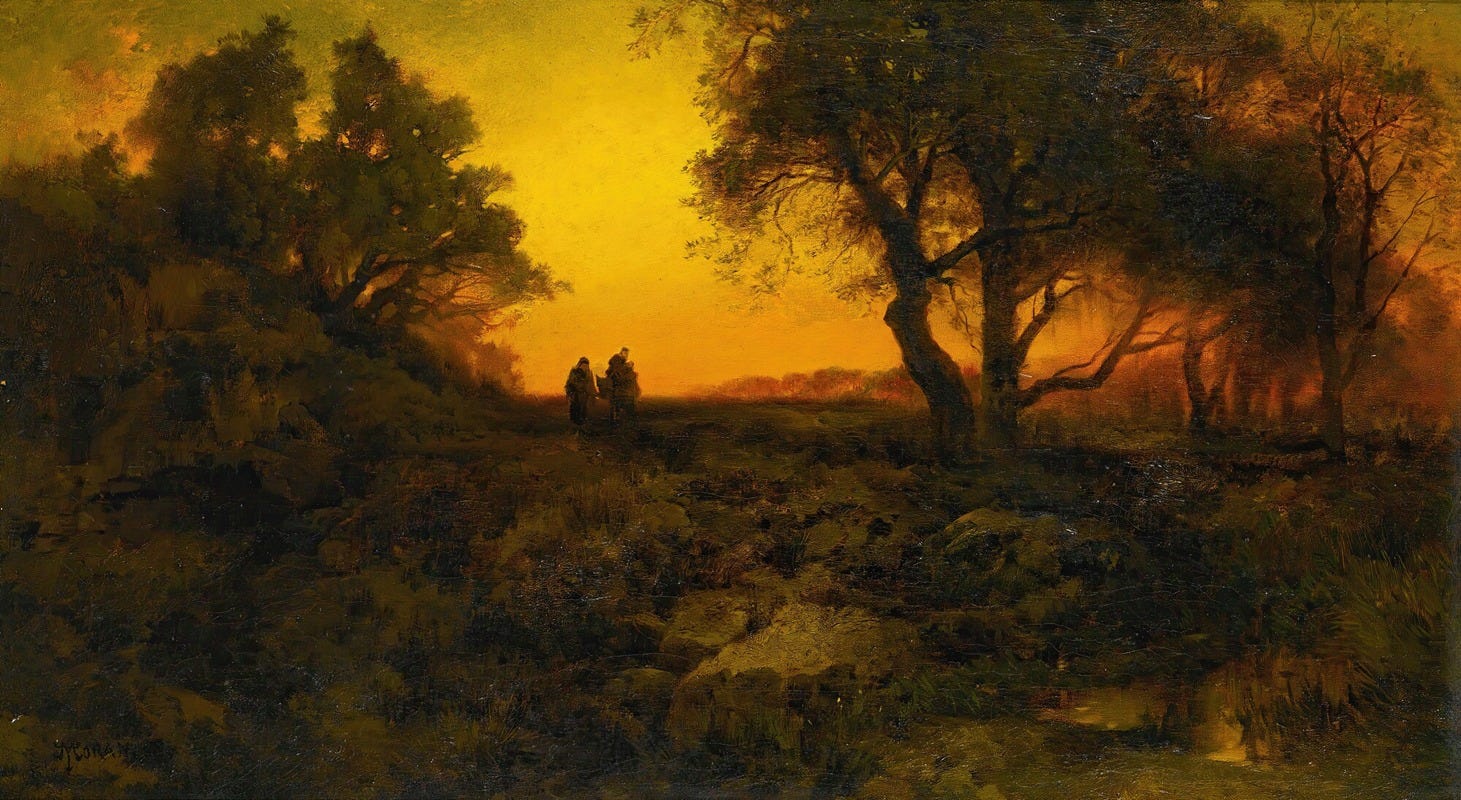
St. John Henry Newman’s thought is famously complex, rich, and autumnal. His most powerful metaphor for the Christian life is a pilgrim coursing the darkness, looking upward to the Pillar of Fire to guide him through moor and fen, crag and torrent: a wilderness fraught with danger, and the shadow of death. Paradoxically, it is precisely the vision of celestial light reigning high above all mortality and change which impels the pilgrim onward, in humble faith and the hope of an everlasting reward.
Lead, Kindly Light, amidst th’encircling gloom,
Lead Thou me on!
The night is dark, and I am far from home,
Lead Thou me on!
Keep Thou my feet; I do not ask to see
The distant scene; one step enough for me.
The theme of sojourn from the twilight of this world into the luminous day of eternity echoes in Newman’s own epitaph. When his dear friend and brother Oratorian, Ambrose St. John, died in 1875 (long preceding Newman’s own death in 1890), John Henry Newman marked their shared grave: Ex umbris, et imaginibus, in veritatem—out of shadows, and images, into truth.
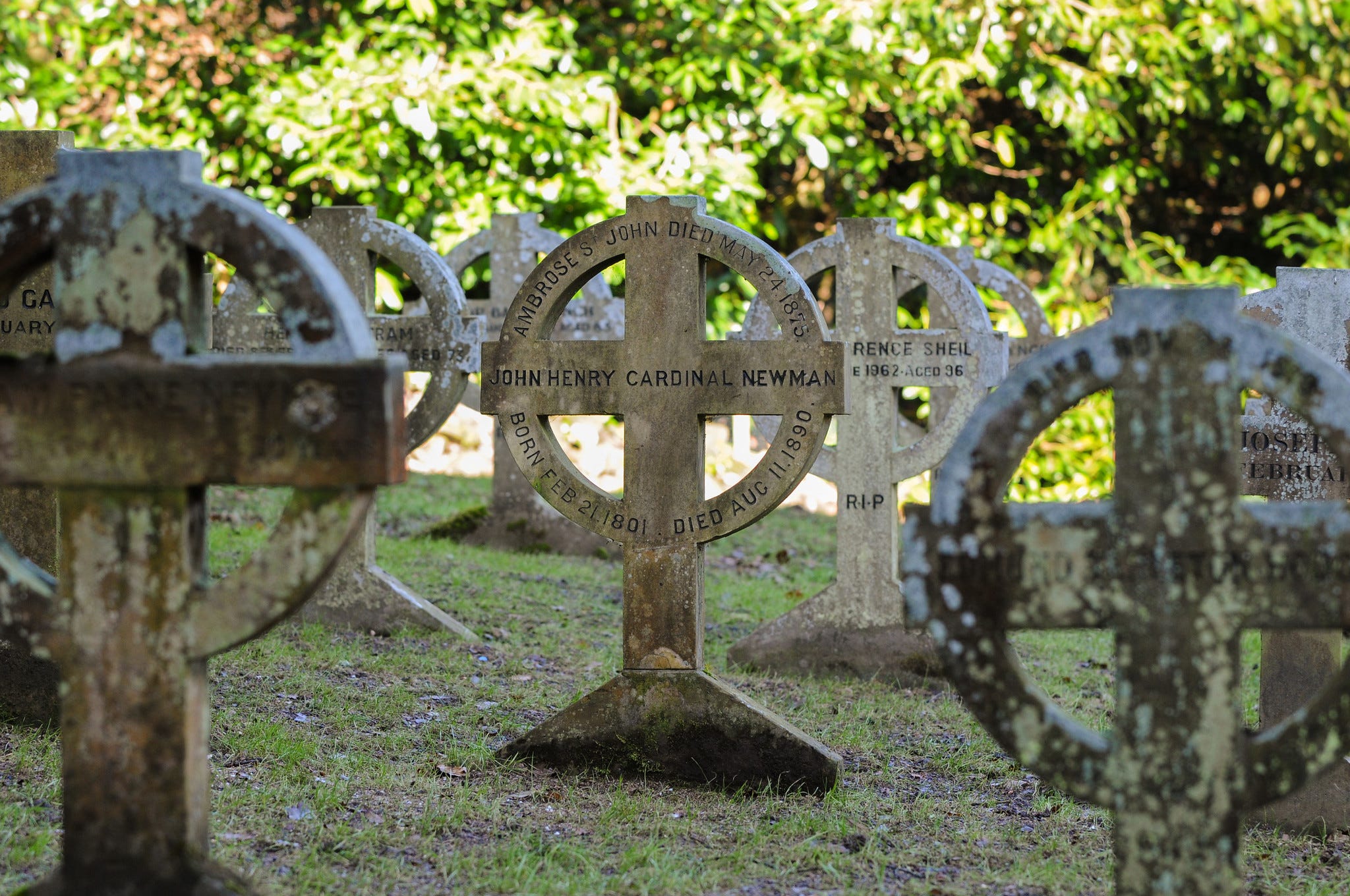
With touching regard for his friend and a humble recognition of the graces Newman himself had received throughout his life, the epitaph alludes to a passage from De Officium Clericorum by St. Ambrose of Milan:
We then must strive for that wherein is perfection and wherein is truth. Here is the shadow, here the image; there the truth. The shadow is in the law, the image in the Gospel, the truth in heaven. In old times a lamb, a calf was offered; now Christ is offered. But He is offered as man and as enduring suffering. And He offers Himself as a priest to take away our sins, here in an image, there in truth, where with the Father He intercedes for us as our Advocate. Here, then, we walk in an image, we see in an image; there face to face where is full perfection. For all perfection rests in the truth.
For Newman, the wisdom of St. Ambrose and the Patristic fathers was the deep and resonant note throughout his whole life, a summons to eternity that echoed throughout the great corpus of his spiritual and philosophical works. Shadows, images, truth. This was Newman’s abiding philosophical habitus, a discipline of mind and heart acquired from the saints, that led him to the Roman Catholic Church, to the heights of spiritual wisdom, and, at last, to Heaven itself.
The Daystar of Faith
St. Ambrose’s De Officiis Clericorum was a fundamentally important text in the Patristic period, and must have been very important to Newman. In fact, throughout his entire ministry of preaching and teaching, the very Pauline and Patristic formula, “shadows-images-truth,” becomes a sort of Jacob’s ladder for Newman, upon which he ranges from the depths of his own interior life to the height of Heaven. It is the pattern by which he understands his experience of this transitory life in light of the promised beatitude of the just (hence its inclusion on his tombstone).
St. Ambrose’s De Officiis (c. 386-391) was written as a philosophical primer for priests, an instruction in the way of right conduct and true happiness. In Book II, St. Ambrose teaches that a happy life is obtained by a calm mind and a pure conscience, writing,
So great is the splendour of a virtuous life that a peaceful conscience and a calm innocence work out a happy life. And as the risen sun hides the globe of the moon and the light of the stars, so the brightness of a virtuous life, where it glitters in true pure glory, casts into the shade all other things, which, according to the desires of the body, are considered to be good, or are reckoned in the eyes of the world to be great and noble.
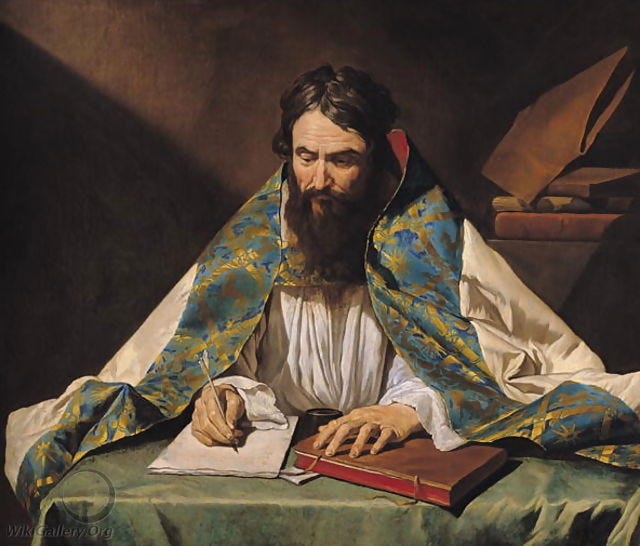
According to St. Ambrose, this quest for a happy life begins in faith, progresses through virtue, and ends in that marriage of justice and wisdom that we call beatitude. For Ambrose, faith begins in the fundamental recognition of God’s sovereignty and goodness, and man’s dependence upon Him. If we are to speak of the “love of wisdom,” faith, according to Ambrose, is the starting point of man’s philosophical quest, for “piety toward God is the beginning of all understanding.” Only the light of Faith truly illuminates the end and the goal of man’s pilgrimage, giving him the first wisdom that is the fear of God. This holy fear, as a light in the land of darkness, is indeed the foretaste of that great radiance that will fill the souls of the just for all eternity.
Shadows and Substance
Shadows are universally associated with partiality, fear, and illusion. Plato’s famous shadows in the cave, emblems of the material world, are distractions from the truth of forms. In contrast to this formulation, Newman’s understanding of typological “shadows”—while he mines a great deal of literary riches from his Victorian pessimism about life in this vale of tears—reveals a profound hope about the progress of man’s quest for truth, for beatitude.
To begin, St. Ambrose identifies “shadows” with the Old Law. These “shadows” constitute the first dispensation (to use Newman’s terminology), in which the rituals of the Law and manifestations of Divine Providence throughout the history of the Hebrew people point to the coming of Christ through outward forms. And as Newman wrote in his essay “Ambrose and the Martyrs,” “a shadow implies a substance.”1 In another sermon, he teaches that the visible Church is the sure way to the invisible Christ, just as “the shadow on the dial is an index of the sun’s course.” And in “The Cross of Christ the Measure of the World,” he writes, “it is God’s usual mode of dealing with us, in mercy to send the shadow before the substance, that we may take comfort in what is to be, before it comes.”

