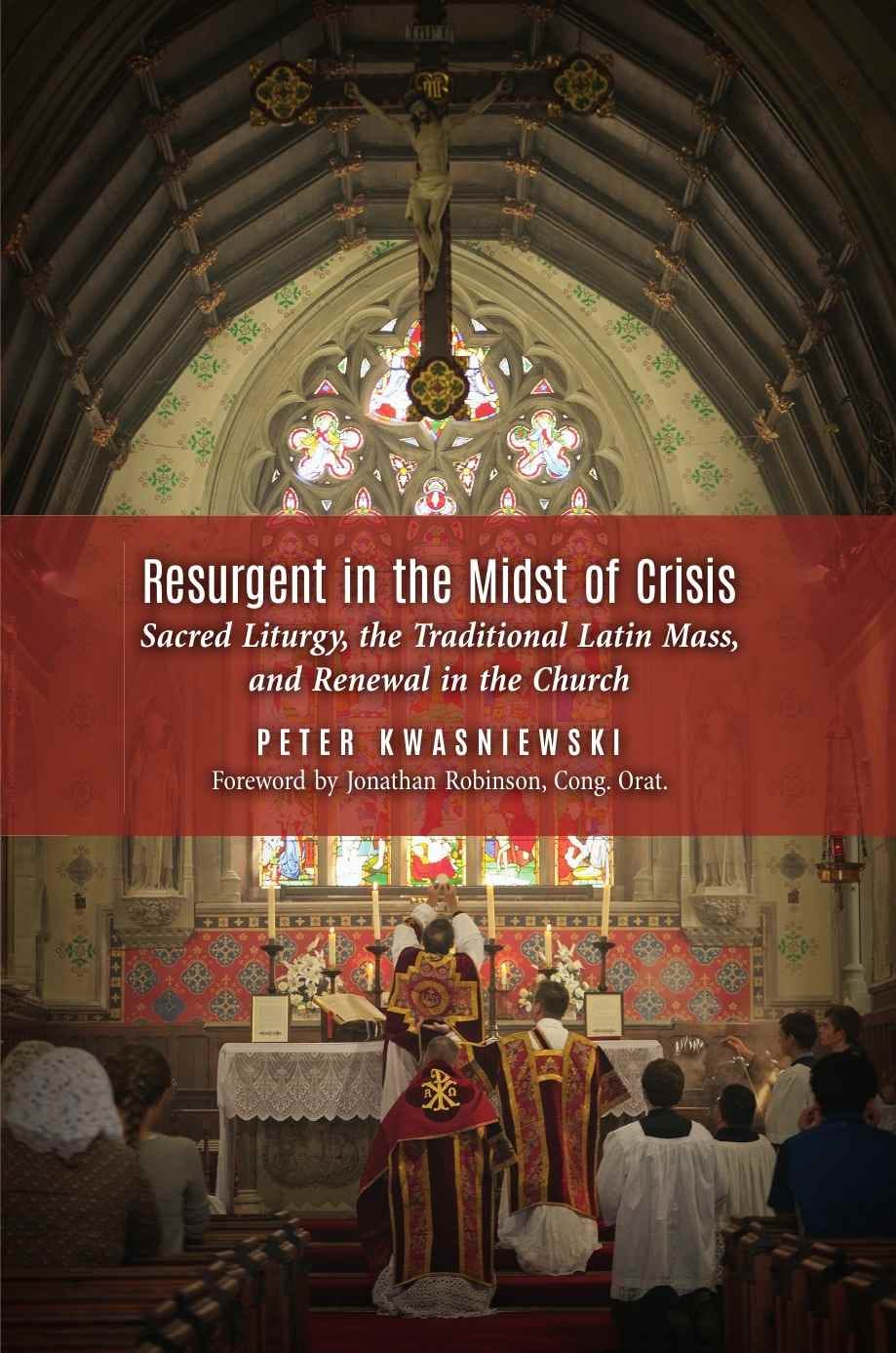
Fr. Jonathan Robinson (1929–2020), founder of the Oratory in Toronto, published his wide-ranging and penetrating book The Mass and Modernity: Walking to Heaven Backward in the first year of Pope Benedict’s pontificate—a pontificate destined to give considerable impetus to a “new Liturgical Movement” of which Summorum Pontificum of 7/7/07 remains the most eloquent symbol.
The Mass and Modernity conveys both the clear vision of its author and the stubborn challenges of the moment in modern Church history at which he was writing. Fr. Robinson seemed to recognize that much had gone dreadfully wrong not only in the implementation of the reformed liturgical rites but in the very principles underlying their engineering. Thus, he writes of the reform:
Instead of improvement, though, there has been loss: a diminishment of that ability “to reach out and touch the Divine” that was once the central thrust of the liturgy….
The principles behind the changes were the result of absorption by many in the Church of ways of thinking that are incompatible with Catholicism….
The most important factor in creating the present unhappy situation was a misreading of the modern world by those responsible for creating and implementing the norms for the implementation of the liturgical reform….
The deformation of the liturgy has to be understood as the result of cultural and intellectual forces that will have to be recognized before anything very serious can be accomplished in the way of serious liturgical reform….
Present liturgical practice has in fact reinforced a good deal of the anti-God initiatives and false teaching about community. In this way the [reformed] liturgy itself has exemplified and deepened modern trends that in my view are destructive, not merely of liturgy, but of the Catholic world view itself.1
As you can see, Fr. Robinson was quite frank about the problem, not beating around the bush as so many others have done (and continue to do).
Yet—and here is the aspect where he seems to be more a man of his time—he hesitated to recommend a wholesale return to the traditional rite in its preconciliar form:
We seem to be faced with the following situation. On the one hand, for a variety of reasons, a full-scale return to the Old Rite is neither possible nor desirable; yet, on the other hand, the New Rite has failed to win hearts in the way the Old Rite used to do, nor is it succeeding in its aim of presenting through its actions and words the sacrifice of Christ that takes away the sins of the world. I think the only way out of this morass is to move the Novus Ordo to what the Old Rite in fact was: the worship of the transcendent God, through participating in the sacrifice of His Son. The role of the Old Rite in this will be to provide a standard of worship, of mystery, and of catechesis toward which the celebrations of the Novus Ordo must be moved.2
You can hear in these words the hoped-for “reform of the reform” that once animated many lovers of the work of Joseph Ratzinger.
When, some years later, Fr. Robinson agreed to contribute the Foreword to my first book, Resurgent in the Midst of Crisis (2014, rev. 2015), he was still of this mindset: the usus antiquior is a valuable treasure of the Catholic Church and should be available, but more important still is taking its rubrical orderliness, sacral aura, and spirit of solemnity as exemplary for all celebrations, including those in the Novus Ordo. To be honest, that’s where many of us once were; it was a relatively easy and good place to be back then, when it seemed to be doable, to have Roman support, and to combine “the best of both worlds.” Now, of course, its emptiness, impracticability, and incoherence have been thoroughly revealed—the subject of my 2025 book Close the Workshop: Why the Old Mass Isn’t Broken and the New Mass Can’t Be Fixed.