
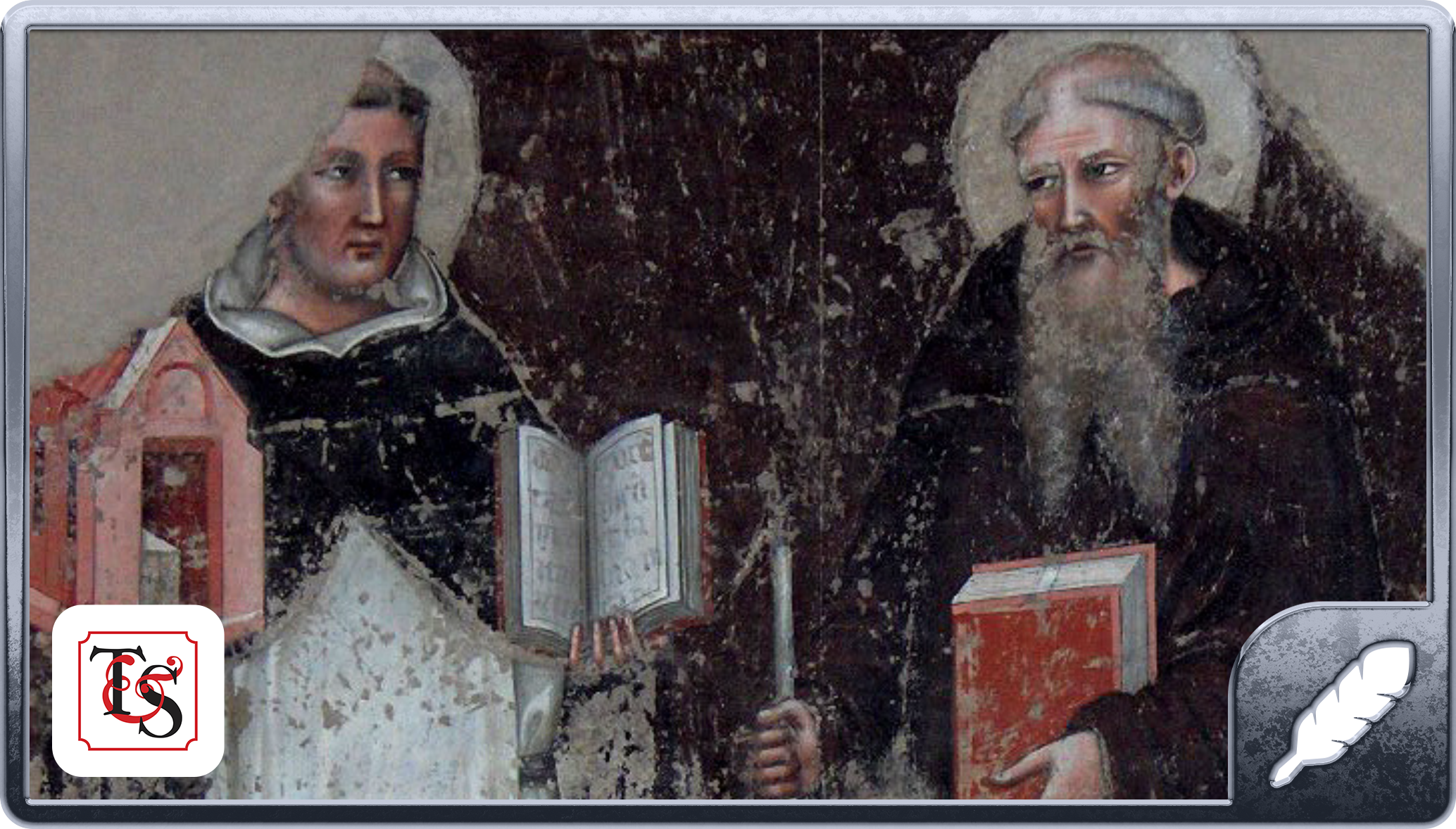
St. Benedict in the Life of St. Thomas Aquinas
When he was five years old, around the year 1230, the young Thomas Aquinas was sent from his family castle to the nearby monastery school of Monte Cassino, the great motherhouse of the Benedictine Order. From that high peak, one may still gaze in wonder at the beautiful countryside below, or lift one’s eyes to cascading clouds and gentle shafts of light that warm the abbey walls. The place, hallowed by fifteen centuries of monastic life, breathes an air of solemn greatness.
The mind of a small child drinks in meaning as effortlessly and unconsciously as breathing. Children delight in discovering, become rapt in listening, and rejoice in repetition. Thomas’s baby ears quickly learned to mark the sound of the great bells and the continual round of holy chant drifting hour by hour from the abbey Church. His little feet learned to mark the steps to the tomb of St. Benedict, and he learned that the best way to imitate his teachers was to keep his eyes down on one of his schoolboy texts. He was a quiet, shy boy, and as the years went on, he immersed himself consciously in his studies and in prayer. Dr. Martin Grabmann observes:
Peace, the motto of the Order of St. Benedict, reveals a plentitude of inner happiness and heavenly peace known to God alone. St. Thomas breathed deeply of this peace of St. Benedict during his years of childhood on the holy heights of Monte Cassino, where one feels much nearer to Heaven.1
Thomas’s biographer, the Dominican William of Tocco, writes:
Here [at Monte Cassino], Thomas would be instructed in a holy way of life and prepared for the divine illuminations that would come to him. All this was done by divine counsel, lest such a bright light for the Church should be reared in obscurity or such a striking model of sanctity be formed with base habits among worldly-minded men.2
Nourished by monastic wisdom and walking the paths hallowed by saints, the deep wells of Thomas’s interior life went to the very roots of the mountain. It was the monks who treasured for long years the memory of the little boy who would insistently ask, “what is God?”
Mysticism and Mercy
In Naples, where as a teenager he had been sent for further study, Thomas entered the Dominican Order. He passionately embraced Dominican spirituality, and not without suffering intensely from his family, who had hoped that he would become abbot of Monte Cassino. One thing was certain to Thomas: if he became a monk as they desired, his destiny was riches, power, and lordship, not evangelical poverty.
The monks of Cassino may also have had an intuition that his vocation lay elsewhere, for when Thomas took the Dominican habit at the age of nineteen, they did not protest his choice, despite the violent rage of the Aquino family. Thomas pursued his vocation with ardor, cherishing with filial tenderness his identity as a son of St. Dominic.
Yet, writes Father Andrew Hofer O.P., “Although Thomas persisted in this decision to join the Order of Preachers, he never forgot the debt he owed the Benedictines, nor did they forget him.”


