


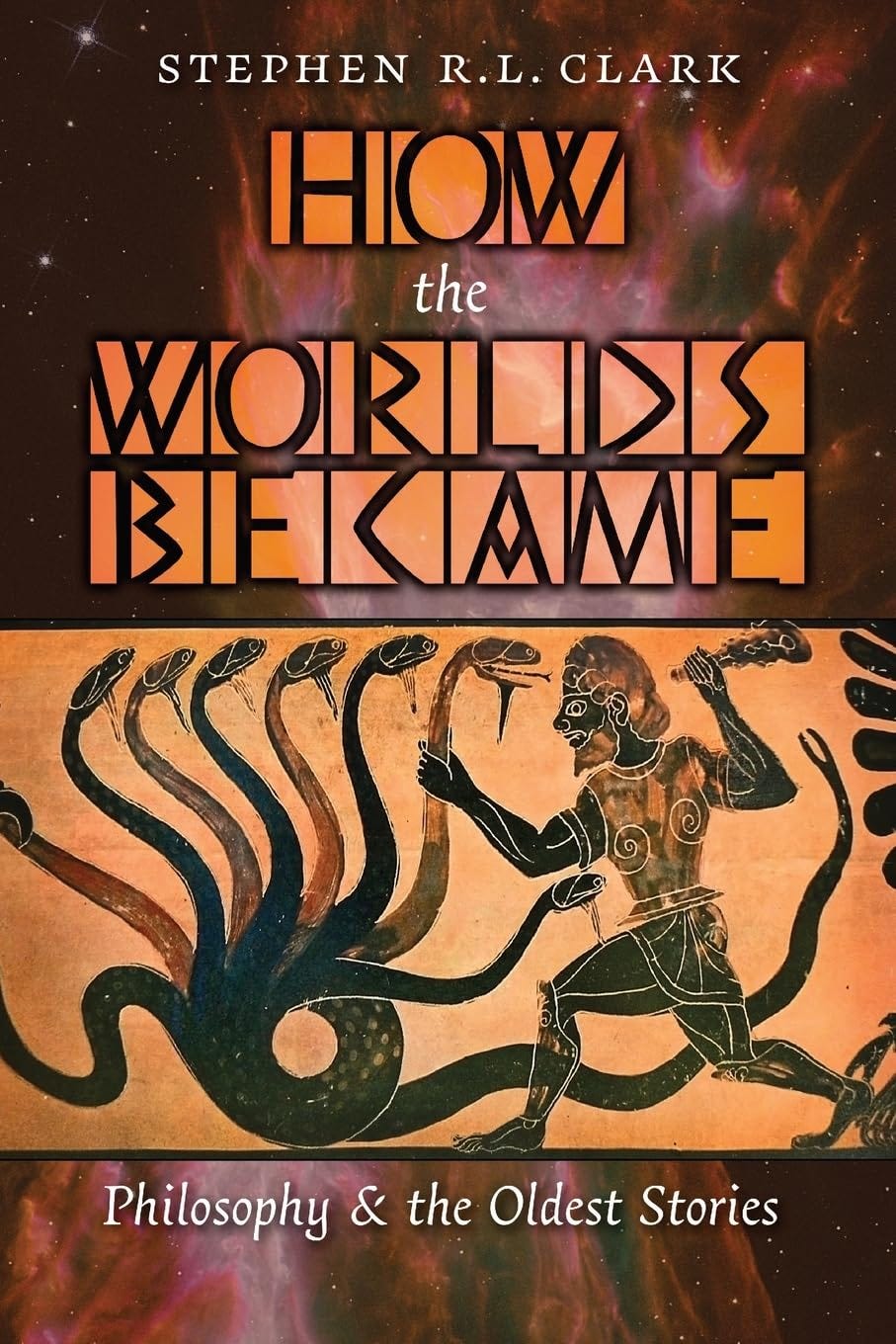
An author whom I find alternately delightful and frustrating is Stephen R.L. Clark. I’ve read many of his books, always with profit, and always with puzzlement. He has a vast encyclopedic knowledge of his subjects but he can waffle and occasionally undermine his own arguments by his diffidence and sense of irony. Still, it’s worth reading an author for a sentence like this: “The world is composed of cooperating and conversing subjects.” Yes, that’s it—that’s exactly what materialism, with the nihilism born of it, does not see, or refuses to see.
As a taste of Clark’s distinctive philosophical-poetic approach, today we’ll look at some passages from his 2023 book How the Worlds Became: Philosophy & the Oldest Stories. As usual, page numbers will be in parentheses.
Philosophers, it is popularly supposed, must argue from clearly correct premises by inexorably logical steps to their often surprising conclusions, following “the argument” where it alone might lead. They must have shed their personal or cultural prejudices, and only accept “objective” propositions of a kind that require no special moral or religious virtue, nor any long apprenticeship or cultural context, to discern. That this claim itself has a special history, and rests on largely unargued premises, is usually forgotten. Nor is it acknowledged that such an intellectual parsimony leaves us necessarily ignorant of almost everything we once thought we knew. (2)
The Song of Songs, for example, is not a historical document recording the thoughts and actions of a particular woman and her man, even if—which is possible but unproven—this was the original intention of the poet who wrote it. Its significance, as part of Scripture, is for the faith community which put the texts together to determine. (13)
Shuve argues, plausibly, that Christian commentators who (as we say) “allegorized” the work did not do so to cover up the supposedly salacious “real meaning”: they took the obvious, “commonsensical” reading to be about the relations of Christ and His Church, as Rabbinic commentators likewise took it to be about the relations of God and His people. (13n25)
“Awareness of the divine begins with wonder,” Heschel writes, and “wonder or radical amazement, the state of maladjustment to words and notions, is therefore a prerequisite for an authentic awareness of that which is.” (37)
Dio Chrysostom, on the immediate non-verbal grasp of mystic rites by any normal human being:
“It is very much the same as if anyone were to place a man, a Greek or a barbarian, in some mystic shrine of extraordinary beauty and size to be initiated, where he would see many mystic sights and hear many mystic voices, where light and darkness would appear to him alternately, and a thousand other things would occur; and further, if it should be just as in the rite called enthronement, where the inducting priests are wont to seat the novices and then dance round and round them—pray, is it likely that the man in this situation would be no whit moved in his mind and would not suspect that all which was taking place was the result of a more than wise intention and preparation, even if he belonged to the most remote and nameless barbarians and had no guide and interpreter at his side—provided, of course, that he had the mind of a human being? Or rather, is this not impossible?” (43)
So also Immanuel Kant, Critique of Practical Reason, 166: “Two things fill the mind with ever new and increasing admiration and awe, the oftener and more steadily we reflect on them: the starry heavens above me and the moral law within me. I do not merely conjecture them and seek them as though obscured in darkness or in the transcendent region beyond my horizon: I see them before me, and I associate them directly with the consciousness of my own existence. The former begins at the place I occupy in the external world of sense, and it broadens the connection in which I stand into an unbounded magnitude of worlds beyond worlds and systems of systems and into the limitless times of their periodic motion, their beginning and their continuance.” (54n8)
Think of Ember Days:
Times and seasons create our lives together, and we celebrate the returning seasons rather than submit to a drunkard’s walk through life, without rhyme or reason. (58)
Quoting Blake (this was one of Malcolm Muggeridge’s favorite quotations too):
When the Sun rises, do you not see a round disc of fire somewhat like a Guinea? O no, no, I see an Innumerable company of the Heavenly host crying Holy, Holy, Holy is the Lord God Almighty. I question not my Corporeal or Vegetative Eye any more than I would Question a Window concerning a Sight. I look thro’ it and with it. (79)
Quoting Proclus, reminiscent of Dionysius on why lowly divine names are sometimes better than lofty ones:
It seems to me that the grim, monstrous, and unnatural character of poetic fictions moves the listener in every way to a search for the truth, and draws him towards the secret knowledge; it does not allow him, as would be the case with something that possessed a surface probability, to remain with the thoughts placed before him. It compels him instead to enter into the interior of the myths and to busy himself with the thought which has been concealed out of sight, by the makers of myths and to ponder what kinds of natures and what great powers they introduced into the meaning of the myths and communicated to posterity by means of such symbols as these. (89-90)
We can “know” things “from the inside,” because we are ourselves “inside.” There are at least two implications, a metaphysical and an epistemological. Metaphysically, the Platonic claim is that reality is essentially a “minded” affair— rather than imagining an array of atomic or more familiar bodies, with no more than “primary” or “objective” properties (that seem to dissolve into merely nominal attributions), we are to conceive that colours, topologies, virtues, principalities and powers are real elements of an eternal Intellect. These are in turn reflected or refracted in our phenomenal worlds: rather than supposing that there are first distinct individuals, from which we abstract some conception of universals, we are to acknowledge that the first discriminable realities are “noetic,” related to each other not by their disposition in a preexisting “space” but by their rational associations. (98)
The words Philo—so true!:
It is a hard matter to bring to a standstill the soul’s changing movements. Their irresistible stream is such that we could sooner stem the rush of a torrent, for thoughts after thoughts in countless numbers pour on like a huge breaker and drive and whirl and upset its whole being with their violence . . . . A man’s thoughts are sometimes not due to himself but come without his will. (101)
Clark continues:
The thoughts, feelings, images that sweep across our consciousness, and that may briefly absorb us are not the same as the self, considered simply as that consciousness. Our error is to identify with the passing thoughts and feelings. Our release is to draw ourselves back from them, even from those with which we are most tempted to identify.
“It is not necessary to examine every problem and every thesis but only one about which doubt might be felt by the kind of person who requires to be argued with and does not need castigation or lack perception. For those who feel doubt whether or not the gods ought to be honoured and parents loved, need castigation, while those who doubt whether snow is white or not, lack perception”: Aristotle, Topics 1.105a4–8 1.11. (107n69)
The so-called “hard problem of consciousness” is indeed an artefact, an effect of that initial decision that the world is really made only of “objects.” Our predecessors were wiser— or at least more innocent: they had not imagined the merely material into being, and therefore took it for granted that the world was composed of cooperating and conversing subjects. … The Rabbis were wise to make the personal element of the Genesis story clear. We may need to face up to our fears, and realize that “religion” is not seeking “explanations” but acknowledging the mystery of being. We do still live in a world of beings, not of things. (120-21)
Citing Plato—this is the “Proof Texter”:
“When he thinks that he is reasoning he is really disputing, just because he cannot define and divide, and so know that of which he is speaking; and he will pursue a merely verbal opposition in the spirit of contention and not of fair discussion.” (168)
What has been called the unreasonable effectiveness of mathematics is a sort of confirmation that we have the root of the matter in us, that our intellect is a spark of the universal reason, an image of the God on whom everything depends. Or else, of course, we should rather abandon that conviction, and with it any confidence that mathematics is more than a sometimes-useful fiction. The “success” of science can only be pragmatic, parochial, transient, and we have no reason to extrapolate the patterns that we happen to see here-now to a vastly wider world. Nor can we reasonably suppose both that there are no universal binding obligations (that is, that there is no God) and also that there is a universal binding obligation to pursue “the truth.” If atheistical naturalists are correct we cannot reasonably expect to discover truths beyond, at best, the parochial, nor do we have any obligation to try. … (175)
Conversely, if we can and should pursue and prefer the “real truth,” then a form of theism is, essentially, correct: we really should listen to reason. … There is a single source for all things; this source is expressed in the Logos, and the Logos is, at least, available to us. This does not constitute a “proof” of those dogmas— I doubt if there are ever any final or conclusive or universally persuasive proofs of anything— but atheistical naturalists are at least condemned to a more incoherent doctrine than are theists, as they must believe simultaneously that creatures like us are very unlikely to be equipped to understand the cosmos (or even have reason to want to), and that they themselves know enough to know that theism is mistaken. (176)
Quoting Durkheim:
The believer who has communicated with his god is not merely a man who sees new truths of which the unbeliever is ignorant; he is a man who is stronger. … Whoever has really practised a religion knows very well that it is the cult which gives rise to these impressions of joy, of interior peace, of serenity, of enthusiasm which are, for the believer, an experimental proof of his beliefs. The cult is not simply a system of signs by which the faith is outwardly translated; it is a collection of the means by which this is created and recreated periodically. (177-78)
Plotinus—my experience often at Mass:
It is there that one lets all study go; up to a point one has been led along and settled firmly in beauty and as far as this one thinks that in which one is, but is carried out of it by a kind of swell and sees suddenly, not seeing how, but the vision fills his eyes with light and does not make him see something else by it, but the light itself is what he sees. (182)
Names—that is, “true names”—embody real natures: the things as they are understood in the original language, or in the “mind of God.” The Name, as much as the statue, is the god’s active presence. (196)
The land of Canaan, it was supposed, was His to give His people, and to cleanse from squatters. And the only way that this could seem possibly true was for the Lord also to be the Creator and thereby the Owner of all lands and peoples. He must therefore stand outside the natural order, as its sole origin and master. At the same time, that Lord was introduced from the beginning, exactly, as the Liberator from all oppressive masters— including the lesser “gods” and their human or demonic servants. (201)
Ceremonies and sacred places are the place where Heaven meets Earth— that is, the hope of a bright eternity is given temporary form here-now. (203)
Quoting Boethius:
“I may say quite firmly that if those things the loss of which you complain of were really yours, you would never have lost them.” (204n58)
Chesterton:
It [the popular instinct] has a very well-grounded guess that whatever is done swiftly and systematically will mostly be done by a successful class and almost solely in their interests. (230)
We shall prevail by ordinary, domestic, virtues, combined with cheerful resistance to all would-be tyrants (and a lot of cunning). (256)
Theodore Parker:
“Will you fear lest a wrong should prove immortal? So far as anything is false, or wrong, it is weak; so far as true and right, is omnipotently strong. Never fear that a just thought shall fail to be a thing; the power of God, the wisdom of God, and the justice of God are on its side, and it cannot fail,—no more than God himself can perish.”
BRILLIANT – G.K. Chesterton:
Science is the study of the admitted laws of existence; it cannot prove a universal negative about whether those laws could ever be suspended by something admittedly above them. It is as if we were to say that a lawyer was so deeply learned in the American Constitution that he knew there could never be a revolution in America. Or it is as if a man were to say he was so close a student of the text of Hamlet that he was authorised to deny that an actor had dropped the skull and bolted when the theatre caught fire. The constitution follows a certain course, so long as it is there to follow it; the play follows a certain course, so long as it is being played; the visible order of nature follows a certain course if there is nothing behind it to stop it. But that fact throws no sort of light on whether there is anything behind it to stop it. That is a question of philosophy or metaphysics and not of material science. (265-66)
Maintaining order and proper ranks is not an unworthy project: how else, we may reasonably ask, shall we avoid dissolution? Those who resent and vilify all “organised religion” have never fully considered what disorganised religion might be like: a world in which we all do exactly what we please, in the name of our own personal “truth,” made “true” merely because we assert it. (275)
***
Clark’s books may be found at, e.g., Angelico Press, or on Amazon.