


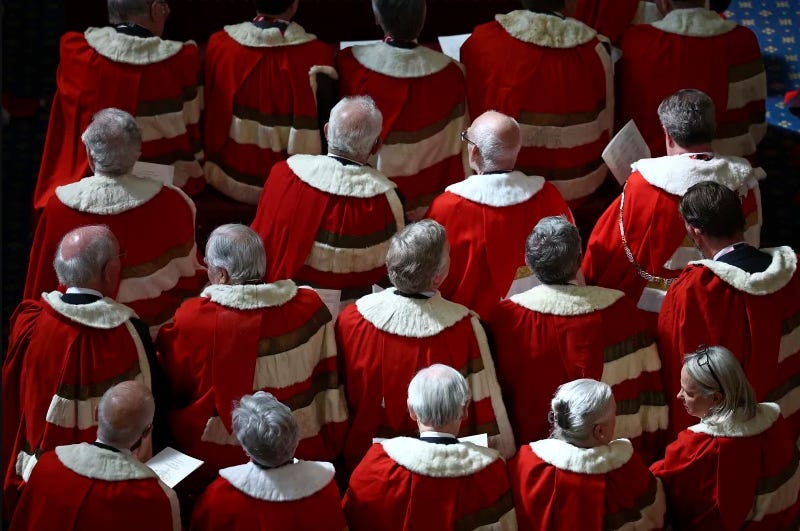
Britain’s current Labour Party government recently legislated to exclude the last hereditary peers from the House of Lords, where they have since time immemorial been voting on and amending legislation. Since the Blair government’s reform in 1998, the number of hereditary peers has been limited, and when one died another was elected, by the hereditary peers themselves, to replace him. Now that interim system has finally gone.
Like most democracies, Britain has two “chambers” of its legislative body. One is directly elected from one-member constituencies (that is, voters in a specified area elect a single Member of Parliament); the other is the House of Lords. For many centuries this was entirely made up “hereditary” peers, that is, peers whose title, and right to sit in the House of Lords, could be inherited by their descendants. New peers were created, and in recent centuries it was the government of the day who would ask the king or queen to “ennoble” people, who would join the House of Lords. From 1958 only “Life Peers”, whose descendants would not inherit, were created. Now the Life Peers are all we will have left: men and women nominated by a government, usually within the last 30 years at most, since people tend to be given peerages late in life.
It seems obvious that the system of having a body of people who simply inherited the right to vote in a legislature is anomalous: indeed, it will strike many people as quite mad. It has this in common, of course, with many features of the British constitution, and to an extent with many features of many constitutions. America’s Electoral College is not something anyone would think up if they were drawing up a constitution today, nor is the convoluted relationship between the French state and the Catholic Church, or indeed the borders of San Marino.
Indeed, the world is full of strange things, and among the strangest are the ways that second legislative chambers are distinguished from first ones. There would be no point electing them the same way as the first, but if they are elected in a different way they will not always have the same political complexion. This tends to lead to the deadlock between the two chambers which is such a familiar feature of the American system, and it is something constitutional experts try to think of ways to avoid.
It is for this reason that members of a second chamber can be, like Ireland’s second chamber, the Oireachtas, wholly or partly appointed. The historic British system worked as well as it did because the House of Lords had an attitude of deference towards the House of Commons, particularly on the budget and on “manifesto pledges” (anything that had formed a part of an election campaign). The weakness of the Lords’ “mandate” was not a problem, but something that enabled the system to function. Then again, the government of the day could add its own supporters to the Lords, to rebalance the membership.
