
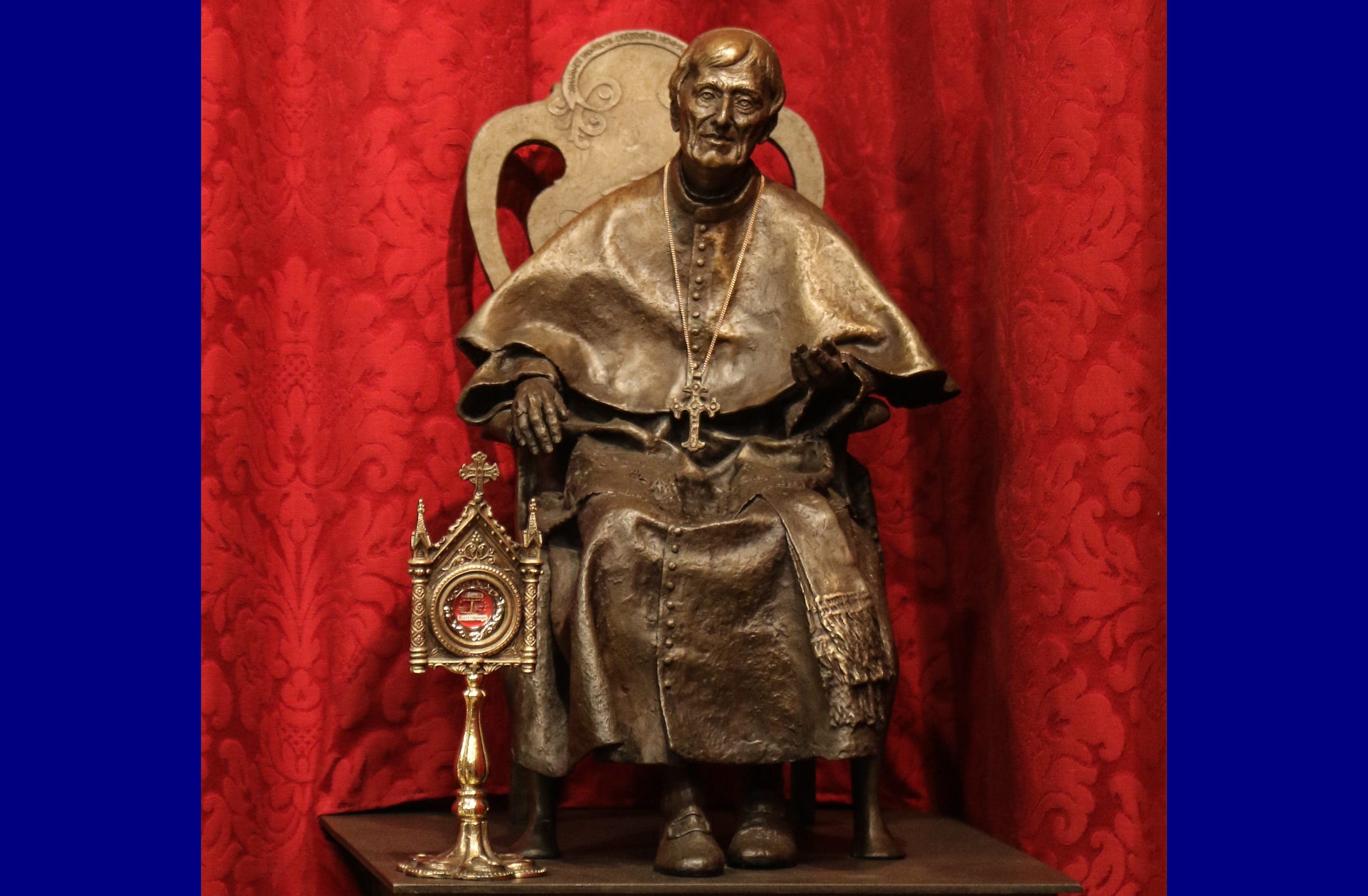
The Marian Devotion of St. John Henry Newman
Note to Readers: If you are receiving two emails of the same T&S article (one from Substack and one from Pelican+), then simply unsubscribe yourself from this Substack! I won’t be publishing anything here that won’t also appear (and in full) at Pelican+. —Dr. K
In November of this year, Pope Leo XIV declared St. John Henry Newman a Doctor of the Church. The bestowal of the title is a great occasion for rejoicing, especially for traditionalists, as Dr. Kwasniewski has tirelessly demonstrated.
Newman’s vast corpus of writings represents material for a lifetime of study, including not only theological works of great significance, but also works in almost every conceivable literary genre. He is universally regarded as one of the greatest prose writers in the tremendous canon of Victorian literature. Some of his most beautiful and theologically rich writings are dedicated to the Blessed Virgin Mary, whom he loved with singular devotion well before his conversion.
The Feast of the Immaculate Conception, to which we bid farewell on this octave day, presents an opportunity to summarize the growth of his Marian theology in the unique context of 19th-century England. Newman’s eloquent defense of Our Lady’s active role in Redemption makes him a prophetic witness in the 21st century when a revival of traditional Mariology and Marian devotion is needed more than ever. His writings are a treasure that Catholics should study carefully in order to promote Our Lady’s honor with rigorous theological excellence, renewed vigor, and a graceful spirit.
Newman’s Anglican Night
Newman’s growth in Marian devotion was of singular importance for his conversion to Catholicism. He recounts that as a boy, he drew a rosary on the pages of his schoolbook. Despite this unconscious foreshadowing of his destiny, he inherited all the anti-Catholic prejudices typical for his time, including a repugnance for seeking the intercession of the Saints and Our Lady. At this juncture, one must emphasize that throughout his life, Newman’s Mariology was downstream of his ecclesiology. That is, his resistance to Marian devotion was not because he had doubts about orthodox doctrines or opposition to her person. It was simply because the Anglican Church forbade it, as his letter to Frederick William Faber of Dec. 1, 1844 demonstrates.
In the 1830s, Newman’s understanding of Mary’s purity and grace was high and austere. In his Anglican sermons, he mentions Our Lady rarely, although with somewhat daring reverence considering the hostility with which his audience greeted such allusions. In “The Reverence Due to the Virgin Mary,” published in 1835, he wrote,
Who can estimate the holiness and perfection of her, who was chosen to be the Mother of Christ? If to him that hath, more is given, and holiness and Divine favour go together (and this we are expressly told), what must have been the transcendent purity of her, whom the Creator Spirit condescended to overshadow with His miraculous presence?
Yet, after this glowing estimation of Our Lady’s personal holiness, his practical conclusion was, “...it is a dangerous thing, it is too high a privilege, for sinners like ourselves, to know the best and innermost thoughts of God’s servants….The higher their gifts, the less fitted they are for being seen.”
Newman later referred to this sermon in his Apologia Pro Vita Sua, when he admitted that throughout the Tractarian period, he grew in interior devotion to the Blessed Virgin and the saints, even as exteriorly he maintained the repressive rigor of Anglican practice:
In spite of my ingrained fears of Rome, and the decision of my reason and conscience against her usages, in spite of my affection for Oxford and Oriel, yet I had a secret longing love of Rome the author of English Christianity, and I had a true devotion to the Blessed Virgin, in whose College I lived, whose altar I served, and whose immaculate purity I had in one of my earliest printed Sermons made much of.
Ironically, Newman’s promotion of his Via Media theory brought him in constant contact with Roman devotion. Providentially, his struggles became the fertile ground for the seeds of grace. In another passage in the Apologia, he recounted:
at least during the Tract Movement, I thought the essence of [Rome’s] offence to consist in the honours which she paid to the Blessed Virgin and the saints; and the more I grew in devotion, both to the saints and to Our Lady, the more impatient was I at the Roman practices, as if those glorified creations of God must be gravely shocked, if pain could be theirs, at the undue veneration of which they were the objects.
As a reward for his herculean efforts to combat the ecclesial abandonment of the Nicene Creed and a suicidal capitulation to the powers of the world, Newman was decisively opposed by the Anglican Bishops, upon whom he had looked for support and spiritual fatherhood against a rapidly secularizing State. With the 1841 crisis of Tract 90, which was the decisive blow to his efforts to legitimize a “Catholic” reading of the Thirty-Nine Articles, Newman’s position in the Anglican Church became untenable. He retired from preaching and went into semi-monastic seclusion at Littlemore in 1842.
In the following period of silent agony, his study of the Fathers revealed to him his true ecclesial position as in a mirror. While studying the life of St. Athanasius, Newman saw with illuminative clarity that there could be no dogma of the Incarnation without the Theotokos; and be she ever so praised, if Mary be the Mother of God, no praise could be too high, no love to her unjustly given. The glory of the Church rose and fell with Mary as with the morning sun. He could not avoid the fact that in 1844 as in 431, Rome had been her champion.
N.B. For those who wish to listen, the audio file may be accessed at Pelican+.


