


Many among the traditional Catholic laity love to pray some portion of the Divine Office or have heard that it is a good spiritual practice to do so. Hearing that it is the “official prayer of the Church,” and “greatly meritorious,” you might feel like you are really missing out—perhaps even being a bad Catholic—if you don’t get on the bandwagon and start getting your ribbons in order!
But if using a hand missal presents difficulties (at least at first), navigating a Divine Office book can be even more intimidating. One might spend a while trying to figure out which feast to observe, which commemorations to add, and which hymn or collect conclusions to use; and that’s even before one begins stumbling over unfamiliar Latin psalm verses. Anxiety arising from such a situation runs counter to the purpose of prayer in the first place: focus on God, rather than on the elements of the prayer itself.
In order to remove any possible trepidation in a layman thinking about praying the Office, I hope to give some suggestions here for slowly becoming familiar with this beautiful prayer of the Church. Sharing thoughts and tips on praying the Office as a layman, I want to remind readers that you need not do everything right all at once! I want to encourage you to put the prayer before the prayer book. Even if you are a liturgical whiz and excel at ribbon placement, this still holds true—it is crucial to a holy and peaceful approach to the Office.
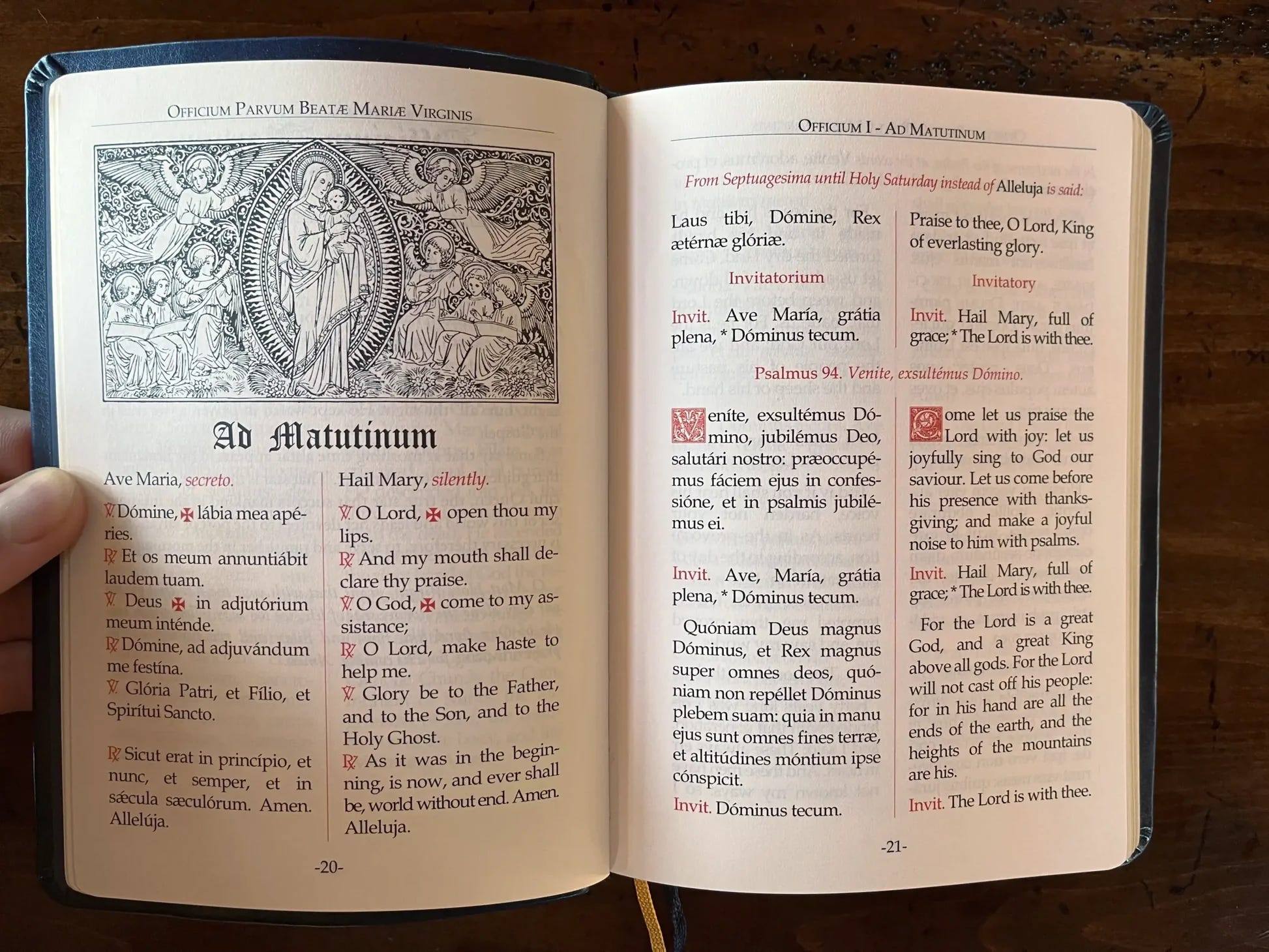
I will assume for the purposes of this article a basic familiarity with the day hours of the Roman or Benedictine Office, as found in The Monastic Diurnal (available from Farnbourough or Clear Creek), Angelus Press’s Divine Office or Compline book, or one of the editions of The Little Office of the Blessed Virgin Mary available from various publishers (I like this editon best). I will also assume that you have read any introductions these books might contain and thus have a basic familiarity with the parts of the Office such as hymns, antiphons, or psalms. If you have not yet found one of these books, you can easily find them online.
The Place of Rubrics
The rubrics exist for a reason: to give a structure to the Divine Office. Fundamentally, what makes praying the Office different from private prayer and plain old prayerful Scripture reading (also known as lectio divina) is that it has a structure and order to its parts. Once learned, the rubrics give you the ease of not having to decide what to do next: it’s already laid out for you by the tradition contained in whatever form of the Office you are praying.
Consequently, it might be scandalous to suggest that you needn’t always follow the rubrics, but this is true! I want to save you, dear reader, from any qualms you may have about praying the Office differently than a priest or religious might. As a layperson, you have no obligation to pray the Office at all. Where a priest or religious has a canonical obligation to the Office arising from his vows and state in life, the layman has no such obligation and consequently should feel free to get to know the rules of the Office bit by bit. You can choose to pray it as strictly or loosely as you like. This is especially important when you are first learning how to pray the Office. You don’t have to get it “right” the first time. Much discouragement can be avoided if you allow yourself to ease into it and laugh off your initial missteps as you discover them.