
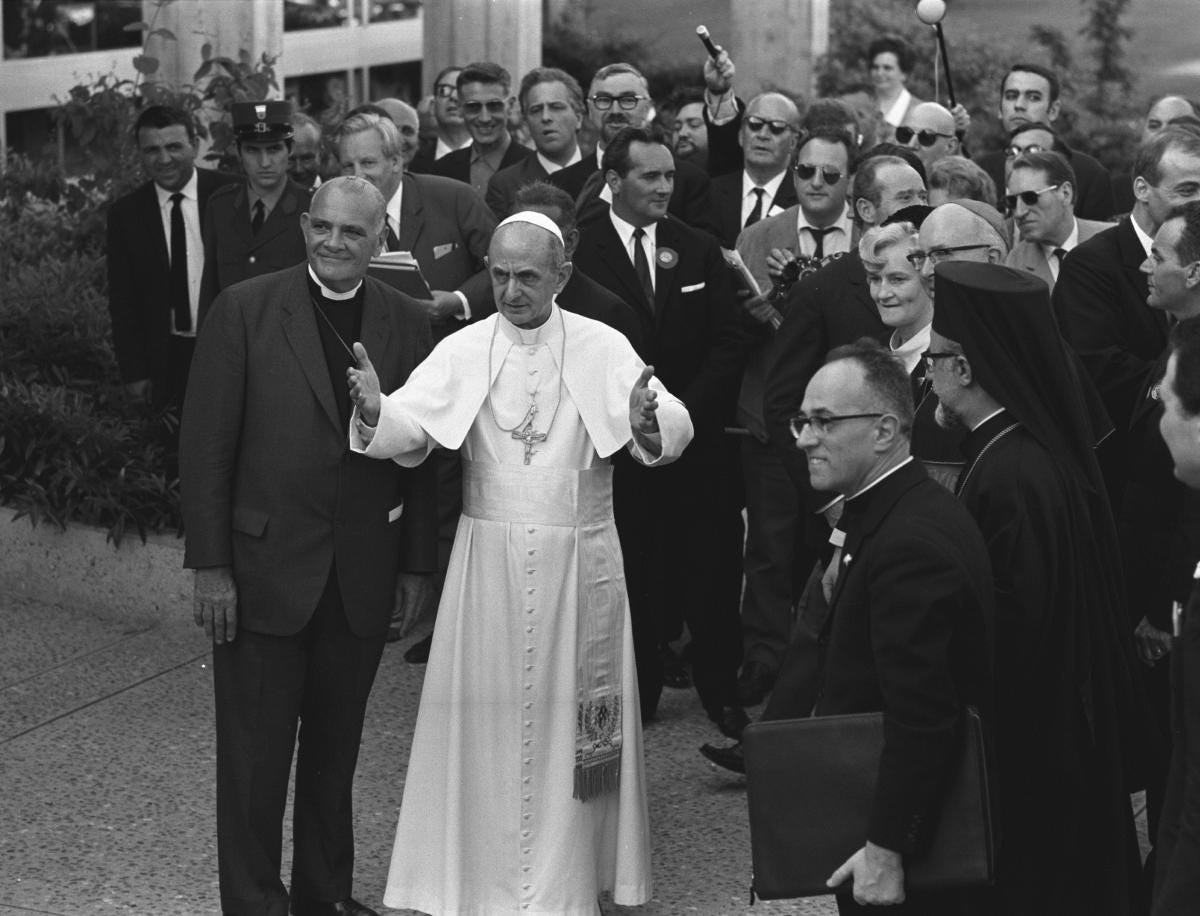
Understanding the Conflicted Soul of Paul VI
Professor’s Bookshelf #11: Chiron as the ideal historical guide
Many readers will have heard of the name of French historian Yves Chiron (b. 1960), who has written over fifty highly-acclaimed works, especially in the field of modern Church history. He has written full-length studies of (inter alia) Urban V, Pius IX, Pius X, Benedict XV, Pius XI, John XXIII, Paul VI, Annibale Bugnini, Dom Gérard Calvet, Padre Pio, Edmund Burke, and Charles Maurras. In recent years, thanks to the diligent efforts of Angelico Press and Angelus Press, Chiron has finally broken the language barrier, and now five of his important books are in English, all of which I strongly recommend:
Given the article published earlier this week by Fr. Thomas Crean OP, who drew our attention to the ways in which Divine Providence used Montini as an unlikely instrument for combating certain trends of modernism, I thought it would be both timely and valuable to share some favorite passages from Chiron’s biography of Paul VI. After all, in light of the SSPX episcopal consecrations this past week, we should bear in mind that the most violent clashes Archbishop Lefebvre had with any pope occurred precisely with Paul VI, even if the formal rupture did not come until later, under John Paul II. It behooves us to try to understand better the peculiar man who, on the one hand, stood up against modernist trends, and, on the other hand, pushed forward an internal revolution in rites and symbols the likes of which the Church had never seen in its entire history on earth.
As usual, I will indicate the page numbers after the relevant paragraphs. Occasionally, I cannot refrain from offering a bit of commentary, which I shall do in brackets. Of course, internal footnote numbers have been removed; those who wish to follow up the details must acquire the book, which is a very good idea in any case. Most of the photos in this post are taken from the book as well. —PAK
Recollection at Mass
[Irony: this is just the kind of quiet, devout soul that Paul VI would later mock in his November 1969 addresses, explaining how much the Novus Ordo would upset people. E.g., “We must prepare for this many-sided inconvenience. It is the kind of upset caused by every novelty that breaks in on our habits. We shall notice that pious persons are disturbed most, because they have their own respectable way of hearing Mass, and they will feel shaken out of their usual thoughts and obliged to follow those of others. Even priests may feel some annoyance in this respect.”]
He would also say that he had learned “recollection,” the spiritual practice of attending to the presence of God in the soul, from his mother. A devout believer, Third Order Franciscan, and member of several other pious congregations, as well as a daily Mass-goer (along with her husband), Giuditta Montini revealed to her son what the interior life could be. (6)
The aloof seminarian
His status remained ambivalent. Everyone among his friends knew that he was preparing for the priesthood, yet he still declined to take up the cassock; right up until a few months before his ordination, he continued to sign his published articles as “G. B. M., Student.” He lacked the strength to survive twenty hours of classes at the seminary every week, but somehow still had enough energy to participate actively in La Fionda and in the activities of the Manzoni Association, and also to give catechism lessons to future first communicants. Finally, part of his time was consecrated to his priestly formation—a very scattered formation. (18)
A precise study of the works contained in his library, which he must have read at this time or in the following years, enables us to describe his breadth of knowledge, both religious and profane, as highly eclectic and without anchor point: “varied and heterogenous readings, vast and disorderly.” (19)
Two months after these memorable days at Monte Cassino, he finally took up the ecclesiastical habit. It was November 21, 1919. Six months later he would be ordained a priest. During the interval, the reception of minor and major orders was accelerated. This haste was perhaps the bishop of Brescia’s favor to an important citizen’s son who could not follow the traditional formation at the seminary. But it is also possible that these sacred orders were conferred on him so rapidly because his health gave greater and greater cause for worry. (21)
[On February 28, 1920, Montini was ordained a subdeacon. He wrote movingly to his best friend Andrea Trebeschi about an experience of which he would later deprive all seminarians when he tried to abolish the subdiaconate:]
“Look at me finally and definitively fixed on the path toward divine election. I am henceforth a subdeacon, after the most fervent days of tranquil and strengthening meditation that I have ever known in my life. I taste the joy of this transformation, which separates me forevermore from the past and its human desires...” (22)
“I find myself well, but fairly isolated, not having been accustomed to living in a disciplined intellectual environment.” (24)
Fr Montini’s commentary reveals an intellectual and spiritual orientation he would maintain throughout his life, continuing through to the end of his pontificate. He invokes the novelty of the modern soul, and its “chaotic complexity.” For this modern soul, religion is no longer “the one necessary thing”; also, to make him rediscover the Gospel he needs “conversations more than discussions; a truth expressed more by artistic words than by perfect words; prayer more than logic.” (27)
[Astonishing how much he knew, and yet how little it profited him:]
An eminent liturgist, he [Schuster] published, in nine volumes, the Liber Sacramentorum (1923–1932), an extensive historical and liturgical commentary on the Roman Missal. Fr Montini would possess all nine volumes and read them attentively. (29)
He immersed himself keenly into this Benedictine environment he loved so much, savoring again, as he wrote to his family, “the magnificent, austere, melodious office.” (33)
Montini’s writings from the twenties and thirties bear witness to an interiorist conception of religion (“the prayer of the soul where one can meet God”), as well as an optimistic vision of the world in which the Christian life should be a “witness.” They also betray considerable interest in modern culture. Aside from the numerous biblical references, contemporary writers in literature, religion, and history are much more frequently cited than classical authors on these subjects. Msgr Montini believed that a new religious culture appeared during the twenties and thirties, so that a “work of intellectual apostolate” was possible, where questions might be considered in a new light. This new religious approach would rarely cause any open conflict with traditional Catholic culture, which would take no notice of it, or pass over it in silence. Msgr Montini wanted to promote what he would later call “a new humanism.” A humanism nourished by multiple sources: the Gospel, a new conception of the liturgy and prayer, and finally, contemporary Catholic culture. (43)
A major reason for Msgr Montini’s decision to live in this neighborhood was the proximity of the Benedictine Abbey of Sant’Anselmo: he would be able to attend the monastic offices frequently and to keep in regular contact with the religious there, who had been carrying out liturgical research for decades. This interest in liturgy, along with the idea that it could be renewed through a simplification tantamount to purification, and through greater participation by the faithful, only grew stronger in Msgr Montini. (45)
[Thanks to what he did later, most Catholics today wouldn’t even know what he was talking about, since they rarely or never hear the Improperia…:]
During Holy Week of 1930, he preached the Spiritual Exercises at Frascati. One of the participants has kept a “precise, localized and even acoustic memory of the pathos and the characteristic voice, incisive and almost strident, in which he discussed the Improperia of Good Friday and the parable of the Prodigal Son.” (50)
But he also stigmatized the “pilgrimages of the devout before cardboard statues” and asked that “the useless and unhealthy multiplicity of candelabras, palms, flowers, etc.” be removed from the altars. (56)
University chaplain
At the same time, another fact likely poisoned the situation. Msgr Montini wanted to publish a book of the religion lessons he had given to the students of FUCI over the years; some had already appeared in the review Studium. To be published, the book, La Via di Christo [The Way of Christ], had to pass scrutiny by the diocesan censor of Brescia, where Msgr Montini was still officially incardinated. The ecclesiastical censor of Brescia, Fr Ernestus Pisani, whose duty was to check that the doctrine being expounded was orthodox, apparently raised several objections. Msgr Montini likely had to justify himself in writing or orally. The nihil obstat was granted with great reluctance in April 1931. On August 9, when the work had finally appeared, Msgr Montini wrote to his family that it had cost him “more controversy to have it published than study to write it.” The reluctance manifest at Brescia regarding the moral teaching of Msgr Montini must have been known in Rome. (57)
Had Msgr Montini resigned in the interests of the student movement, or had his resignation been forced? Evidently a number of prelates and religious judged him to be suspect, and asked that he be removed from his position. The final decision lay with the pope. (58)
Emotional, fickle, and uncertain in his judgments
[Wladimir] D’Ormesson addressed a long report to the French Minister of Foreign Affairs at the conclusion of his mission. It featured a portrait of Msgr Montini, based on several months of frequent meetings; not all the details are flattering:
The pope holds him in such affection that Msgr Montini seems to have a halo. He is a bit of a choir boy or favorite child for the Holy Father, and this reputation, which he upholds with a pious authority, allows him special consideration. Emotional, fickle, and uncertain in his judgements, he is at the same time easy to like, very sincere, very open, and yet inscrutable. That he has been profoundly formed to the Secretariat of State’s ways is tangible. The balance between his natural temperament, which enables him to maintain some independence of spirit, and the nature of his duties, enables a sort of spontaneous equilibrium in him. And it is at the very moment when one believes one has discovered a friend that one finds oneself before an impenetrable bureaucrat.
This sketch would be incomplete if one did not add Msgr Montini’s indisputable fondness for France, his sense of justice (the current news causes him great sorrow) and his professed horror for the methods of the Nazis. But all that does not push him all the way to action. Speaking one day in front of me about the atrocities which the Germans were committing in Poland, he had this to say: “Is there no one to condemn these crimes?” The day when he becomes pope—for everyone agrees in predicting that Msgr Montini will one day be pope (which is obviously dangerous for him), he will ask himself, I fear, the same question, without realizing that he himself is the answer . . . (79)
The personal opinions of Msgr Montini at this time will not be found in these official texts, but in the statements of those with whom he met. All bear witness to a man “open” to innovative and audacious theological currents, with a simultaneously accommodating and prudent nature. During the post-war period he very soon became conspicuous as having a different sort of spirit at the heart of the Vatican. It has been noted: “Each ad limina visitor bearing a thorny dossier knows that it is better to begin the Roman tour with him rather than with someone else . . .” The office of the Substitute was also open to entreaties from condemned theologians, theologians who risked condemnation, ecumenists who wanted the Church to soften her positions, and also diplomats who sought to defend authors who were at risk of seeing their books put on the Index, or else had other favors to ask. (106)
[Interestingly, Montini seems not to have been a fan of the Bea psalter:]
Sometimes Msgr Montini intervened directly in situations, other times he knew merely to give advice, act as an intermediary, or else counsel prudence and recommend patience. An untranslatable play-on-words soon spread in well-informed ecclesiastical circles: “Why go to the mountain [Pius XII] when you can pass by Montini?” One of the first to take this route was Father Yves-Marie Congar. He had published with Fr Henri-Marie Féret, in the review La Maison-Dieu, a harsh critique of the new Latin translation of the psalter. Pius XII, who had this work done by a commission overseen by his confessor, Fr Augustin Bea, a German Jesuit, was upset at the two Dominicans’ criticisms. Fr Congar visited Msgr Montini for the first time on May 21, 1946, and learned that a memorandum in defense of the Psalter, undoubtedly written by members of the commission, was in circulation. The Substitute counseled him to respond. Frs Congar and Féret did so a few days later after obtaining a copy of the memo in question. (107)
Msgr Montini, in his conversations with diplomats and visitors, strove to minimize the weight of the encyclical [Humani Generis]. In a conversation a few weeks later with the philosopher Jean Guitton he explained: “The encyclical never speaks of errores . . . . It speaks only of opiniones. That indicates that the Holy See aims not at condemning errors, but at condemning modes of thought that could lead to errors, but in themselves remain respectable. . . . The French are wrong to interpret as condemnation what is merely a warning— an appeal to prudence, to gradualness, to maturation.” (114)
[On his friendship with Guitton:]
The work [Guitton’s La Vierge Marie] pleased Msgr Montini because of its strong insistence on the distinction between “faith” and “devotion”; also, it had been written in an ecumenical spirit (it was dedicated “to our Protestant, Anglican, and Orthodox brothers”). September 8, 1950 marked the birth of a great friendship between the two men. Msgr Montini had Jean Guitton promise two things: that each year, on September 8, he would come to visit him, and that he would always tell him the truth. Jean Guitton was faithful to these two promises, even after the man who had “saved him from the scourges of the Inquisition” became pope. (117-18)
Pius XII’s growing distrust
It is difficult to ascertain precisely why Pius XII never created Msgr Montini a cardinal, and ultimately sent him away from Rome. Yet some educated guesses can be made. Jean Guitton who, in the course of time, became a confidant of Msgr Montini’s, later acknowledged that a shadow hung over this situation. “There are things I know that are difficult to say. Certainly, it was dramatic. At some point, Pius XII began to distrust Montini. He understood that it was his duty to prevent Montini from becoming pope.” When this distrust began is hard to determine. Yet clearly there were some in Rome who wished for his removal from the Secretariat of State. From the end of 1948 onwards, there was a rumor that he was going to be removed from Rome and named to the then-vacant patriarchal see of Venice…. Incontestably Msgr Montini was increasingly out of step with the Vatican. (120-21)
Msgr Montini considered this promotion [to the archbishopric of Milan] to be a sanction. The pope was pushing him away from Rome; the fact caused him great pain. His nephew stated: “It was a drama for him in every sense of the word, particularly the emotional sense: at that time I saw him with tears in his eyes.” On November 1, the nomination was officially made. Le Monde, in commenting on the news, asserted that he would soon be named cardinal and that one could already inscribe him on the “short list” of the papabili. The prediction was half right. Pius XII created no more cardinals during his lifetime. He did so to avoid having to elevate Msgr Montini. (129)
On November 6, Msgr Montini gave a farewell discourse to members of the diplomatic corps accredited to the Holy See. He did not allow any pain or bitterness to show. But no one was fooled. Wladimir d’Ormesson bluntly informed his government: “He had exercised a power of ‘resistance,’ opposing with discreet tenacity, but not ineffectively, the power of the zealots.” The “reactionary” clan had obtained his transfer. (131)
Cardinal Archbishop of Milan
Having never been in charge of a parish himself, he was going to find himself at the helm of a diocese with more than nine hundred highly diverse parishes…. For the first time in his life as a priest [he is 58 years old at this moment!], in a pastoral duty entrusted solely to him, he had to make decisions on his own and have them applied by his collaborators. (132)
[Ah, that kind of prelate…:]
“When we approached him to kiss his ring, he quickly withdrew his hand,” remembered Fr Congar, Une vie pour la verite, 117. (136n26)
[Montini’s ideas as archbishop of Milan were the rough drafts of his ideas during and after Vatican II:]
A “general mobilization” of the Church was necessary to “repair the losses, defend the positions, recuperate lost members, and win new ones.” He therefore concluded that it was imperative to adapt Church institutions “to the spiritual needs of our era,” “reform” them, and “modernize” them. These terms of adaptation, reform, and modernization would become, in the following years, the marching orders of a large number of bishops. (137)
Archbishop Montini had asked preachers to favor “goodness” over “polemic”: “Let this preaching offend no one, satirize no one, attack no one; instead, let everyone be invited, informed, almost called and awaited.” (141)
The disillusionment was not long in coming. In Milan, after a brief eruption of fervor, the results of the Great Mission were profoundly disillusioning. The religious and moral situation of the city deteriorated. The archbishop complained of it bitterly. In 1960, when the meeting of an ecumenical council was announced, with the declared objective of realizing an aggiornamento (“bringing up to date”), did Archbishop Montini see another chance for the Church to go towards the world, with other methods than those which had failed during the Mission of Milan? (142)
John XXIII and Vatican II
On November 4, the coronation took place in Saint Peter’s Basilica. Beforehand, John XXIII wrote a letter to Archbishop Montini to announce that he would hold a consistory soon, and that he and Tardini would be the first cardinals named. The pope asked the archbishop of Milan to keep this secret until the official announcement. By this thoughtful courtesy, the new pope showed his desire promptly to repair what seemed in some eyes to be an injustice on the part of his predecessor. It was also a mark of special esteem, and the first in a series of favors demonstrating that John XXIII saw in Montini his successor. (144)
Over time, as the opening of the Council drew closer, the cardinal became more and more optimistic. In August 1960, during a course on “cultural aggiornamento” organized by the Catholic University of Milan, he declared:
This council, unlike many of those which have preceded it, is being called in a moment of peace and fervor in the life of the Church. It does not have to resolve worrying or distressing internal problems; instead, uniquely, it has been convened to continue internal progress. No heresies, schisms, or dramatic difficulties at the heart of the Church will assemble the bishops around the pope; instead they are meeting out of their desire to enjoy the Church’s own internal unity, their obligation to make the Church’s own vitality more effective, and the need for sanctification and internal growth. (151)
It was essential to adopt a new attitude towards the Communists, who had experienced “our severity, but not our charity.” (153)
Writing about the necessary “internal reform” of the Church, he announced: “She will take care to update herself in casting off, if necessary, this or that old royal cloak resting upon her sovereign shoulders to dress herself in the simpler clothes that modern taste demands.” (156)
This first thunderclap at the Council [i.e., the overthrowing of the lists of council commission members] was not an isolated intervention but the result of a coordinated action by a few. Paul VI himself would later admit to Jean Guitton that the intervention of Cardinal Liénart had been decided a few days before during the course of a restricted meeting of six or seven cardinals, of whom he was one…. John XXIII had put a small house adjoining Saint Peter’s Basilica at the disposal of the archbishop of Milan. This special favor allowed Cardinal Montini to see the pope discreetly, and also just as discreetly to receive visits within the Vatican from bishops, periti, and theologians. (162)
After these two extraordinary discourses, John XXIII announced an upheaval of the Council: a coordinating commission would be created to unite the other commissions and follow their work (it included Cardinals Suenens, Léger, Lercaro, Montini, and Döpfner), and more importantly, the seventy some schemas to be studied would be reduced to seventeen. (164)
According to his secretary, on his deathbed John XXIII announced the name of his successor: “My successor, in my opinion, will be Cardinal Montini. It is for him that the votes of the Sacred College should be cast.” (167)
Montini as Pope
Out of concern for his personal comfort and his fondness for modern art, which he shared with his faithful personal secretary, Fr Macchi, he [Paul VI] commissioned numerous works in the following months, calling mostly upon decorators and artists from Milan. In the apartments the heavy garnet-colored tapestries and the gilded furniture were replaced by light toned fabrics and furniture in a modern design. Green plants and works of contemporary art combined to give a less solemn touch to the high rooms. The papal chapel was also entirely renovated: the marble floor, a glass ceiling, stained-glass windows, the way of the cross, even the tabernacle; all was redone in a modern style that resolutely broke with the anterior style. (171-72)
He notably declared [in 1964]: “We must give the Church’s life a new mode of feeling, willing, acting; to have her rediscover a spiritual beauty under all its aspects, in the fields of thought and word, in prayer and the methods of education, in art and canonical legislation.” This announced renewal for the rediscovering of a “spiritual beauty,” which the Church was supposed to have lost in all aspects, was bold. Few paid any attention to it. (184)
On February 3, 1964, Msgr De Proença Sigaud gave the pope a document signed by five hundred and ten archbishops and bishops of seventy-eight countries, imploring him to acquiesce to a request made by the Virgin during the apparitions at Fatima: that the pope in union with the bishops of all the countries in the world should consecrate the world to the Immaculate Heart of Mary, especially Russia that she be converted. Paul VI refused this solemn consecration, but in order not to seem like he left this request unheeded, the following November 21, during the third session of the Council, he “entrusted the human race” to the Virgin Mary and give her the title of “Mother of the Church.” (186-87)
On his return to Rome, the pope discovered an atmosphere of doubt and uncertainty that had been generated by the last difficult days of the third session of the Council. Among even the cardinals, the divisions were great. The council texts then hanging in suspense, notably those on religious liberty and the Church in the modern world (with its numerous practical implications), had created factions which seemed impossible to reconcile.
The pope was greatly troubled. After Christmas, he asked his secretary Father Macchi, the man of confidential missions, to go to France to consult with Jean Guitton and Jacques Maritain in his name. Fr Macchi went to fetch Jean Guitton in Paris, and then they went together to Toulouse where Jacques Maritain had retired to a community of the Little Brothers of Jesus. It was on December 27. There they discussed the different questions which had divided the Council assembly. Jacques Maritain proposed to write memoranda for the pope on some of them. The following March, Maritain sent four texts to Paul VI, on subjects that at times go beyond the conciliar problems themselves: “On the notion of truth”; “Religious liberty”; “The apostolate of the laity”; and “Common prayer and private prayer: the vernacular language and sacred texts: studies.”
The first two only reinforced Paul VI’s determination to have the Council adopt a declaration on religious liberty. Maritain insisted on the right for each individual to think freely, even in religious matters, without the state being able to contradict him. “The state,” wrote the philosopher, “no longer has any right to intervene in matters of the conscience.” It was a legitimization of the separation of Church and state—a separation which Paul VI had always supported. The memorandum on the liturgy was more critical. But, on the whole, Maritain’s reflections were well received. Certain practical suggestions were implemented, such as the abandonment of Latin for the teaching of philosophy and theology in seminaries and Catholic universities. (198-99)
[Here is what Paul VI was saying in May 1965. How ironic! The liturgical reform in fact relaxes all of this:]
“Whoever sees in the Council a relaxation of the prior teachings of the Church, towards her faith, her tradition, her asceticism, her charity, her spirit of sacrifice, and her adhesion to the Word and the Cross of Christ, or worse still, an indulgent concession to the fragility and fluid, relativistic mentality of a world without principles and without any transcendent purpose—a sort of convenient, undemanding Christianity—will be making a serious mistake.” (203)
Maritain arrived in Rome a few days later, on the 11th, and would be a low-key guest of the pope’s in Castel Gandolfo. Did their discussions bear on the declaration on religious liberty which was going to be presented for a vote again in the following days? Did Maritain meet with other persons besides the pope, notably Cardinal Journet, his friend, who was preparing to make a bold declaration in favor of religious liberty? Surely yes. In any case Paul VI is known to have asked Maritain to prepare some “messages” to be read at the end of the Council. (206)
[Speaking of freeing Italians to vote for Communists:]
“We desire Italians to make their own way freely.” (208)
[In October 1965 (!!!):]
“Besides the crisis of faith in the world, there is not, happily, a crisis of the Church.” (216)
The liturgical reform in full swing
The liturgical reform that Vatican II called for, and its implementation during the pontificate of Paul VI, constitutes without a doubt the Council’s deepest change in the life of the Catholic Church. It is also the most obvious change, and it gave occasion to the greatest number of excesses and deviations. It most directly concerned all Catholics and affected everyone intimately, clergy as well as the faithful. It was the most controversial, and met with the strongest resistance.
Paul VI followed this liturgical reform step by step with scrupulous attention, because he had longed for this reform for decades. One of the artisans of this reform has said: “Nothing was decided, much less promulgated, without Paul VI being aware of it. He received the plans, which he annotated with his own hand, making his preferences clear and sometimes also his demands or refusals, so much so that sometimes real crises were created.” (217)
In October 1965, as we have seen, Paul VI still thought that the Church was not undergoing a crisis. In 1966 and 1967 he began to perceive things differently, although this did nothing to modify the general trends of his papal policy. (225)
[Anticipating Europe’s suicidal loss of courage to remain itself and to keep the Turks out, here’s what Paul VI did in 1967:]
To facilitate the diplomatic negotiations for his visit to the mostly Muslim country [of Turkey], where Catholics numbered only a few thousand, he returned to the Turkish government the battle standard which had been captured from the Turkish fleet after their defeat at the naval battle of Lepanto and which had been kept in Rome ever since. (231)
[Didn’t he see how complicit he himself was in this drifting??!!:]
These groups “do not escape from the influences of a world in profound mutation, in which so many certainties are contested or questioned. We see even Catholics allowing themselves to be taken in by a passion for change and novelty.” (241-42)
[Was he really so lacking in self-awareness, or any kind of awareness? Complete divorce between creed and cult—assuming we are to take him at his word:]
Paul VI corrected and denounced a phenomenon to be observed among people who call themselves religious and Christian, which is an anthropocentric religion, that is to say, a religion oriented towards man as the principal center of interest. But religion should be, by its very nature, theocentric, and oriented first of all towards God, its principal and its ultimate end, and towards man as a secondary concern, who is conceived, desired, and loved according to his divine origin and consequently according to the relation and duties which flow therefrom. (242)
The very conception of the Mass was altered as well: now it was defined as “the sacred synaxis, or the assembly of the people of God uniting under the presidency of the priest to celebrate the memorial of the Lord.” This definition recalled nothing of the traditional definition of the Mass as a renewal of the sacrifice of the Cross and allowed one to believe in a solely spiritual presence of Christ. Instead, it was closer to the Protestant doctrine of the Eucharist.
This Novus Ordo Missa would paradoxically win praise from various Protestants, while earning open or covert criticism from eminent members of the Catholic hierarchy. Max Thurian, of the Protestant community of Taizé, wrote some weeks after the publication of the new Ordo that it was “an example of a fruitful concern for open unity and dynamic fidelity, or true Catholicity: one of the fruits may be that non-Catholic communities could celebrate the Lord’s Supper with the same prayers as the Catholic Church. Theologically, it is possible.” (251)
[Paul VI was autocratic when he shouldn’t have been, and not autocratic when he should have been:]
All bishops had been consulted on the opportunity of authorizing the distribution of the consecrated host into the hands of the faithful. 1,233 pronounced an unfavorable opinion, 567 a favorable opinion, 315 a favorable opinion with reservations. The majority of the bishops of the world were therefore hostile to a modification of tradition on this point. The Congregation for Divine Worship, at the request of Paul VI, nevertheless published an instruction which maintained communion on the tongue while allowing communion in the hand in countries where the practice had already been established, as long as there was a vote of the episcopal conference and the formal approval of the Holy See. Out of concern not to hinder the liberty of episcopal conferences, and anxious to respect diverse opinions, Paul VI refused to establish a common law for the Church on this matter, even though he was personally hostile to communion in the hand. (253)
Ostpolitik’s casualties
[It may come as a surprise that Pope Francis was only continuing in his China policy the attitude first marked out by Paul VI: see p. 263.]
But the Holy See and Cardinal Mindszenty quickly fell into disagreement. When the primate asked to be able to name suffragan bishops to take care of the various Hungarian communities in exile, he was denied. In July 1973 the “Secretariat of the Catholic Committee for Peace” was created in Hungary to organize priests who were favorable to the regime, and to control the Church. The Holy See did not protest.
Meanwhile, Paul VI, who had received the manuscript of Cardinal Mindszenty’s memoirs and had read them, dissuaded him from publishing them. Then, on November 1, 1973, he asked the cardinal to renounce his archiepiscopal see. Cardinal Mindszenty refused. Had not the pope himself promised to allow him to keep his position? After another request by Paul and another refusal by the primate, on February 5, the decision of the pope to declare the archdiocese of Esztergom vacant and to nominate an apostolic administrator, Msgr Lékai, to replace the deposed archbishop, was made public.
The news sparked indignant commentaries in the press. The writer Giuseppe Prezzolini, despite his ties to the pope, declared that there was “something Machiavellian in the deposition of the cardinal: la raison d’Etat.” Graffiti on the walls in Rome near the Vatican read: “The pope betrayed Cardinal Mindszenty.” On February 6, the Primate of Hungry made a public declaration in which he made known that he had not resigned, but that the decision had been taken “unilaterally by the Holy See” and that “the leadership of the Hungarian dioceses is in the hands of an ecclesiastical administration put in place and controlled by the Communist regime.” (267-68)
The press office of the Holy See published a press release explaining that the decision had been made to allow the Church to secure her mission in Hungry. One year later, Paul VI named five new bishops in Hungary and, after the death of Cardinal Mindszenty, Msgr Lékai would be named archbishop of Esztergom and Primate of Hungary. (268)
This synod [in 1971] also gave Cardinal Slipyj an opportunity to recount how Catholic Ukrainians in the USSR were persecuted, and then to call “Vatican diplomacy” into question with respect to its prudence, its silence, and its politics of compromise. (271)
The clash with traditionalists
[So, this advice apparently doesn’t extend to the liturgical tradition?:]
“Fidelity” (to the pope and Vatican II) and “openness” (to distinguish themselves from “integralism” or “traditionalism”) were combined to affirm the rejection of the “current debacle” and, at an hour when “the essence of the faith is a stake,” the necessity for intellectuals “to exemplify that which had given life to the Church for two thousand years.” (272)
On October 27, 1972, Jean Madiran, editor of the journal Itineraires, addressed a letter to Paul VI beginning “Give us back the Scriptures, the catechism, and the Mass,” that is to say a faithful translation of the Bible, the teaching of the whole deposit of Faith, and the Traditional Mass. “We are more and more deprived of these,” wrote J. Madiran,
by a collegial, despotic, and impious bureaucracy which claims, rightly or wrongly, but which claims without contradiction that it is imposing itself in the name of Vatican II and Paul VI . . . . A party that you knew well when it played innocent and hid its plans, a party whose success has revealed it to be cruel and tyrannical, now diabolically dominates the Church’s administration. This currently dominating party is that of submission to the modern world, of collaboration with Communism, of immanent apostasy. It holds almost all the command posts and reigns over the lax through intimidation, over the weak through persecution. (274-75)
[Except that, for the liturgical reformers, these two things were not believed to be active in the historical unfolding of the liturgy—it was the great parenthesis:]
On May 9, he published an apostolic constitution on Christian joy, Gaudete in Domino. Once more, he demonstrated how much he placed his confidence in the Holy Spirit and Providence. (279)
In a speech before the cardinals on May 24 of that year [1976], speaking especially of Archbishop Lefebvre, Paul VI complained that:
They cast discredit on the authority of the Church in the name of a Tradition for which only material and verbal respect is shown; they separate the faithful from the bonds of obedience to the See of Peter as well as to their legitimate bishops; they refuse the authority of today in the name of that of yesterday.
In the same speech he called on the Catholic traditionalists to adhere to all the reforms initiated after Vatican II:
In the name of Tradition itself [!!!] we ask all of our sons and all the Catholic communities to celebrate, with dignity and fervor, the rites of the renovated liturgy. The adoption of the new Ordo Missa is certainly not left to the free decision of priests or the faithful . . . . We command, in the name of that same supreme authority which comes to us from Christ, the same prompt submission to all the other liturgical, disciplinary, pastoral reforms ripened these last years by the application of the conciliar decrees. (284-85)
Paul VI was outraged by the accusations brought against himself and the Council. He declared, “if there is later a schism, it is not I who will be responsible for it, but the insane and now morbid obstinacy of Archbishop Lefebvre, who is tearing apart and scandalizing the Church by his disobedience.” Paul VI had other harsh words for Archbishop Lefebvre: “He is a lost soldier…. He belongs in a psychiatric hospital…. He is the thorn of my papacy.” (286)
Even the theologian Hans Küng, who was opposed in every way to Archbishop Lefebvre, regretted the attitude of the pope. Soon after the pope’s death, he wrote, “I was always pleased about the fact that Pope Paul VI excommunicated neither Archbishop Lefebvre nor the Traditionalists. Everything hung in suspense. It left a door open to reconciliation. I regret however that the pope did not permit them to celebrate the Traditional Mass.” In the same article, Hans Küng wrote: “I am personally grateful to the pope for having protected me over the course of these years.” It was not until the next papacy that the rebel theologian would be sanctioned. (287)
Hans Küng attests also: “as far as I was concerned, he always refrained from disciplinary measures, and indeed prevented them.” (288)
As if to reassure himself, the pope had added: “I have fought the good fight. I have run the race. I have kept the Faith…. I have done what I could.” (294)
[Evidently, he thought so. But… was it true?]


