


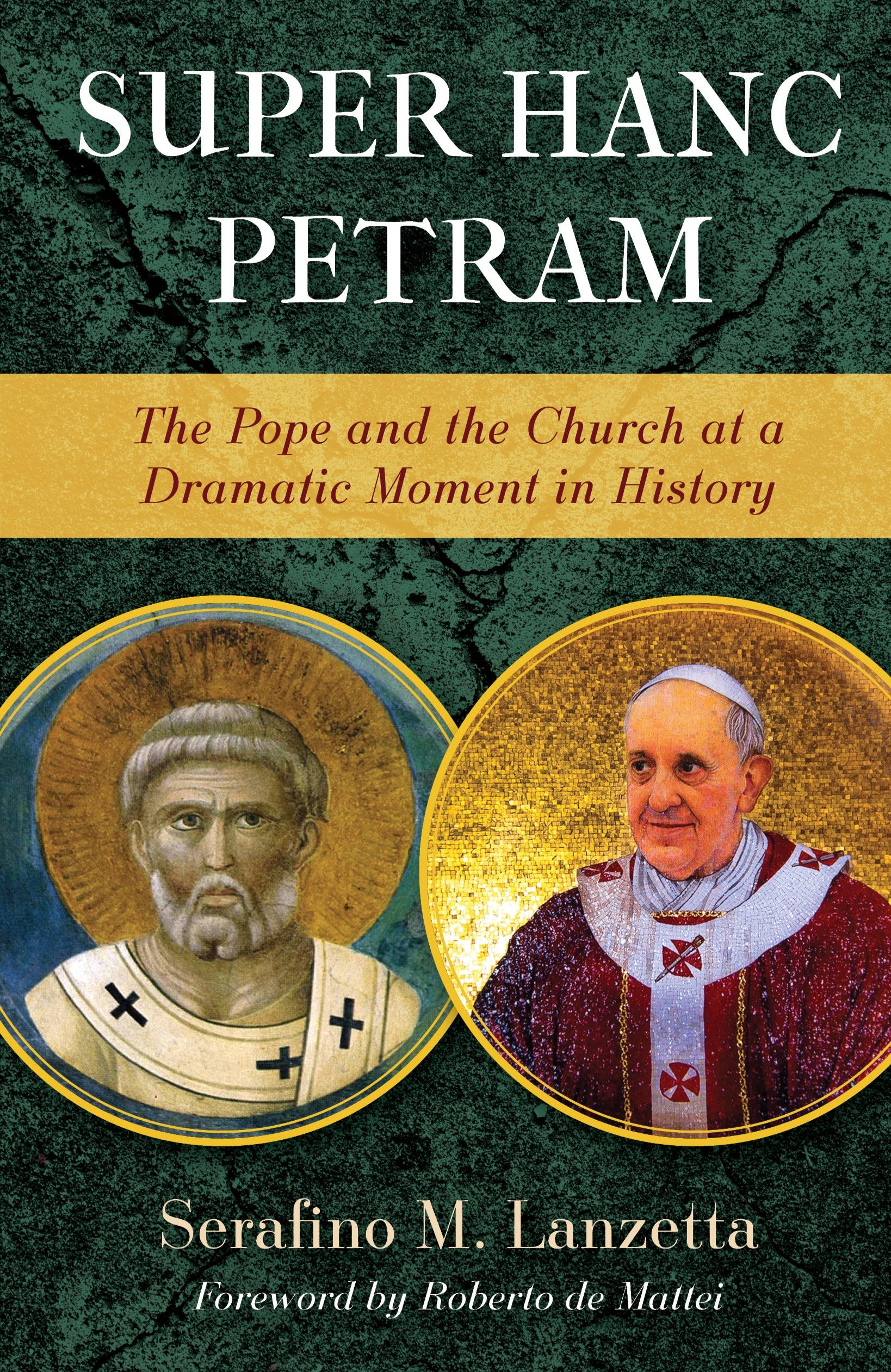
Every now and then, a book appears that ought to have a much wider impact and readership than it receives. As a writer who has worked with a dozen publishers and as the director of a publishing house, I am well acquainted with the variables and dynamics. Chance and luck play a much greater role than anyone on the outside might guess. A book’s cover or title might fail to gain attention or, on the contrary, might deflect it—for example, if there’s a Latin phrase, or the visage of Jorge Mario Bergoglio, either might “scare people away”—all the more, both!
I believe that Fr. Serafino Lanzetta’s study, Super Hanc Petram: The Pope and the Church at a Dramatic Moment in History, is a book of remarkable lucidity, charity, and theological profundity—and an example of a book that has not yet found the readership it deserves. One of the very strange effects of the fast-moving social media age in which we live is that Catholics are likely to consider the Francis pontificate to be “a thing of the past,” something not worthy thinking about or studying—as if the Church can simply “move on” and ignore the damage he has done, the doctrinal errors he has sown, the institutionalization of abuse for which he is responsible. On the contrary, Catholics need to have memories that store up decades, centuries, and millennia; we need intellects that range from eternity across time.
Bluntly said: we need to derive fruit from the Francis papacy by allowing its challenges to refine our understanding of the papacy and of genuine Catholic doctrine. That is what Lanzetta’s book accomplishes. The following excerpts will give you a good taste of it.
From the foreword by Roberto de Mattei:
The first and most important contribution this book offers is of an ecclesiological nature. Father Lanzetta seeks to define accurately the pope’s role and the institution of the papacy. He shows the danger of giving precedence to pastoral care over doctrine, to action over being, to the person of the pope over the institution of the Church. Original and interesting reflections are dedicated to the correct relationship between the pope and the Church. There is no Church without the pope, Father Lanzetta affirms, but neither is there the pope without the Church. The formula ubi Petrus, ibi Ecclesia must necessarily and ontologically correspond to ubi Ecclesia, ibi Petrus.
Peter is the rock of the Church; he is the one who in himself serves as the foundation for the building up of the Church; Peter’s faith is the presupposition of his constitution as a rock. “Faith is united to the person and therefore we could speak of Peter, the pope, as a believing person. Faith is the reason for his being a rock and the rock, which is his own person, is in turn based on faith in Christ and on the faith of the Church.” To put Peter’s personal faith before the faith of the Church is to slip into subjectivism and dogmatic relativism. Hence, there is a profound unity between the person of Peter and the faith of Peter. (viii)
The rest of the quotations are from Fr. Lanzetta.
We must understand in what way Peter is kepha—in name and in fact, by virtue of his faith in Christ—to be able to grasp if and under what conditions this rock might be allowed to crumble without the Church itself crumbling. We must reflect on this pair of realities, pope-Church, and show their profound unity in a hierarchical relationship. This relationship includes distinction, with not Peter, but Christ, at its center; Peter is dependent upon Christ and the Church. The love and honor due to the pope is indisputable, amplified to the utmost with the dogma of the Roman Pontiff’s infallibility. All this is certainly Catholic and must remain so.
But one cannot deny the risk of excess—of accentuating the role of the pontiff to such an extent that the Church, and thus the Faith, is seen as in some way dependent on him as an individual man. In reality, it is the pope who depends on the Church and on her faith, and not the opposite. His action should be circumscribed within the confines of the mystery-Church of which he is the foundation, within the confines of the Church’s doctrine of faith and morals. The Church in some way precedes the pope in her being constituted as ekklesia and as a salvific body on the foundation of the Twelve by virtue of the offering of the Body of Christ. The pope is the servant of this mystery, for he must preserve its unity and never propose a confused multiplicity of teachings, even if speciously justified in the name of pastoral action. (xiv)
The notion of integral ecology, which had man at its center, as the sole creature to be made in the image and likeness of the Creator, has now become the ecology of the Earth, of nature, while man is somehow criminalized, together with all modern technology, for having exploited “Mother Earth.” If the Earth takes the place of man, what will be the theological and moral standard of the social magisterium? The Earth without man portrayed in Laudato Si’ is man without Christ in Fratelli Tutti. (xvi)
It seems that while the figure of Pope Francis stands out on the world stage, the role of the pope and the divine institution of the papacy have been obscured. There is a noticeable rift between person and ministry. (2)
Important for the sedevacantism question:
There is a profound unity between the person of Peter and the faith of Peter. They are so united that they are no longer separable, unless a pope chooses to be unfaithful to his mission of being the rock, to renounce believing and thus to renounce confirming his brethren. It is Peter himself who, chosen by Christ, is founded on the immutable rock of the Faith and this rock is Christ alone. Christ founds the faith of Peter and therefore brings into being the person of the pope as the rock of the Church. In this manner Christ establishes the Church on a firm and unchanging foundation. Even if the faith of this or that pope were to fail, Peter’s faith would never do so, as it is always a divine gift of interior illumination.
When a pope renounces the exercise of his munus proper, which is confirming the brethren in the Faith, and even goes so far as teaching ambiguous doctrines verging on heresy, that does not immediately mean that that pope is not a true pope. Rather, we would need to ask how it is possible for the faith of a pope to fail. Although raised to the highest degree of dignity in the Church, with a grace proportionate to his state, he still remains Simon—someone who struggles to become Peter and lets himself be dazzled by various temptations, by the spirit of the age which from time to time proposes an easier way, a way that is not that of the Cross. Simon would prefer Jesus to refrain from going to Jerusalem to be crucified and to die, but is rebuked in no uncertain terms, because he had become like Satan, one who divides man from God (cf. Mt 16:21–23). Peter, on the other hand, once he repented, allows himself to be crucified like the Master. (20-21)
When Jesus declares Peter blessed for having correctly professed faith in His divinity, He also highlights the fact that that faith was not revealed to him by flesh or blood. In other words, it is not the fruit of his human ability, but revealed by the Father who is in heaven (cf. Mt 16:17). This supposes that there could be a pseudo-faith or an erroneous teaching stemming from the flesh and blood of Peter, that is, from that material and this-worldly man that Peter still remains.
This can be seen, for example, in Peter’s duplicitous behavior, when he ate with the pagans and then kept himself apart from them out of fear of the circumcised (cf. Gal 2:11–14). Paul had to correct him publicly. If he had not, this ambiguous pastoral behavior, based on a doctrinal ambiguity about the Torah’s role as it related to faith in Christ, which operates by means of charity, would have led to two Christian communities being created: one comprised of the pagans and the other, more orthodox, of converts from Judaism. Peter would thus have been the cause of scandal and schism in the Church. But Paul justly opposes him openly (cf. Gal 2:11).67 Rare are those in our day who, like Paul, have the courage and determination to do likewise in similar circumstances. (22-23)
Peter must believe with the whole Church; he must profess his faith correctly so that he can confirm others in that same faith. Faith is above the pope and is therefore the only thing capable of judging him. In one of his sermons, Innocent III expounded this very important doctrine: faith is so necessary to the pope that, while for all his sins God alone is his judge, for sins committed against the Faith, he can be judged by the Church. This principle can already be found in the Decretum Gratiani, where there is an assertion attributed to St. Boniface (bishop of Mainz and quoted by Ivo of Chartres), according to which the pope can err in the Faith, therefore he cannot be judged by anyone except when he deviates from the Faith.
Canon 1404 of the CIC, which reads “prima sedes a nemine judicatur” underlines the injudicability of the Roman Pontiff as supreme legislator. He who makes the law is not judged by the law. This is canon law, above which, nevertheless, there is the immutability of the Church’s faith as received and transmitted. The law is made in accordance with the faith of the Church and for the sake of protecting this faith. Just as the Code of Canon Law depends on divine Revelation, so the pope depends on the faith emanating from divine Revelation itself. It follows that the “Bishop of Rome who leads the first See as Successor of Peter is not above the Gospel or the Church. Nor can Peter’s Office be understood by analogy to an absolutist czar or dictator.” (30-31)
Faith therefore judges Peter, and the holy faith alone. In this sense, when the Church remains united as a believing body, the union of all the members with their Head in the one sensus fidei is superior to Peter and judges a Peter lost in the meanderings of human and worldly thought. The infallibility in credendo of the Church precedes the infallibility in docendo. In such a case, even the humblest baptized person who professes the Symbol of Faith would be authorized to rise up and correct the miscreant pope.
The view is currently fashionable that the pope’s infallibility (ex cathedra) would prevent the person of Peter from losing the Faith or from falling into doctrinal or moral errors. However, this is akin to saying that faith is the property of the pope or that it is the pope who makes the Faith. The Faith, instead, precedes Peter and only in this way infallibly establishes the Church. A pope who became a heretic in a formal way would contradict his Petrine ministry, but this would not mean that the Church would fail, since the gates of hell have no power against it.
Furthermore, the pope who became a heretic would not demonstrate that he is not a true pope, but only that he is a pope without the faith of the Church, one with a human faith in a heretical doctrine—just as Judas’s betrayal of his ministry does not mean that he was not a true apostle, or as Peter’s denial of the Lord at the culminating moment when he should have borne witness to Him does not mean he lost the munus to confirm his brethren. These lapses prove only that Judas and Peter, in different ways, were unfaithful to the grace of their ministry. (37-38)
The pope’s power does not absorb that of the bishops due to the fact that both the papacy and the episcopate are of divine institution. The pope is given neither the right nor the power to change the rights and duties of the episcopate. (39)
At the end of this chapter, we wish to summarize the main assumptions and the conclusions reached. Peter is the Rock of the Church, that is, the one who with his person, chosen by Christ, serves as the foundation for the building up of the Church. To be this and to remain a “rock” despite the waves and calamities to which Christ’s ship is subject, he must be subject to the Word of God; he must remain faithful to that faith which he professes insofar as he is illumined interiorly by the Holy Spirit. The faith is a gift of Christ to Peter, so that the latter, by believing, will confirm his brethren. Only by believing with the Church and with her uninterrupted traditio can he confirm his brethren. The faith precedes Peter, just as Christ precedes the Church. The Church, the believing Body, united to its divine Head by virtue of the Holy Spirit, always therefore precedes the person of Peter—and every other bishop who succeeds the Fisherman of Galilee—not only chronologically but also ontologically. For Peter to be a rock for the Church and not a stumbling block, it is therefore necessary that he be a persona credente. If the Faith is the reason for his being a rock, the rock, which is himself, must be founded in turn on faith in Christ and on the faith of the Church.
If Peter decides not to believe with that faith which he receives as a gift, he will not be able to confirm his brethren. Yet he will not, for that reason, lose his office. This is the greatest mystery to be reckoned with. A man could be pope because he was elected to fill this office, without actually being that for which he was chosen. Such a situation would surely provoke unprecedented doctrinal confusion, causing disruption due to the absence of a sure guide and the obfuscation of the office of unity to which Peter is called. It would be a sort of Holy Saturday of the absence of Christ, where, however, faith does not vacillate because it is all in the Heart of Mary, the Heart of the one who believes in an immaculate manner as the Church-Spouse and thus sustains the Church in her darkest moments. (41-42)
The problem is the silent apostasy in the Church, completely atypical because it is not the rejection of the Faith sic et simpliciter, a refusal to believe as such, but the transformation of the Faith into something else. We are faced with a liquid apostasy, which has its roots in the tried and tested attempt to separate the doctrinal aspect of Revelation from the pastoral one. (52)
This notion appears to be quite widespread today, and quite popular in the Church among prelates and theologians. What is newer is always better. It is not simply the pursuit of novelty that captivates, but rather the idea that in the new, in the present becoming, there is a better awareness. A new pope abrogates a previous papacy, abrogates a missal, establishes a new practice, inaugurates a new tradition, or rather a new way of understanding tradition. In other words, there is a continuity of becoming, rather than a continuity of being. Becoming precedes being and Heraclitus triumphs over Parmenides. (100)
It is undoubtedly commendable to hope that one day men will unite in common values, renounce selfishness and injustice, forego waging war, and abandon the lust for power which reduces God’s holy creation to a consumer wasteland. However, one cannot ignore the reality of original sin, which has deeply wounded man both in himself as well as in his relationship with God, and therefore, with the whole of creation. Yet there is no reference to original sin in the papal document [Fratelli Tutii], nor to the notion of salvation in Christ, who, by dying for us, reconciled us with the Father, and thus restored the conditions for reconciliation between all men.
The desire to create a new, fraternal, and reconciled world apart from God and His Son, Jesus Christ, is yet another false promise of the ancient serpent of Genesis: you will be like gods, you will choose—instead of God and without Him—what is good and what is evil. Your life is in your own hands. That promise, however, turned out to be empty and ruinous from the start. The man, Adam, who opted for this do-it-yourself approach, did not establish, along with his descendants, a closely knit and happily united human family. The egotism inherent in the sin of disobedience to God has inclined him instead to a universal, fundamental, and destructive selfishness. (108)
The vision of time starting from eternity is lacking in Francis’s encyclical, and this deficiency has the result of shrinking the discourse to the here and now, to the moment in which we are living. (110)
The formal object of an encyclical letter is therefore missing: God who reveals Himself and the faith that emanates from divine revelation, which distinguishes a pontifical encyclical from a mere missive, enabling it to be inscribed in the long line of an authentic and ordinary magisterium. (111)
The unity shattered by original sin and pride is re-formed in the Son, so that whoever possesses the Son, professing faith in Him, also possesses the Father, but whoever denies the Son and finds an alternative filiation-fraternity does not even possess the Father, has no God (cf. 1 Jn 2:23). (113)
The Good Samaritan, in reality, is Jesus Himself…. It is in Christ that the concept of “neighbor” acquires a universal connotation. This is the case, moreover, with the mystery of the Redemption: He died for all so that all might be redeemed from evil and sin and brought back to God. Thus, all those who live might no longer for themselves but for Him who for their sake died and was raised (cf. Eph 1:7; 2 Cor 5:15). There is no trace in the parable of the Good Samaritan of a merely human love, nor of an altruism with philanthropic traits; it contains the revelation of Christian love, of God’s love put into practice (cf. 1 Jn 4:7). “Love is of God” (ibid.) because “God is love” (1 Jn 4:8). There is no anonymous, neutral, religiously indifferent love. Neither is such a love present in the Gospel, nor in the world, nor in the life of Christians who live in the world, since, if Christ died for all, “all have died” with Him (2 Cor 5:14), that is, all are redeemed by His Blood poured out for many (Mt 26:28). (115-16)
Of the possibility that someone might be cast by the wayside of life due to sin against God, there is no hint. (117)
This [blessing of homosexuals] is truly something unheard of and unprecedented. Now the battle is being fought openly in the Church and not over an article of faith, such as, for example, at the time of Arianism, the theandric mystery of Christ, but over an even more basic issue, one which undergirds the Faith. Therefore, if this truth collapses, the edifice of Revelation inevitably collapses.
At stake is the question of man as created by God and mankind’s identity as male and female; marriage as a natural and supernatural covenant between man and woman, and therefore the Church as a spousal mystery. If the complementarity between man and woman falls, a fortiori the typological-spousal signification of Christ and the Church falls. If the mystery-Church falls, the sacraments are abolished, grace is annulled, and much more besides, with a devastating domino effect, the preliminaries of which are already in Amoris Lætitia. This is an extremely serious situation. Behind the apparent mercy in blessing all kinds of love, because after all “love is love,” is the anthropological lie of the man who wants to create himself, without God and against Him. It is resuscitated Eden, where the real teacher ex cathedra is the devil.
We are facing a revolution that lays hold of what is truly essential, natural, human. But like all revolutions that glory in the name, its cessation is never predictable. The one we face has gone even further. It does not stop at man. It next tries to replace human nature, created and redeemed man, with green nature, with trees and rivers. The anthropocentric turn of Gaudium et Spes, blessed by Paul VI, criticized during the Council by Karl Rahner but then promoted and developed explicitly by him in the postconciliar period, is now just a rainbow reminiscence of cravings and instincts blessed with lots of holy water.
At the center, however, is no longer man, certainly not Christ, but Mother Earth. Ecologism is the new soteriology, and climate change experts its prophets. Quite a few dioceses, for example, are now committed to becoming carbon neutral by 2030 in parishes and curial buildings. But whether people still go into these buildings seems not to be a matter of pastoral concern. Astonished, one wonders how it could have come to this. What went wrong at the philosophicaltheological level to make possible proposing the salvation of the planet, the condemnation of “green sin,” while opening the door to real sin and human misery? Christ is not there, but after all, His absence does not even seem that relevant to us. Christ has become a means to talk about something else. His name allows one to give oneself a name, Christian, in today’s multicultural and syncretistic Areopagus, yet God seems to be just a name, one that comfortably brings together the most diverse religions. He Himself doesn’t matter much anymore. (165-66)
Ultimately, we seem to be trapped in a self-aggrandizing labyrinthine circle, where conciliar is synonymous with synodal, synodal synonymous with Church, and Church synonymous with the Second Vatican Council. (168)

Mamma mia, it's like Father said to me last night, it is like giving communion to a dead person,
What a week,
I have hope. Why? Because eventually the bread will run out, and I like what an SSPX priest preached; he said it's our job to live a life of grace so others can do so,
So when the time comes, and they are all out of bread, we will welcome them.
But until then, I will keep living a life of grace.
This was really helpful!
Thank you!