
What Should We Do When Faced with Two Religions?
Advice from a priest to red-pilled discerners, seminarians, and clergy
In my book Once and Future Roman Rite, I speak about the sense in which we can legitimately speak of “two religions” competing for terrain in the Catholic Church on earth. Thus, I note that
modern Catholic apologetics…fixates on doctrinal propositions but neglects their predoctrinal foundations, liturgical context, and doxological purpose. One might say that apologists try to have the lex credendi independently of the lex orandi. A Catholic apologist may have the entire Summa memorized, but if he is not praying in continuity with the way Saint Thomas did, he is very likely not to believe and live the same religion Saint Thomas believed and lived.
To make the observation more concrete:
The new rite carried over only 13 percent of the orations [i.e., collects, secrets, and postcommunions] of the old missal unaltered, while discarding or heavily editing the remainder, or taking up older prayers and rewriting them to make them palatable to a modern mentality. When I first learned about this, I nearly fell off my chair. Inasmuch as the Mass is the most perfect expression of our holy Faith and its truths, this comparison of texts brought home to me how different is the religion expressed in and presented by the new Mass from the religion expressed in and presented by the old Mass. They overlap to some degree, but they are not the same. The lex orandi is the lex credendi, so if you make enough changes to the one, you will inevitably change the other.
In a note, I furnished a definition of the term:
“Religion” here is being used in the older scholastic sense, according to which it names a virtue—indeed, the highest moral virtue by which we give honor to God through external words, actions, and signs.
Later, I develop a thought experiment to illustrate the point:
Would a Byzantine Christian think he had worshiped God properly if he were thrust into a liturgy that contained less than 10 percent of one of the transmitted forms of the Divine Liturgy? Impossible!
Let us run with this thought experiment for a moment. Imagine the Divine Liturgy of Saint John Chrysostom as our starting point. Now, take away most of the litanies; substitute a newly-composed anaphora (with only the words of consecration remaining the same); change the troparia, kontakia, prokeimena, and readings; greatly reduce the priestly prayers, incensations, and signs of reverence; and while we’re at it, hand cup and spoon to the laity, so they can tuck in like grown-ups. [By the way, I recently published at NLM two satirical posts that presented, in detail, such a “reform” of the Divine Liturgy of St. John Chrysostom: see here and here.]
Would anyone in his right mind say that this is still the Byzantine Divine Liturgy in any meaningful sense of the term? Sure, it might be “valid,” but it would be a different rite, a different liturgy. Just for good measure, let’s say we also remove the iconostasis, turn the priest around, take away some of his vestments and substitute ugly ones, and replace all the common tones of the ordinary chants with new melodies reminiscent of Broadway show tunes and anti-Vietnam folk songs. Now we’d have not only a different rite but a totally different experience. It is not the same phenomenon; it is not the same idea (in Newman’s sense of the word “idea”); it is not the expression of the same worldview; indeed, it is not the same religion, if we take the word in the strict meaning of the virtue by which we give honor to God through external words, actions, and signs.
Speaking in summary:
So many and such great novelties have all the appearances of a new religion, and a new religion could only be a false religion.
With all that as preface, I now share (with his permission) a text that was written by a priest in the midst of a crisis he was experiencing, where it had dawned on him more and more that the liturgy he was expected to use as a priest in the modern Church was, in significant ways, the liturgy of a different religion than the one Catholics traditionally professed, and that he was at a crossroads where he had to decide whether he could go on or not. He finally decided to leave his diocese and affiliate with a traditional community that offers exclusively the traditional Roman Rite.
While I might express certain ideas differently, I think his way of writing about his situation has the merit of candor, forcefulness, and insight, and for that reason, I share it with my readers here—especially men who are discerning vocations or who, having made a choice, are now suffering from the multitude of cognitive dissonances that modern Catholic life thrusts upon them.
The more I go forward, the more I see the challenges of reconciling tradition (which I prefer to call authentic Catholicism) and the new paradigm (novus ordoism). When you are actually on the ground level in community life and in pastoral ministry, you see very clearly, very tangibly, on a daily basis, that they are like two different religions.
The former conceives of the Catholic faith as the light set on a lamp stand, like the burning bush of God’s presence attracting all men of good will to its divine Light; and the latter sees the Catholic faith as the street lamp, used to illuminate man (reading Paul VI and John Paul II, you have to read endlessly about the greatness of man, ad nauseam) as he works to build the modern edifice. The former sees itself as the ark of salvation, without which men will fall into the eternal abyss of hell; the latter as one means among many for helping people to feel better and be nicer.


I just switched over to Pelican, so please cancel here.
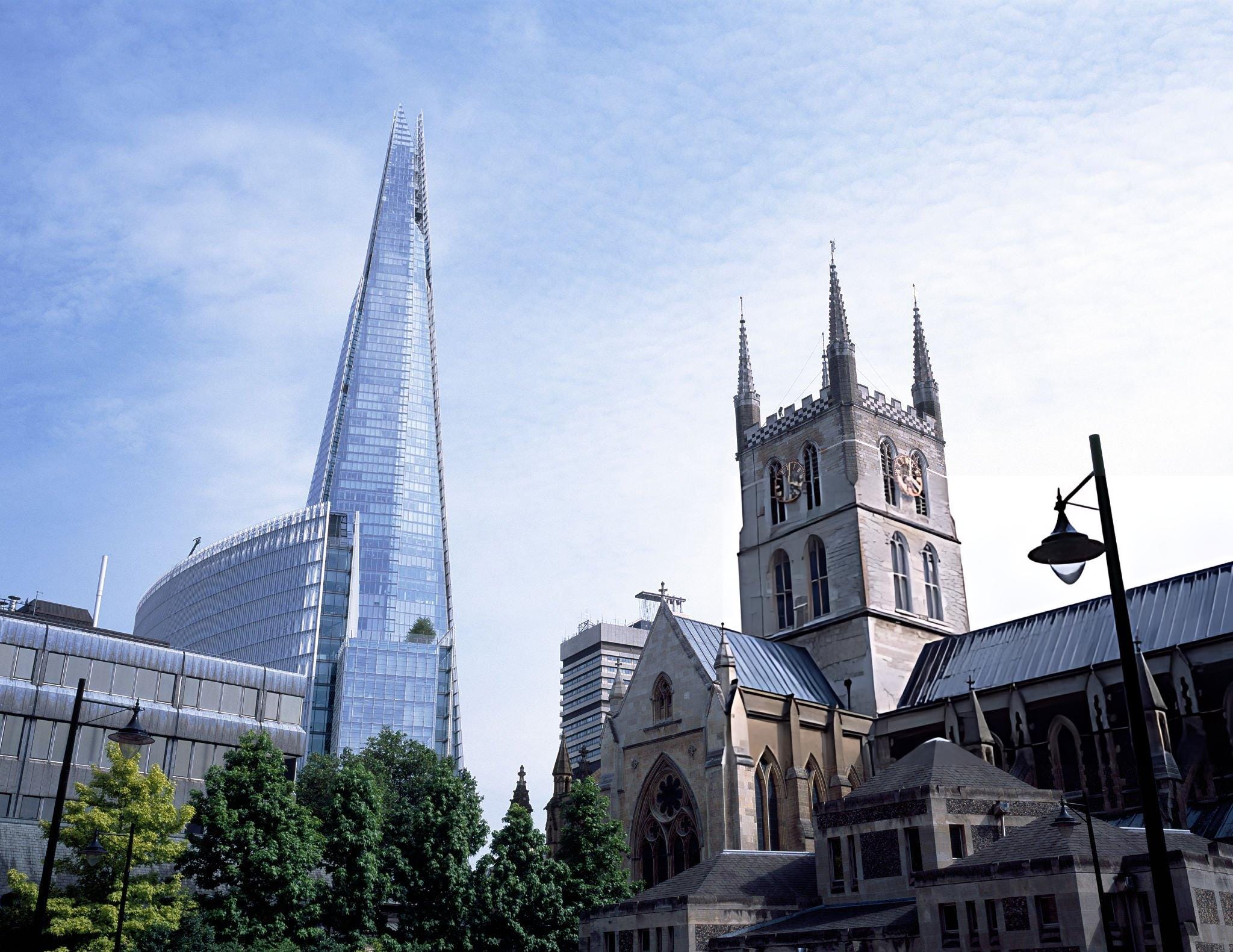
Ironic to see Southwark Cathedral (Church of England, although, of course, the building itself stolen by Henry VIII) in the image at the top of the post! Many of the glorious Tyburn martyrs were dragged past this building -- "as bridegrooms to their weddings" -- on their way to die.