


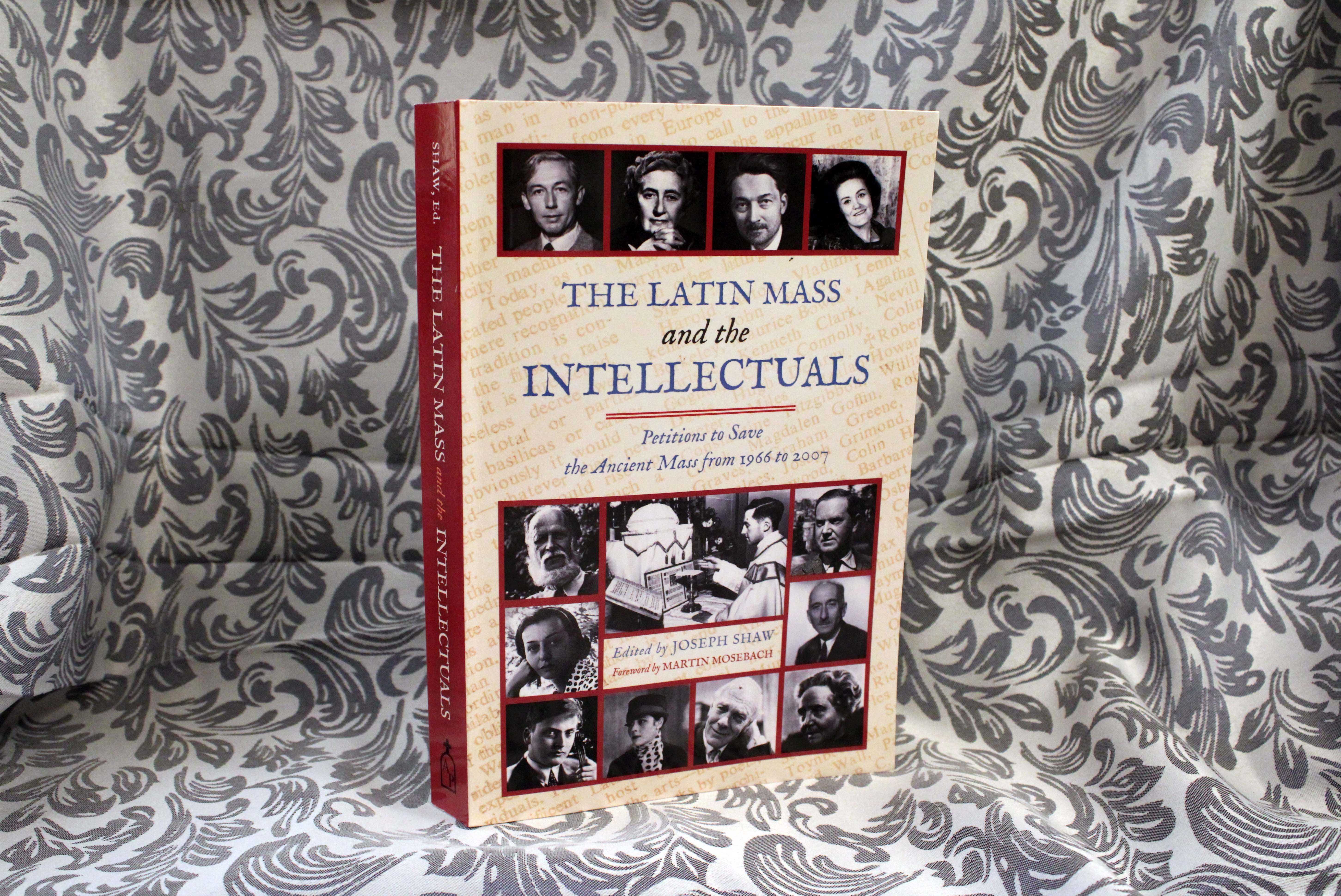
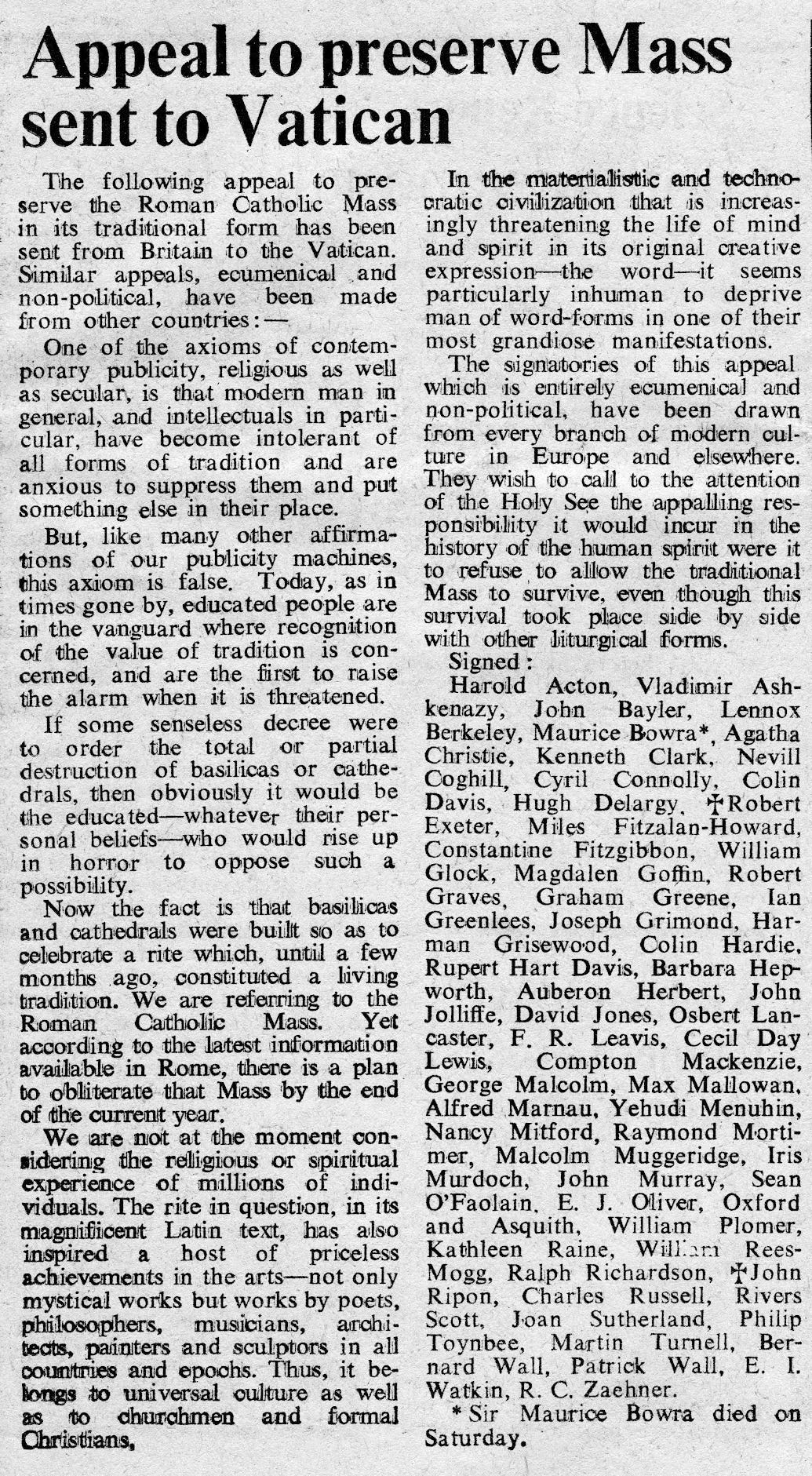
The Latin Mass and the Intellectuals—an anthology edited by the formidable Dr. Joseph Shaw of the Latin Mass Society of England and Wales, and published by Arouca Press—is among the most fascinating books I’ve ever read. It offers a close-up view of why, not to put too fine a point on it, most of the world’s greatest thinkers, poets, artists, both Catholic and non-Catholic, were all vehemently opposed to reformatory schemes that would drastically alter the most historic of Christian liturgies, the Roman Rite, after the Second Vatican Council.
Some today might be tempted to write off such protesters as aesthetes or dreamy philosophers, but the reality is, they were keenly perceptive men and women, highly sensitive to the movements of culture and the human spirit, who thought about things in a broader context and over a wider field of historical awareness than the somewhat small-minded liturgical functionaries of the Consilium tended to do or were even capable of doing. Add to this that many prominent cultural figures at the time were converts who had studied their way into the Church and had become convinced of the claims she had made for centuries about an immutable faith transmitted with stable symbols in a rite that breathes antiquity and mystery.
Some anthologies are very uneven in the quality of their entries. This book is quite different: as diverse and eclectic as it is, nearly every chapter makes a strong showing, and several are so brilliant that they should be required reading across the board for all traditionalists. I think the samples below will speak for themselves, but let me draw particular attention to the following chapters by Joseph Shaw:
“Pius V and the Tridentine Missal,” which blows out of the water once and for all the numerous myths that surround that pope and missal (hint: he didn’t create a new missal for his times, nor did he impose it on everyone);
“The Crisis of the 1960s”
“Marnau, England, and Cardinal Heenan” (an in-depth history of how the “Agatha Christie indult” came about)
“Laity and Converts”
“Artists: Aestheticism, Development, and Ritual”
“Medievalism, from Ruskin to Tolkien”
“Modernists Against Modernity”—here, the modernists in question are the artistic ones, not the theological ones
The Perennial Philosophy, Raine, and Zolla
Against “Fascist Culture”
Without further delay, some scintillating excerpts. Much of the value of this book lies in its copious quotations from cultural and intellectual figures of the 1960s and ’70s whose precisely correct protests should not be forgotten, but should be incorporated into our own understanding and defense of the traditional rite. —PAK
From Martin Mosebach’s Foreword
The great gain of defending what had hitherto been the most venerable, which has now become something objectionable, is a deepening of knowledge about the liturgy, which often enough renders its enemies speechless. Not a single argument for “reform” can stand up to this knowledge. The claim to have returned to a greater purity of early Christianity has been refuted by historians and archaeologists; the claim to have led the congregations to a more mature participation in the Mysteries has been cruelly exposed as a misreading of reality by the exodus of the faithful from the Church, which began abruptly in the West with the implementation of the “reform.” Pastoral reform has led to a widespread ignorance of the doctrine of the sacraments among the faithful. Reverence and the sense of holiness have largely disappeared from the remaining churches. (xi-xii)
The “manufactured liturgy,” which the Church has put in the place of the “evolved liturgy,” to use a distinction suggested by Pope Benedict XVI, cannot be described as a “cultural fact”: no outstanding masterpiece of literature will be inspired by it. Where it has created something new, musically and architecturally these products have sunk into kitsch and sectarian aesthetics: useless material for art of real value. Liturgical aggiornamento has catapulted the Church out of the society it so assiduously wanted to serve.
One could take the position that it is perfectly justifiable for the Church to turn away from the fashionable and notoriously unreliable intellectuals, the “great and the good,” if the connection with these milieus hinders its mission and obscures its message. But here we come to the real catastrophe of this deluded demolition work. Closely linked to the traditional liturgy were the manifold expressions of popular piety, which were thrown overboard and ridiculed at the same time as the vetus ordo. The reality is that the postconciliar Church has not only abandoned the intellectual, but has also lost its attraction for the poor, the uneducated, the lower classes, the proletariat, those who cannot express their desires and needs, but who felt a presence of the “beyond the here and now” (Heimito von Doderer) in the traditional liturgy.
This was characteristic of the traditional rite: over the centuries it has been directed with the greatest success at the most highly educated and, at the same time, at the illiterate. By contrast, the new one repels the former and cannot retain the latter. (xiii)
To dare, at such a historical moment [viz., the time of Vatican II], when culture is in a state of disintegration, to tamper with, of all things, an evolved liturgy that was generally accepted as a matter of course and had become a cultural staple, was an undertaking that testifies to the fact that the Council Fathers who undertook it were bereft of any historical and political sense— not to mention being abandoned by all benevolent spirits. In this situation, which of course should have been recognized, there was only one thing to do: to preserve and protect everything that still existed after the appalling multiple revolutions and, in any case, not to lay hands on it…. The only way to stand firm in this turmoil is to raise the inviolability of the liturgy to an axiom beyond all discussion and to consistently refuse to enter into dialogue with the spirit of the age, which has lost all notion of holiness. (xiv–xv)
Latin versus vernacular: two worldviews
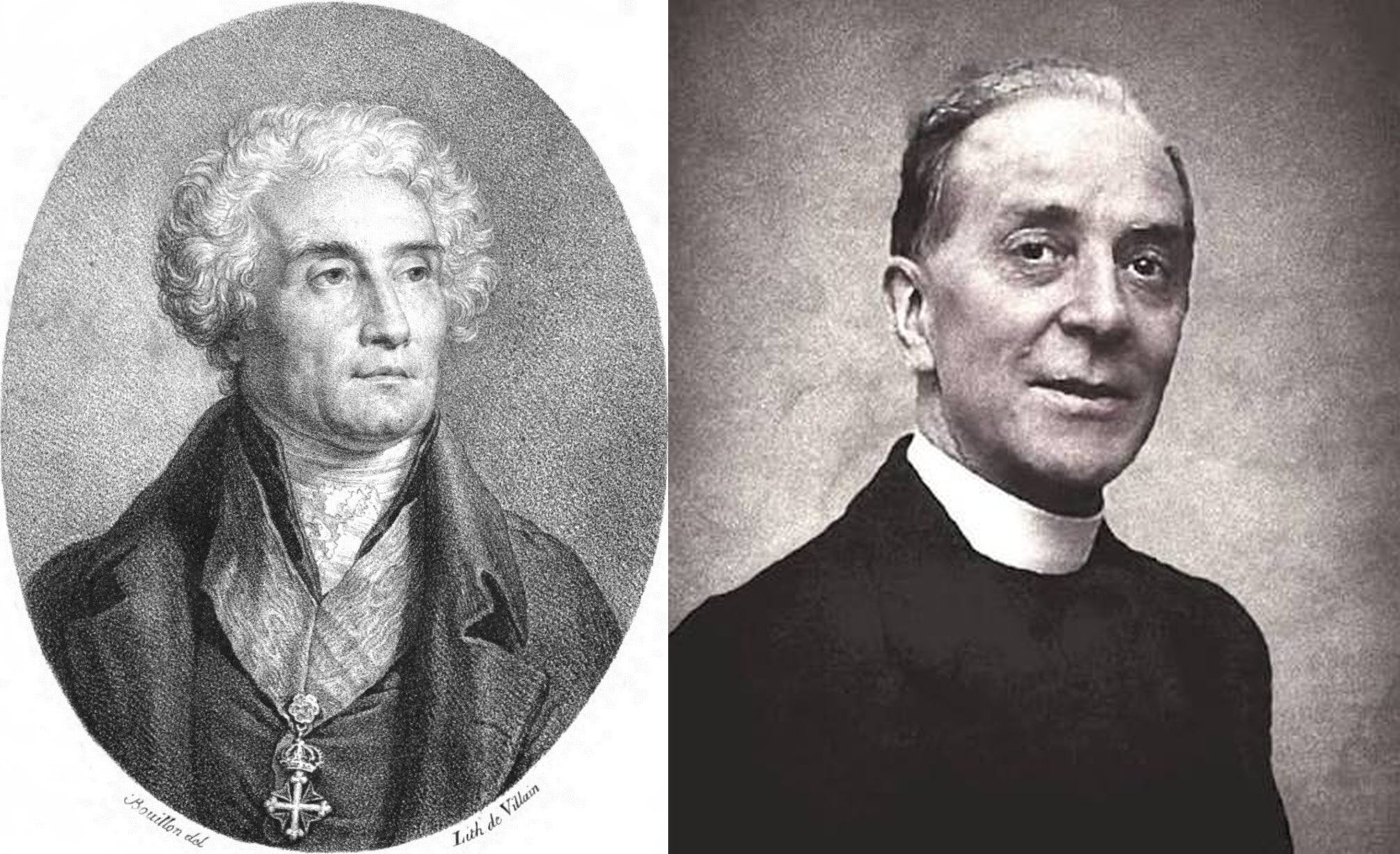
The following excerpts are from Sebastian Morello’s chapter on Joseph de Maistre, in which he explains an influential method of arguing for Latin that was quite widely accepted prior to the Council.
In Maistre’s view, the notion that language possessed within it the means for participation in the community, and was the medium for the community to be bound together, was true no less for the ecclesiastical community, namely the Church. The Church, a sacred community, while assuming into itself many nations, with their many vernaculars, simultaneously transcended all nations, since it did not have its origin in this world but came into the world from without (cf. John 18:36).
The Church needed, according to Maistre, a language by which it might express its law and its doctrine, and offer its liturgy, safeguarding eternal things while leaving intact the vernaculars of the nations it had come to sanctify. Given that the Church’s sacred language possessed within itself a treasury of accumulated wisdom that was necessary to conserve its sacred mission, vanquishing the Church’s sacred language would be, according to Maistre, an inherently revolutionary act. (19–20)
The first step to nationalizing the Church (a move that he deems to be an aspect of the temporal sphere’s revolution against the spiritual sphere, which is what he believes to be at the heart of all revolution) is the vernacularization of the Church’s liturgical life. (24)
He holds that the universal constitution which he believes is the Church, mandated to become embodied in all temporal constitutions and assimilate them into itself, must possess a universal tongue with which to convey itself to all nations while leaving intact their vernaculars, which are themselves treasuries of accumulated natural wisdom…. Maistre believes that were the Church to abandon its sacred language it would simultaneously thwart its mission to make disciples of all nations, becoming a mere private association within them, understanding itself only with the language of the land. (24)
Maistre believes that the Church has a mission to expand Europe, which he identifies with that union of spiritual and temporal powers, which to him is Christendom. This expansion, according to Maistre, is the only way to prevent the ongoing attempts by nations to violently subjugate one another. For him, the overcoming of humankind’s innate volatility is not an achievement of natural virtue, but a consequence of transformation by supernatural grace. Violence between nations—nations which, for him, should relate to one another as neighboring families—is the unavoidable consequence of the nations’ fragmentation away from a Christian social order, that is, an order within which the means of grace are politically established. By this fragmentation, the nations unlearn their unique respective missions in the providential meaning of history.
If the Church is to accomplish its pacifying “ministry” of expanding Europe, extending Christian civilization to every part of the world, it must not forget the supernatural reason for its existence. According to Maistre, the Church’s self-knowledge and its ability to unite the world in “European fraternity” will be hugely weakened if it loses its sacred language. As he puts it, “the brotherhood resulting from a common language is a mysterious bond, the strength of which is immense.”
In the Maistrean analysis, the new mission of the pope, in the new revolutionary age born out of 1789, is inseparably linked to his liturgical language. By opting for the vernaculars of those nations which it ought to reunite in “European fraternity,” the Church would implicitly declare that it is not a divine society coming from without, but a natural society arising from within their political jurisdictions, like any club or private association, and may be regulated as such. (25)
The Church, by this vernacularization, would instruct the nations that it does not come for their union and redemption, but is derived from them, possessing no such divine and universal power. Ultimately, with the loss of Latin, the Church would proclaim its satisfaction with the Revolutionary settlement of subordinating the spiritual to the temporal power. In such a settlement, the temporal power would be so detached from the life of the Church as to become the “secular State,” which Maistre identifies with the unredeemed, fallen world—that is, with the principality of Satan (John 14:30). The Church, by losing its language, would tacitly absolve itself of the duty to evangelize, concurrently conveying its willingness to accommodate—and subordinate itself to—the demonic order. Thus, for Maistre, the Roman Church’s mission and language are conserved together, or they disappear together. (25-26)
Evangelization is a broader project of “baptizing” civil society, culture, and the political order…. . In the face of the rationalist assumption that evangelization takes place when all is understood, formulated, explicitly comprehended, and vernacularized, Maistre sees evangelization arising out of habit, devotion, pious feeling, sacral culture, mystery, and awe. (27)
The preservation of Latin, according to Maistre, will not only help to safeguard the Church from giving up its mission and accommodating a Revolutionary settlement, but may also prevent the Revolution from entering the Church’s hierarchy. If the priestly order were to adopt revolutionary ideas, Maistre believes this would be by way of an Ecumenical Council, uniting all the bishops of the Church. “If ever a general council of the Church could appear,” writes Maistre, “it would be determined according to the prevailing ideas of the age.” At the beginning of Du Pape, he states his concern that revolutionary ideas may make their way into the Church’s teaching and practice due to a misplaced romanticism which aims to “recall us to the first ages” of the Church.
Maistre saw that revolutionary egalitarianism, conjoined with enthusiasm for sundering the spiritual and temporal powers, could spread under the guise of a false ecclesiastical renewal centered on rediscovering the spirituality of the early Christians— or rather, a highly romantic conception of what comprised that spirituality. Burke appears to have seen this theme developing before Maistre. He remarks on the convenience of linking revolutionary aspirations with early-Church romanticism for the purpose of encouraging the Christian faithful to return to the catacombs, so to speak, under the guise of an ecclesiastical purification. He replies to them thus: “We shall believe those reformers to be honest enthusiasts, not as now we think them, cheats and deceivers, when we see them throwing their own goods into common, and submitting their own persons to the austere discipline of the early church.”
Maistre worried that an Ecumenical Council, by the promotion of this early-Church-centered romanticism, would bring the Revolution into the Church, thereby corrupting its teaching and liturgy. According to Maistre, if the Church is to be renewed, this will not be by wiping the slate clean in an attempt to recapture the life of the early Church, but by a new commitment to its ongoing tradition and by the moral reform of the Church’s members. He therefore argues that an ever-growing “archaeological” view of the Church must be abandoned and replaced with that of the Church as a living and eternal corporate person who “never grows old.” Due to his concerns about the possible seeping of the Revolution into the Church’s clerical hierarchy, Maistre believes that the Church must hold fast to Latin, the abandonment of which would mean losing an important medium by which the Church accesses its own tradition. According to Maistre, the Church alone can stop the cycle of perpetual revolution into which the French Revolution has thrust the world: the priestly hierarchy must sanctify and lead the laity in a counterrevolution. (27-28)
The conservative settlement for which he argues, namely that of the union of spiritual and temporal powers in a combative posture of tension, that is, checking and tempering one another to maximize accountability, is advanced to thwart both political and ecclesiastical abuses of power, thereby curtailing the generation of violence. (29-30)
Golden words from Fr. Bryan Houghton
The one Person who obstinately refuses to participate in an audible, vernacular, Mass is God; on His side, He continues to utter no more than the Word made flesh. Anyway, if participation with God is in any sense contingent on an audible, vernacular, liturgy, then everywhere and for over a thousand years the Church has encouraged and taught an inadequate system of attendance at the Sacred Mysteries. If that is so, in what can the Church be trusted, since she cannot be in what is her primary concern: religion itself, the participation of man with God? If it cannot be God, then is the other party to the participation the priest and one’s fellow worshippers? At first sight it looks as though it is. Canon J. B. O’Connell in the Redemptorist Pamphlets writes: “It is almost incredible to think that for a thousand years the vital link between the worshipping people in the benches and the ministers at the altar had been cut.” (53)
The dialogued Latin Mass was absolutely inadequate for this purpose. It merely multiplied the servers from two to two hundred, perhaps; but mere servers they remained, uninvolved, uncommitted, impersonal, anonymous, by the mere force of the hieratic tongue. In their own tongue, however, they speak meaningfully. No longer are they servers but persons, not slaves but free men, the People of God…. The Latinist looks for selfeffacement, anonymity, in the Mass; the vernacularist for self-commitment, inanonymity. They are irreconcilable. (54)
Latinist and vernacularist are not being stubborn about some superficial matter of pastoral practice. The whole basis of prayer, of the Church in actu, is at stake. (64)
Vindicating rebellion
Shaw:
In this context, the reform of the liturgy, at first tentative, and then all-encompassing, had two effects. First, it appeared to vindicate the forces of rebellion, as it suggested that there had been something radically amiss in the liturgy up to that point. Secondly, it served to undermine still more the already weakening sense of community within the Church. The second point is the thesis of Stephen Bullivant: the Catholic Church weathered the social, cultural, and economic storm of the 1960s and 1970s less well than comparable religious groups because her distinctive ancient liturgy had been a key plank of Catholic identity, and at a crucial moment, when other planks were under stress or giving way, this one was abruptly removed. (70)
It is certainly an historical irony that the most sweeping act of papal power in the Church’s history, an act which would have been inconceivable in any century before the twentieth— viz., the liturgical reform— facilitated the greatest rebellion against papal authority in the modern era: the rebellion against Humanae Vitae. (73)
Christopher Sykes in 1966:
What will new generations say of the men of the present time who seek to destroy their inheritance? Suppose men and women of the future get hold of old Missals and Holy Week books? What will they think of the men who threw them away? (84–85)
Alfred Marnau in 1999:
It was the introduction of the new rite of Mass in the early 1970s, and the instruction that the old had to be discontinued, that concentrated our minds wonderfully and gave us a focal point on which to mount a specific course of action. It was that proposal that made us wake up to the fact that the Mass, our beloved Mass, had been vandalised to such an extent as to pass belief, although it still took some time for us to realise what had been done. I was waiting for someone to tell me that the whole disaster was a joke, a try-on, and that at any day now the priests would return to the Mass for which they had been ordained. We were all naïve, and naïve for quite a long time, but when I realised it was not a joke I became active. I was very much a new hand at this sort of thing—gathering signatures—and some people thought I was mad to get involved. After all, I was until a few years earlier, a rather lapsed Catholic, and was one of those whom the destruction of our most precious spiritual and cultural heritage, manifested in the destruction of the liturgy, brought back to the Church; to be counted, to say No, to what we considered a return to barbarism and blasphemous vandalism. Yes, there were such, and some were not even Catholics, lapsed or otherwise, but alarm bells began to be heard by thoughtful men and women. (91)
You cannot sever the traditions of centuries, embark on a completely new venture, and expect life to continue with equilibrium. Life is simply not like that. (96)
Una Voce Italy, 1966:
The Latin-Gregorian liturgy, which corresponds perfectly to those sublime constructions [viz., the cathedrals] so revered by the people, is the patrimony of all the faithful, as well as of the Ecclesiastical Authority. May it lovingly watch over the duty of its preservation. (Shaw, 168)
David Jones (Shaw, 182):
“It isn’t as if anyone ever left the Church because of genuflection at the Incarnatus, or will come back now because the Mass is simplified.”
“Surely understanding the Mass is the business of a lifetime.” (182)
Bernard Wall, 1971:
For me, defending the Mass in its traditional form is a bit like defending Venice, it means preserving a threatened heritage of art. But in addition to the aesthetic aspect of the matter, there is in me resentment for the autocratic ways of the Church, which is shared by many other signatories of the appeal, although some of them cannot be considered believers. I regret that the Church issues extraordinary decrees without consulting the interested parties and overthrows without any explanation what was still its official position ten years ago. Mine is a protest both against the authoritarianism of the Church and against the disavowal of the intrinsic value of the Mass in its traditional form. (202–3)
Lennox Berkeley:
The purpose of the Church has rightly been to enable people to understand and follow the Mass more easily. But it often happens that, when you begin to change, you are seized by a frenzy of total demolition. (204)
Giacomo Devoto:
Liturgical language is not only communication, it is an act of submission, indeed of humility…. We immediately realize that it breaks particularisms, not only linguistic but also national and hierarchical. This interpretation of religious language fosters a symmetry that prevents the asocial atomism of individuals. (204–5)
Massimo Pallottino:
I signed the appeal as a scholar of history who for many years has been fighting on the front line for the defense of artistic and cultural heritage, so that one of the greatest living monuments, in the Horatian sense, of our civilization is not stupidly and gratuitously destroyed: that is, the liturgical traditions of our Church. But I also signed as a Catholic, not only and not so much because of the perplexities aroused by some theological ambiguities of the new rite of the Mass—which they want to impose on everyone—but above all because I am convinced that the threatened prohibition of the traditional Mass would represent a clear deviation from the principle of universal openness and freedom in the external ways of worship, sanctioned by the Second Vatican Council, as it would preclude a very large number of Catholics from praying according to the millennial formula and in the language they prefer. In its authoritarian approach, this measure would not be a manifestation of progress, but a sign of obscurantism. (206)
Houghton-Brown in August 1970:
I thought that [defending] the authority of the Holy See was different to defending the conduct of the Pope [Paul VI] who I consider has done more damage to the authority of the Holy See than any other Pope for the last thousand years. If one defends the conduct of Pope Paul one undermines the authority of the Holy See. (216)
The archbishop of Lille, Mgr. Gérard Defois, expressing the typical French line about why we must, regrettably, punish the upholders of the old rite, because they are integralists!
This [ancient] liturgy has formed many generations of Christians and certainly has a real grandeur to it; the problem does not lie there. Rather, the problem lies in a vision of the world maneuvered by those who declare themselves its defenders, in their refusal of the Church’s adaptation to modern society, and in their integralist reading of the Gospel of Christ the King which confuses the Kingdom of God with the kingdom of men. (238)
Considering Pope Paul’s attitude, Houghton-Brown remarked:
A language that is “easy and usual” [in the words of Paul VI] is the death of ritualistic worship. Pope Paul evidently has no knowledge of the psychology of worship. He must be that kind of intellectual for whom the poetic image is a stumbling block to his understanding and he is utterly mistaken in imagining that “the poor and humble” remain unmoved by the beauty of poetry and ritual simply because they do not appreciate these things intellectually. They understand these things in their hearts, if not in their heads, and it is the understanding of the heart that unites their souls to God. The attempt to make the ritual of worship appeal to the intellect instead of to the heart is the most tragic mistake ever made in the history of the Church. (250)
Joseph Shaw comments:
Catholic intellectuals influenced by the Liturgical Movement were often able to see the limitations of rationalism. On the other hand, rationalism is an attractive ideology for the functionary of middling intellectual powers who wishes to appear superior, since it requires the application of technical knowledge, which can in principle be borrowed from specialists, rather than the exercise of judgment. (254)
A correspondent in The Tablet said about the ancient Mass:
It is what drew many of us into the Church, a potency and depth of worship which few other Christians preserved and which we had been looking for all our lives. It is also what the Church, to our bewilderment, now appears to condemn as “private devotion” and to look on as not only worthless but sinful. Misery is not a strong enough word for what we feel. (257)
They [converts] lament the loss of silence, the loss of the sense of the numinous, the loss of the dignity and gravity of the Mass. These features of the ancient Mass are not mere aids to prayer: they are instructions on how one is to pray. “Before such an act there is nothing you can do or say. You can only remain silent.” (260)
Shaw:
The artistic value of a ritual lies in its continuity, and while this observation is applicable to a range of cases it applies above all to religious ritual, because this expresses the most profound values. Whereas lesser forms of art change, become old and lose their power, to a greater or lesser extent, ritual maintains its capacity to transform those who take part in it, while leaving behind successive generations of the avant-garde. (271)
Anthony Archer:
It was an unkind fate that allowed the new mass to come to completion just when—elsewhere—the importance of non-verbal communication was being rediscovered. (281)
Back to Shaw:
The ancient Catholic Mass is a remarkable premodern survival in the modern world. From a spiritual point of view, those able to experience it at the center of a Catholic community in the mid-twentieth century, and indeed since then, were able to witness not something like an ancient building inhabited by modern people, but rather something like an ancient village with its bustling denizens in the middle of a modern city. It was not simply a piece of art from another era, but a form of life, a spirituality, with the power to transform those who engaged with it, utterly at odds with the soul-crushing conditions of modernity. For the modernist artist sick of “chocolate box” art—conventional, stale, and sentimental—this liturgy was not part of what needed to be overthrown, but an ally of incomparable power. (291–92)
The presentation of truths through symbols is not simply a way of giving them greater dignity or beauty, let alone a way of hiding them from the uninitiated. It is a way, rather, of communicating a message, to those willing to enter into serious contemplation of the symbol, which transcends what could be expressed in a series of plain propositions. (295)

Carl Jung:
The practice and the reproduction of the original [religious] experience have become a ritual and an unchangeable institution. This does not necessarily mean a lifeless petrification. On the contrary it can become the form of religious experience for ages of time and for millions of people without there being any vital necessity for alterations. (295)
Marco Pallis:
It almost passes belief that the shapers of Church policy should have chosen this most critical moment in its history in order to scrap what was probably the greatest single asset of coherence in the Catholic world, namely the familiar form and language of the Mass, thus compromising all the feelings and habits that centuries of worship and prayer had built up around its celebration. (296)
Kathleen Raine:
The more sublime the work of poetry or art, the more do we feel that it expresses something already known, something deeply familiar and intimately our own. (298)
Erik Tonning on David Jones:
The liturgical changes from the 1950s onwards which culminated in the 1970 reformed missal were a source of immense suffering for Jones. The liturgy had been the anchor of his artistic and religious life, and he came to feel that, consciously or not, the reform was driven precisely by the kind of utilitarian, positivistic, “demythologizing” and ultimately secularizing impulse he had always fought against…. The reform played down the role of the priest as sacerdos, and the specifically cultic, sacral elements of propitiatory sacrifice, in order to cater to an ultimately Protestant-Humanist understanding of the liturgy as commemorative meal focused around preaching and imparting useful moral lessons. He felt acutely the loss of innumerable details of liturgical language, music, rubrics, dress, and ritual— and the reform years were very much like a protracted state of mourning for him. The liturgists had, he said, “an absolute knack for abolishing what is richest in the poetry of the Mass,” thus undermining “a complex of mysteries of incredible splendour that is consonant with man and his nature as a sign-making animal. The Roman Liturgy as it stood with the chant was a stupendous artwork loaded with the sacral, apperceived not by the understanding of this or that particular word or words but by the whole of men’s faculties.” (315)
Shaw again:
Catholics who want to hear Mass in the vernacular can turn up at 99 per cent or more of actual celebrations without fear. The availability of their preferred options, however, is not enough for militant religious progressives: it would seem they will only be satisfied when all alternatives have been hunted down and destroyed. The last note of Gregorian chant must be drowned out by guitars. The last pew must be dragged outside and sold to a gastro-pub. This could perhaps be explained in terms of a kind of Rousseauist, radical anti-traditionalism, a view that sees all inherited practices, obligations and relationships as crippling to the human spirit. Those who have been imprisoned in them must be freed—by force, if necessary—and forever afterwards traditions must be kept at bay, like the Polio virus. (364)
The strange thing is, these claims [viz., that traditionalists are just “preserving a museum display”] are being made to justify the dissolution of communities that have been successful in keeping traditions alive. The fight is at its most bitter, indeed, when a flourishing worship community is told by a new incumbent or a bishop that the religious and cultural heritage it has enjoyed for some time must be destroyed. It is at this point that we hear the kinds of claims I have already quoted: that the people involved are not worshipping in the right way, or even that they are mentally ill. The reality is that the traditionalists are not making their heritage into a tourist attraction or museum piece: they are preventing this from happening. It is when their resistance is overcome that the heritage they seek to preserve is handed over to museums. It is then presented to the paying public as something dead, like the artistic tradition of some long-lost civilization. (365)
One is reminded of the concurrent (give or take just a few years) destruction of Penn Station in NYC in the 1960's, and the actual power obtained in its aftermath by citizen (read:lay) groups who could, going forward, stop wanton descruction of historical landmarks that the modernist city planners (probably a Montini or Bugnini or two amongst them) were intent on leveling.
Bought it. This will be a welcome read.