


PRELIMINARY NOTE
Today is the last day to get 25% off on your Tradition & Sanity subscription:
Subscribing gives you access to the full posts every Monday and Thursday, with their voiceovers, plus over 600 articles in the archives on a wide variety of topics in traditional Catholicism… and enables me and my contributors to continue the work we do here, for the glory of God and for the good of souls.—Dr. K
When I was in high school and college, I wrote a good deal of poetry. It started off free-form, in that lazy way moderns have, but soon, under the influence of Gerard Manley Hopkins, Francis Thompson, T.S. Eliot, and like representatives of “The Other Modern,” I began to try my hand at more traditional forms. The high point was a one-act play, written in heroic couplets, about the destruction of a monastery by French revolutionaries, written at Georgetown University in the fall of 1989, a bicentennial opportunity that could not be missed, at a location that was gorging on the revolution’s fruits. Then, in a sort of puritanical phase, I destroyed all of this verse—a foolish act I now regret. But one poem somehow escaped the purge. It’s not my best, but it has sentimental value… and it is relevant to my story.
Church light-filled! stretto-spires heavenward flying
To greet God, Maker, Master, Harmony
Of souls; Church truth-belov’d, deceit-denying,
Inflamed with amorous divinity:
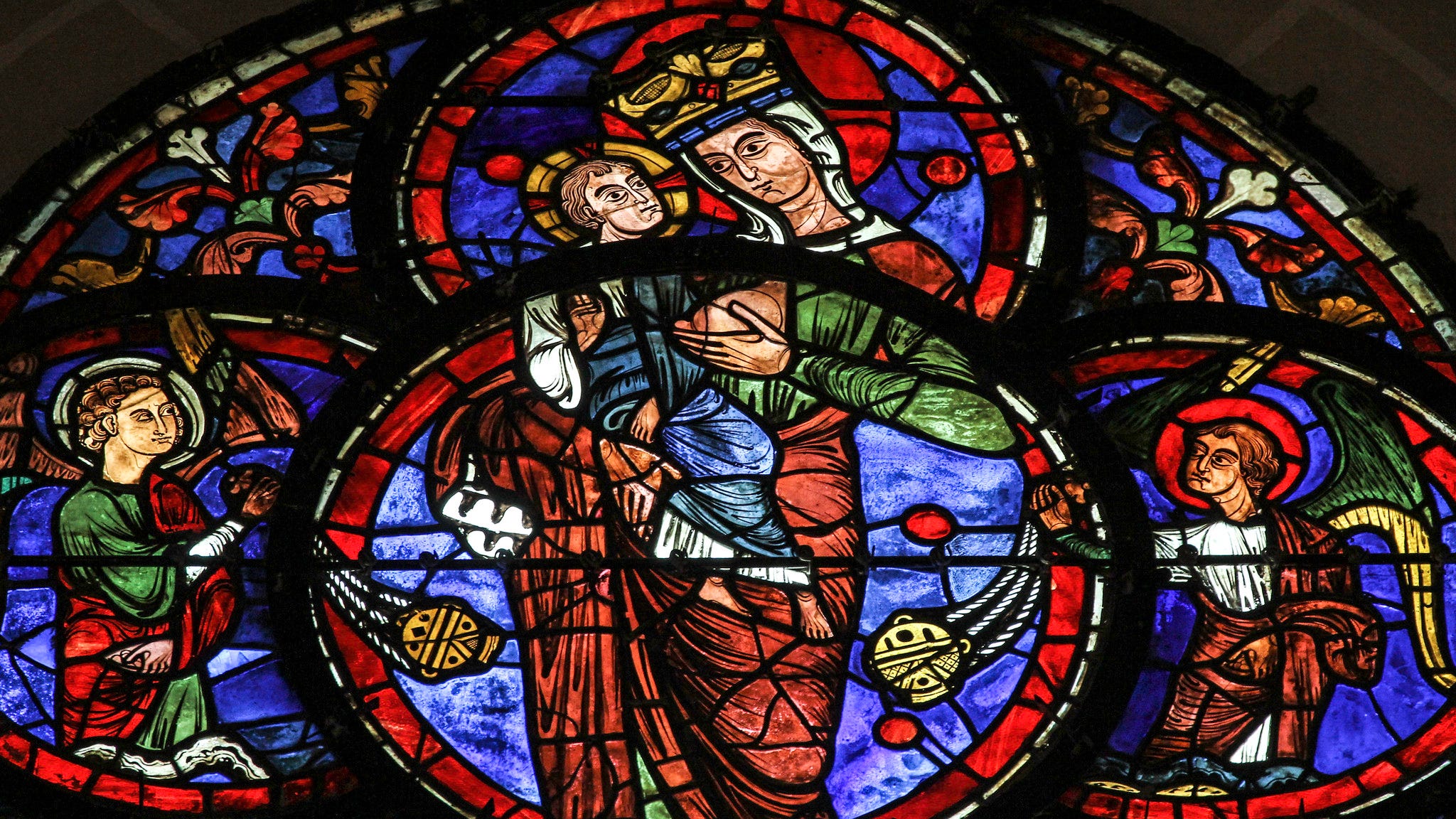
O mighty Chartres (in glass a thousand tales
Beyond world’s ends), stone bends to supplicate
The faithful Virgin, whom our prayer assails
Meek, confident. “I bid thee, hurl this weight
Of sin into the sea, a mountain planted
Deep.” Thus the villager; thus lord and king,
All men, athirst for light, contritely panted,
Pilgrims laved and fed at grace’s spring.
O Virgin, glass-beheld, in sculpture fair,
I beg thee: Hear with living ears my prayer.
I wrote this poem in high school not because I had already been to Chartres cathedral or had immediate prospects of visiting, but because I had just finished reading Henry Adams’s Mont Saint Michel and Chartres, in which a cultivated agnostic enthuses over medieval Catholic France. I was inspired, too, just by his telling of the travelogue, by his array of impressions.
The year in which Henry Adams privately published Mont Saint Michel and Chartres—1904—happens to have been the same year in which the French liberal unbeliever, Marcel Proust, published an article in Figaro, “The Death of Cathedrals.” The similarities are remarkable: two introspective intellectuals, cultured agnostics on opposite shores, who were fascinated by the glories of Gothic art and architecture (“the masterpiece that is the medieval cathedral, with its thousands of painted or sculpted figures, its chants, its services, is the noblest of all the works to which the genius of France has ever risen,” writes Proust)—cultural relics of what was, to them, a superannuated religion, yet a religion whose relics, transmitted down through the ages, still touched and healed their fellow men in the present time.
Surely Proust and Adams must have had analogous experiences in order to write as movingly as they did of the incomparable value of the French churches born of divine faith. Proust in particular saw, or rather felt, that the edifices built for this sublime cultus cried out to be worshiped in, for that was their soul, their source of life: “The most beautiful works of French architecture and sculpture…will die on the day that they no longer serve the worship for which they were born, which is their function just as they are its organs, which explains them because it is their soul.”
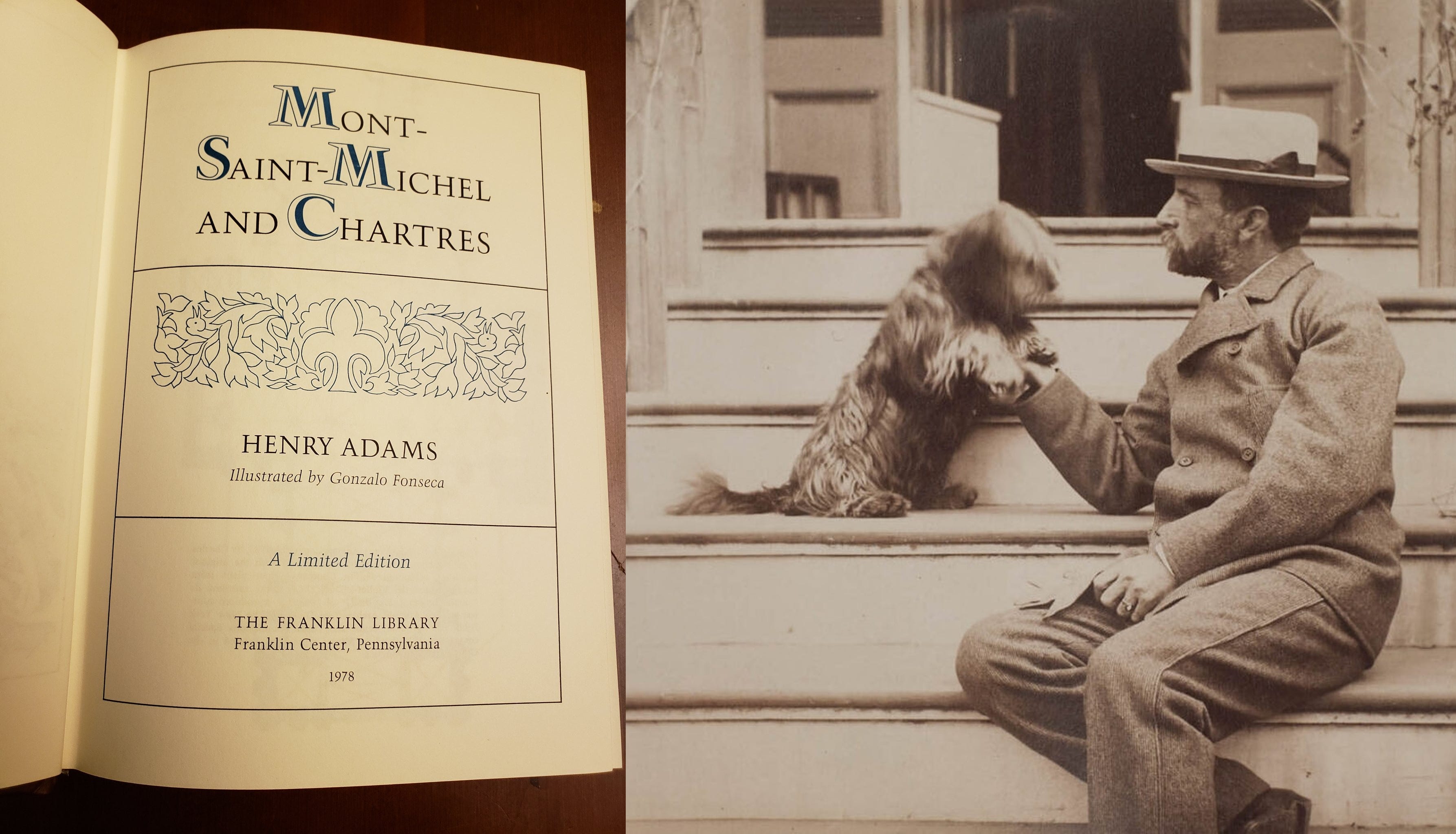
The most famous chapter in Adams’s book is entitled “The Virgin and the Dynamo”: a contrast between the Queen of Heaven whose devotees at Chartres built her a marvelous shrine full of radiance, and the impersonal forty-foot electrical generator that Adams had beheld at the Great Exposition in Paris in 1900, symbol of a mechanistic, industrialized civilization. This contrast—whether cast in terms of Adams’s competition between a virgin mother’s shrine and a lifeless generator, or in Proust’s more subtle opposition between the effete aestheticism of Bayreuth or scholarly reconstructions of ancient tragedies and the living Christian faith that sustained the rites still celebrated in the places built to house them1—invites us to consider the two aspects from which technology can be evaluated: quantitative and qualitative.
Quantitative superiority means, for example, being able to lift a larger number of heavier objects faster, or being able to produce more books more quickly. Qualitative superiority means being able to craft a beautiful object such as a statue, a stained-glass window, or an illuminated manuscript, even if it takes a very long time and the objects are comparatively few in number. This distinction having been made, it is easy to draw the conclusion that medieval technology was superior to modern in a qualitative sense, while modern technology is superior to medieval only in a quantitative sense. In the end, which is the more important of the two?
“In the modern world of measurements,” writes André Gushurst-Moore, “success is defined in physical terms, by that which is faster, bigger, taller—the celebration of power.”2 One is reminded of the difference between the ancient Roman lectionary still contained in the Tridentine missal, as perfectly suited for its purpose as a slender Gothic column or a vaulted arch, and the modern multi-volume lectionary used for the Novus Ordo, a heaped-up pile of Soviet-style apartment blocs.
In 2015, about twenty-five years after writing that poem, I finally made it to Chartres (in fact, almost exactly eleven years ago, for the visit happened at the start of October). I was not among those jolly, flag-bearing strong souls who make the trek by foot singing through mud and rain on the famous pilgrimage from Paris to Chartres—one might say, from the Dynamo to the Virgin. The grace of this visitation came rather during a father-son trip made while I was on sabbatical.
My son and I arrived at the sleepy medieval town on a train from Paris. Given our limited time, we had had to make a difficult choice: visit St. Denis, the first of Gothic churches, or Chartres, the finest of them. St. Thérèse’s “I choose all!” strategy was not going to work in this situation. We agreed on Chartres, the very name of which is like sweet mead or glistening water.
When I first caught sight of the spires, my heart began to race. As we drew near, I fell in love with her face, which I knew was no mere façade but an earnest of the vastitude within, as in the verse omnis gloria eius filiae regis ab intus (Psalm 44:14).3 And when we entered, and my eyes had adjusted to the soothing half-light, I was transported out of myself and did not return to my shoes for a long time: my mind was soaring elsewhere, my eyes lost in dizzying vaults and shimmering glass. I do not know how to describe my feelings, except to say with Dionysius the Areopagite: it was no mere learning of divine things, but a suffering of them.
After we had left, I wrote the following in my journal.
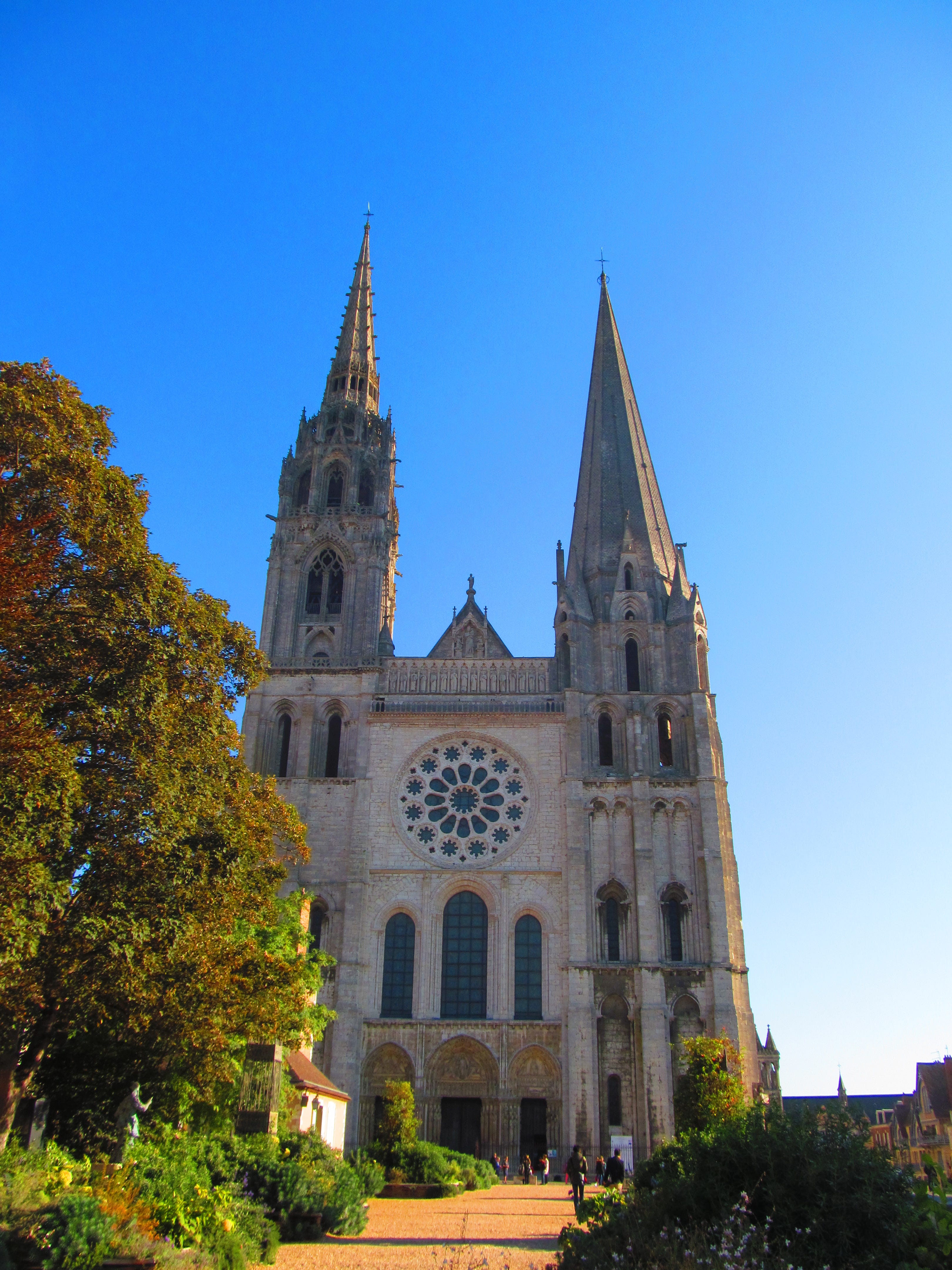
“October 1. Chartres Cathedral is, indeed, a ‘miracle in stone and glass.’ I have never seen a church more beautiful than this. Nothing in Rome can even begin to compare with it. It utterly lacks the pomposity, worldliness, self-importance, and humanistic vanity of the Renaissance structures of Italy, the self-conscious triumphalism of the Counter-Reformation Baroque. It is grand but always turned heavenwards—and turning one’s soul heavenwards. There is deep humility and prayer built into, nay fused with, this immensely impressive edifice. Everywhere God is glorified in His saints, in the light that pours through the windows, ever shifting as the day proceeds, in the colors, the eyes, the sculptures… I said to J.: it is nothing less than the Bible in glass and stone. To say that medievals who could understand these images were ‘illiterates’ would be to say that moderns who cannot are idiots.
“Baroque art stresses God become man, heaven penetrating into this world—in the sacraments, the Eucharist, the priesthood, the Church visible as a body. It is deliberately sensual, bodily, plastic, dramatic. Gothic speaks rather of man aspiring to God, earth being lifted up to heaven, the ascent of the soul via Christ to God. It is straining to leave the body, to let the light suffuse and transfigure everything visible so that it might shine with intimations of divinity and immortality. The light-colored stone works together with the great height and the exquisite windows to create an effect of weightless uplift: Sursum corda. It is not so much dramatic as symbolic—more prayer than propaganda. It delivers its message with the existential shock of beauty. But how many are receptive to this shock anymore? Sure, every visitor can say: ‘It’s lovely’ or ‘it’s amazing,’ but does it have a deep and lasting impact on them? In these times, when everyone’s eyes are glued to smartphones, when their ears are stuffed with earbuds, the words of Jesus take on a pitiful sound: ‘He who has ears to hear, let him hear; he who has eyes to see, let him see.’4
“Nothing we have done in architecture could even compare with Chartres, let alone equal it or surpass it. Built by people with so little technology compared to ours! But they had faith, vision, wonder, ambition, and the desire to give God the greatest and best. Yet moderns are arrogant, and put down the Middle Ages. This shows how blind we really are (or have become).