
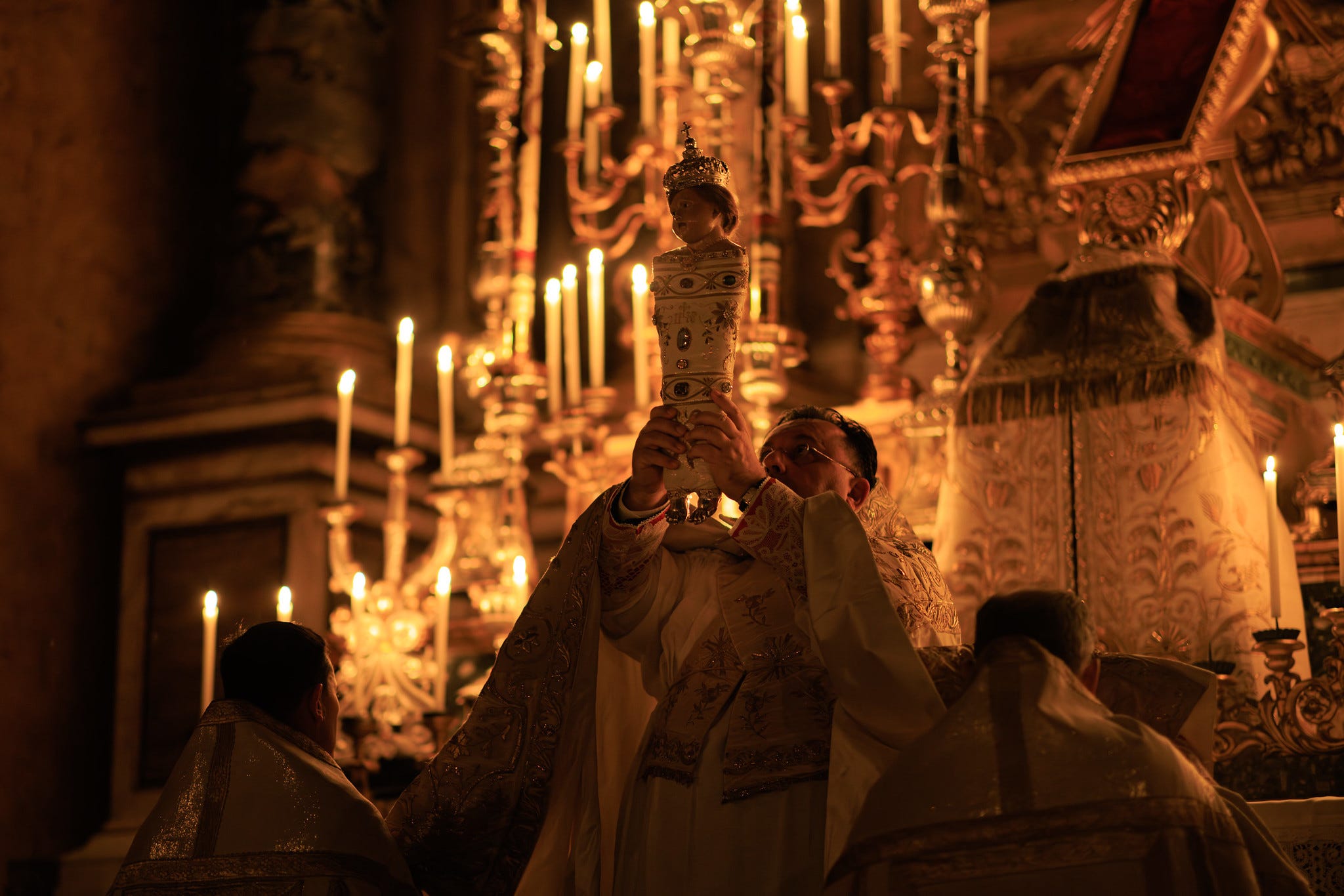
Dr. K’s Weekly Roundup, December 27, 2025
I wish one and all a very Merry Christmas (above, you can see the “elevation” of the Christ Child that took place at the FSSP’s parish in Rome, prior to Midnight Mass). I wish you likewise a happy feast of St. John the Evangelist. My wife and I were married on this day 27 years ago, Deo gratias.
Robert Lazu Kmita comments on the mystery of the Incarnation:
Enveloped in the penumbras of a twilight world, in which being and nothingness are mysteriously intermingled, we wander through the labyrinth created by our own illusions and self-deceptions, stirred up by the temptations of “that old serpent, who is called the devil and Satan, who deceiveth the whole world” (Revelation 12:9). Instead of prolonging and amplifying a dream that often turns into a nightmare, Plato proposes the only perfectly logical solution for the one who knows: the exit from the dark labyrinth. In one way or another, this is what all the lovers of Wisdom in the past have proposed. Yet God, the Almighty Creator, has prepared and fulfilled a solution that surpasses everything the ancient sages could have imagined.
This week’s roundup will be rather short, as I am deeply enmeshed in holiday obligations, but I do have some important things to share, especially in the liturgical sphere, which is why I shall begin there.
Liturgical Realism
An extraordinary essay by Ross Arlen Tieken that brilliantly articulates the worldview undergirding Catholic traditionalism, and in a way that pushes against various reductionisms:
For Liturgical Realists, the “liturgy wars” are not an issue with juridical procedure or “traditions” or “validity” but with the implicit philosophical rejection of a participatory cosmos in which each man and woman have a vocational role as priest, prophet, and king, sacrificing all of creation to God in tandem with the sacrifice at the altar, which is itself the real Sacrifice of Calvary, the New Covenant.
This is (or has been throughout much of Christian history) simply normative Catholic and Orthodox belief; but the implications, when set against the backdrop of modern Church discourse, are staggering. Those implications are consistently and almost perniciously obscured by either (a) needlessly interfering with the received form of the liturgy or (b) surrounding the liturgy with contradicting messages from the church and the culture.
In other words, if the liturgy is warped, our faith will be warped. And if the faith is warped, our liturgy will be warped. Diminishment of the liturgy or the faith will result in the diminishment of the culture, and its ultimate destruction....
If matter, time, people, blood, societies, cultures, institutions, history, etc. cannot participate in the Divine life, then the Bible is a lie and sacraments are nonsense. This is the heart of the Christian claim. What distinguishes Christian mediation from pagan mediation is not “less matter,” but the Person of Christ as the sole mediator and criterion and locus of all mediation between heaven and earth. Mangling this diminishes and destroys not only Christianity, but the possibility of human dignity.
The Roman rite and Coredemption
An article on how the classical Roman Rite helps us understand the concept of co-redemption:
The Offertory, dearest Father, is one of the most beautiful moments for the priest, but also for the faithful who have the privilege of attending the ancient rite of Holy Mass, and it is one of the treasures that priests and the faithful have unfortunately been deprived of by the liturgical reform.
By what I am about to say, I do not wish to justify those who do not grasp the unspeakable gravity of the recent Doctrinal Note on the Virgin Mary, but I want to try to understand how it is possible that they do not grasp it, and I think that this inability to comprehend is not unrelated to the liturgical reform: how, indeed, can those “poor ones”, from whom the Offertory has been taken away, to whom the sacrificial meaning of the Holy Mass has been hidden, who have thereby lost the disposition to unite themselves to the Sacrifice, understand the Coredemption? The two things go together. Lex orandi, lex credendi. And the Offertory is one of the moments when the role of the Coredemptrix is most clearly revealed.
In fact, moments of offering are repeated throughout the Mass, and each time, with Christ offering Himself, there is the Virgin Mary offering Him as well. What took place in the secrecy of the sacristy in a still hidden way (the preparation of Jesus-Host in the womb of the Virgin Mary and Her interior offering), then in a suggestive way during the priest’s first ascent to the altar (which may recall the Presentation in the Temple), is made explicit in the Offertory, when the priest uncovers the host and then offers it. Just as the Virgin Mary offers Her Son before the Sacrifice that He will then make of Himself, so the priest here offers the oblata, which he already designates as the “host”, the victim of the sacrifice (hanc immaculatam hostiam, calicem salutaris), before the Sacrifice itself, which he will then make present, in persona Christi, at the moment of consecration.
The Offertory also corresponds to the moment when Christ Himself offers Himself to the Father, both at the Last Supper, where, on the eve of His sacrifice, He already offers His Body and Blood, and in His prayer in the Garden of Olives; and the Offertory culminates in the tremendous moment, when, after pronouncing, in the name of the Church, the prayer of offering to the Most Holy Trinity, the priest, speaking then in the name of Christ Himself, turns one last time to the faithful and invites them to pray with words reminiscent of those spoken by Jesus to the sleeping apostles: Orate fratres... Here, the faithful, recollected in their offering of themselves, which they unitewith the offering of Our Lord, instinctively bow their heads or close their eyes: they cannot meet the gaze of the priest who turns towards the faithful, for at this moment the priest is Christ, and to look at him at this solemn moment would seem irreverent. Then the priest collects himself in the secret prayer, which corresponds to Jesus’ prayer in Gethsemane.
Shaw on Grillo et al.
Joseph Shaw notes that the Vatican has for a while now tried to dissociate its worst policy decisions from the heretical or quasi-heretical justifications furnished for them by “court theologians,” and that this will not do.


