
Dr. K’s Weekly Roundup, January 17, 2026
Permission to say the TLM?; a cocky Roche infestation; Schneider's Solution; liturgical lessons; ravages of feminism and managerialism; and more
“Permission” to offer the TLM?
I heard recently about a priest who was warned by a fellow priest that he could not say a private TLM because “he didn’t have permission and it would be disobedient.”
B as in B, S as in S.
Let’s get this straight. A priest does not need permission to say a private TLM. Such is the considered view of the best canonists, including Card. Burke, arguably the greatest living canonist. For the full array of arguments, see:
“Newly Ordained Priests and Permission to Offer the Traditional Latin Mass”
“Can a Bishop Restrict a ‘Private Mass’ in the Usus Antiquior to a Priest and a Server?”
“Does a Priest Need Permission to Offer the Traditional Latin Mass?”
People who operate under an exaggerated notion of episcopal authority simply assume that anything a bishop claims to have power to regulate, he actually does. Men have forgotten the first principles of law and have surrendered to an authoritarianism that relieves them of the obligation of discernment.
In my booklet True Obedience in the Church, I explain very clearly what obedience is, what it extends to—and what it excludes. As it happens, Sophia Institute Press has a big sale going on, and you can pick it up for $5 (so, now’s the time to get a bunch for distributing to friends, including clergy!).
Lastly, if you want to understand the animus against the TLM, but also why it is the key to any future renewal in the Church, I’d recommend my book Reclaiming Our Roman Catholic Birthright.
God bless you, faithful fighters for tradition.
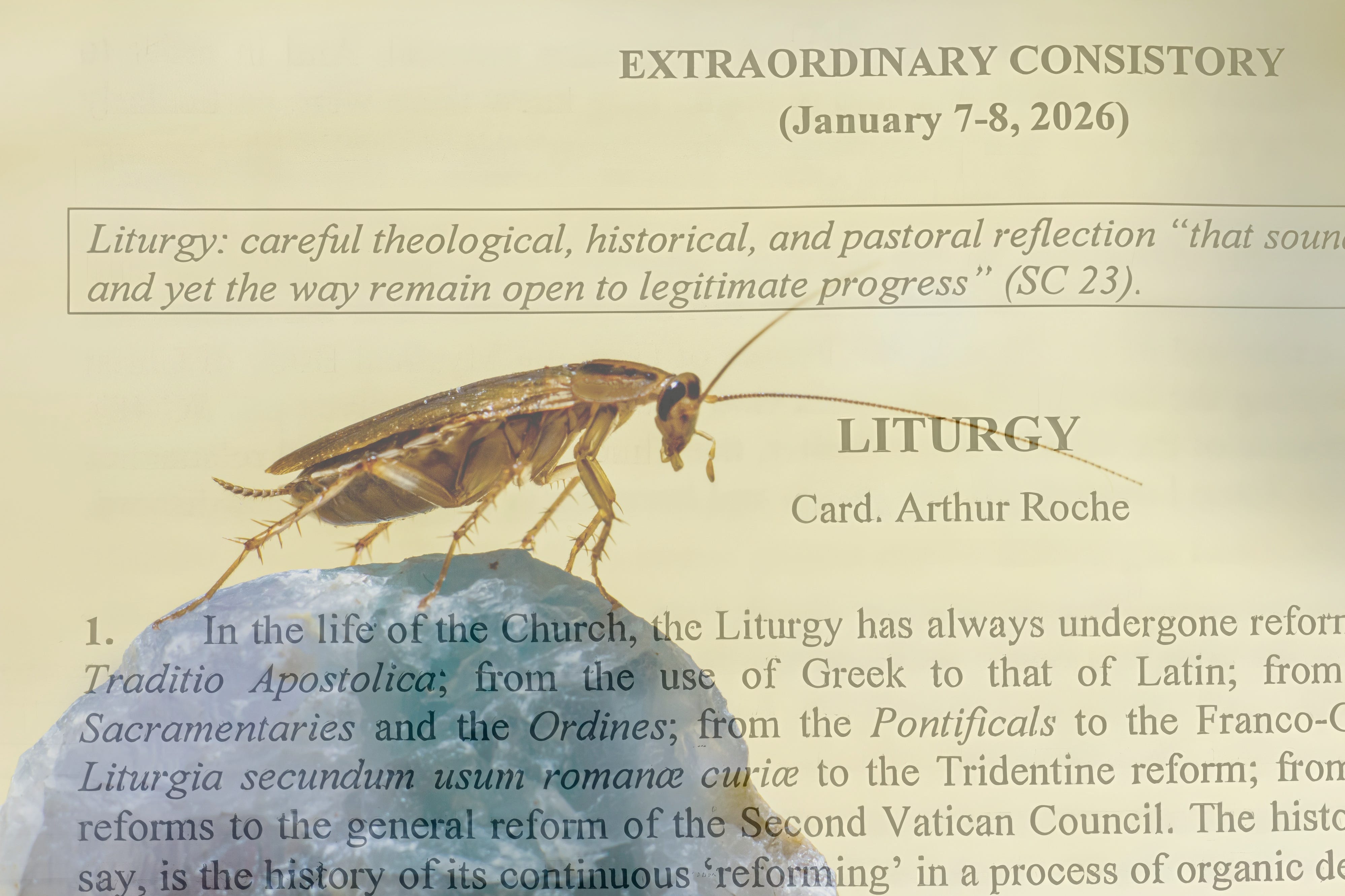
A cocky Roche infestation
The biggest news item this week was the leaking of the 2-page document that Cardinal Roche, as prefect (Lord, have mercy) of the Dicastery for Divine Worship, wrote and had distributed to all the cardinals who came to Rome for the extraordinary consistory. Once again, it is thanks to Diane Montagna that we have this text, for surely some cardinal was fed up with the whole business and sent her photos of it.
The sheer breathtaking stupidity of these two pages should be held up as a model of all that is wrong in the heads of these people. A bunch of tired long-exploded claims mashed up with a generous sprinkling of equal signs (Vatican II = liturgical reform = Holy Spirit) and several outright lies.
My favorite mendacity is his statement that “The use of liturgical books that the Council sought to reform was, from St. John Paul II to Francis, a concession that in no way envisaged their promotion.”
1. First, as you’d think the Prefect for the DDW should know, it was Paul VI who first allowed the use of the “unreformed” books, not John Paul II.
2. More to the point, the Vatican over the years approved many religious orders, communities, and houses that make exclusive use of the old liturgical books, and these groups have established a growing number of apostolates with growing numbers of faithful. All along, this was understood and accepted. How exactly is that “not envisaging their promotion”?
3. Finally, Benedict XVI’s Summorum Pontificum EXPRESSLY makes room for the return and spread of the old rite, precisely because it has been found to be fruitful, especially among youths: “Immediately after the Second Vatican Council it was presumed that requests for the use of the 1962 Missal would be limited to the older generation which had grown up with it, but in the meantime it has clearly been demonstrated that young persons too have discovered this liturgical form, felt its attraction and found in it a form of encounter with the Mystery of the Most Holy Eucharist, particularly suited to them.” (Letter of Benedict XVI to All Bishops, July 7, 2007)
If I were one of his fellow cardinals, I’d say to him: “Arthur, resign from your office. You have neither the intelligence nor the goodwill to run it without endangering your soul by your ignorant and malevolent scheming.”
This time, at least, I can’t help but agree with Chris Jackson’s gigantic dressing-down:
Every few months the postconciliar machine produces another document that pretends to be calm, pastoral, historically informed, even reverent toward “Tradition.” Then the mask slips. The target is always the same. The old Mass must not merely be regulated, not merely “balanced,” not merely “integrated.” It must be starved, shamed, and finally buried.
Cardinal Arthur Roche’s consistory report is that pattern distilled. It is written for cardinals, packaged as a neutral overview, and built around the same three moves the regime has used for decades. First, a selective timeline where “reform” is made to sound like nature itself. Second, a moralized definition of “unity” that treats uniformity as charity. Third, a loyalty test where affection for the Roman Rite is reclassified as an ecclesiological defect. The result is a manifesto....
Strip away the quotation marks and the historical montage, and the message is simple. The Church of the past is to be treated as a prelude. The Roman Rite is to be treated as an adjustable product. The saints are to be treated as spiritually nourished by something the modern Church now regards as the wrong expression of itself. The Council is to function as the permanent veto against the past. This is not a Catholic instinct. It is a revolutionary instinct.
A Catholic looks at the inherited worship of the Church and sees a treasure. Roche looks at it and sees an obstacle to a project. That difference explains the last sixty years. It explains why the reform has had to be defended not by its fruits but by administrative pressure. It explains why the traditional Mass has had to be treated as dangerous....
Roche’s consistory paper is not chiefly about liturgy. It is about control and narrative. The revolution must remain the interpretive key for Catholic life, and the old Mass is the living contradiction of that claim. It proves that the Church can worship without the postconciliar program. It proves that Catholics can flourish without the manufactured rites. It proves that reverence, sacrifice, hierarchy, silence, and Godward orientation still convert souls.
So Roche does what every revolutionary bureaucracy eventually does. It rewrites history. It redefines unity. It weaponizes obedience. It pathologizes dissent. It frames the victims as the cause of the conflict. Traditional Catholics are expected to accept their own dispossession as “communion.” They are expected to surrender their inheritance as “unity.” They are expected to applaud their own marginalization as “progress.”
The deconstruction here of Roche is entire and exhaustive. I could quote the whole thing, but I’ll leave you the pleasure of reading it. Oh, here’s one more electric line: “A truly organic development does not require a war to enforce it.”
Please note that Thursday and Saturday articles are available for FREE to all readers at Pelican+. All that is required is that you create a login with your email (as on Substack). And, if you subsequently stay logged in at Pelican+, the button above will bring you straight into my full article.


