


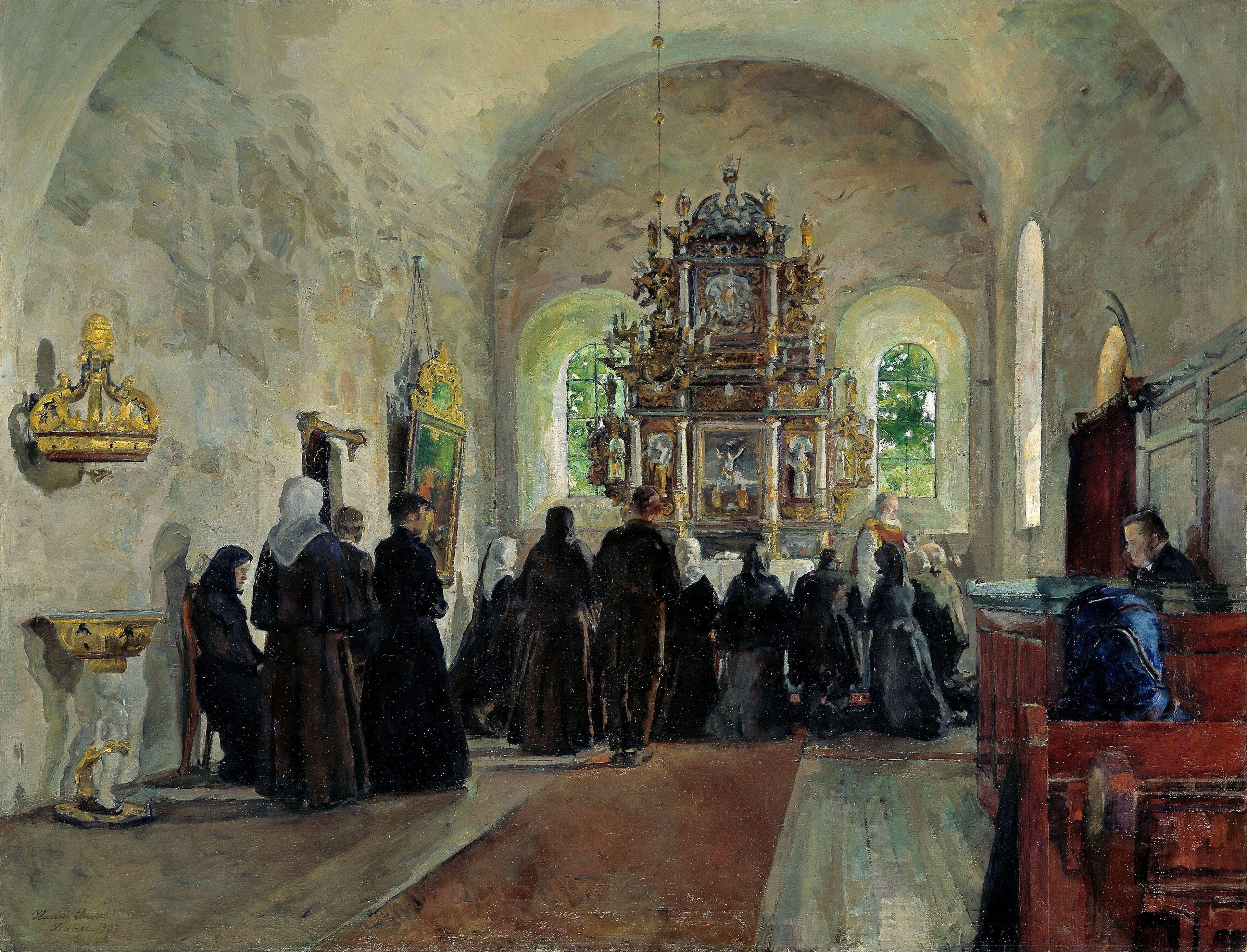

Those who answer “yes” to the question posed in the title usually seem to take it for granted that we will somehow always have a majority liberal-progressive Church in which trads are an “insignificant minority,” fighting an impossible uphill battle, doomed to lose.
But this is patently absurd. The liberals are undermining themselves in all kinds of ways. Their worldview is self-destructive and does not promote real buy-in to any coherent form of Catholicism (as we can see very evidently with the parodistic and parasitic “synod on synodality”). All the statistics in the West are showing decline—demographic implosion from the lack of offspring, church closures, consolidations, inadequate vocations, drifting and apostasy. Sociologists of religion have frequently pointed out that liberalization diminishes commitment, while reaffirmation of core principles and practices strengthens it. In a few decades, the only Catholics left will be (broadly speaking) traditional ones. Just consider the Amish, who are poised to overtake all the mainline Protestant branches, simply by quietly growing, growing, growing.
It may very well be the case that some kind of giant empty mollusk of bureaucracy, a German Church or a Synodal Church or whatever, may, decades from now, still be lurching along the path of its own slime, or, like a cockroach, fail to perish in the nuclear winter, but it will not be the Church of Christ recognizable to believers—or even to a half-alert sociologist—by its continuity of doctrine, morals, and worship.
In a nutshell, the traditionalist maintains that, once secularism has done its very worst (and we can be quite sure we haven’t yet seen the worst it can do), the Catholics left standing when the dust settles will be recognizably Catholic, whether they’ll be called “traditionalists” or not (the name is not, after all, so important, compared to the reality it picks out), and the same historic religion will continue—no doubt in poorer and humbler circumstances, but with a fervor and a clarity that will stand in sharp contrast to the bloated, well-funded behemoth of cultural flaccidity that the media today lazily call “the Catholic Church.”
Now, an objection can be and certainly has been raised:
“Regarding the issue of obedience, Dr. Kwasniewski, you’ve written a lot about how we should obey church leaders unless something they teach or command is clearly contrary to what has always been believed, taught, and practiced. Okay. But that can be tricky in practice. Much of what comes out of the Vatican is phrased in indecipherable mush-speak. Most of us do not have much if any theological training to parse out the tough cases. (For instance, I am reading John Joy’s Disputed Questions on Papal Infallibility wherein it is clearly shown that questions of a seemingly slam-dunk quality are, in fact, debatable.) There are times when the ‘trad filters’ don’t seem to help and may in fact hurt the discernment process. While I believe those who advocate the path of lay resistance to what could be bad or even heretical teaching are sincere and trying to offer some clarity in what Brian McCall calls a ‘conundrum,’ I wonder if the path of ‘justified disobedience’ becomes, for the tradosphere, what ‘conscience’ became for the progressives? In short: what began as a defensible project in the face of manifest confusion over time becomes a way for some to pick and choose which parts of the program to follow, playing right into our concupiscence-infected natures.”
Yes, of course this is a worry. But it is a worry from which we cannot entirely escape, since we are living in a world in which they are “rival versions of Catholicism,” each being pushed very heavily, whether by the institution or by cohorts of the faithful. The “meaning of Catholic” (to use an expression of Timothy Flanders) is not, in our times, as clear as it used to be or ought to be.
In a relatively calm and healthy period of Church history, it is possible to receive the faith as a child, in a simple catechism, and live it without ever having to delve into theological, historical, canonical, or any other subtleties. This is not such an age. When there is great confusion, individual Catholics by the power of their Confirmation must step up to the plate and do some heavier lifting (pardon the mixed metaphor). There is no other way: we must educate ourselves to the extent we can, and then do the best we can with what we have learned of the truth. (I wrote recently about how we nail our “pitons” into the cliff as we climb.)
In the end, the safest way is always to rely, whenever possible, on authoritative sources that we know are authoritative and always will be. What are these?