


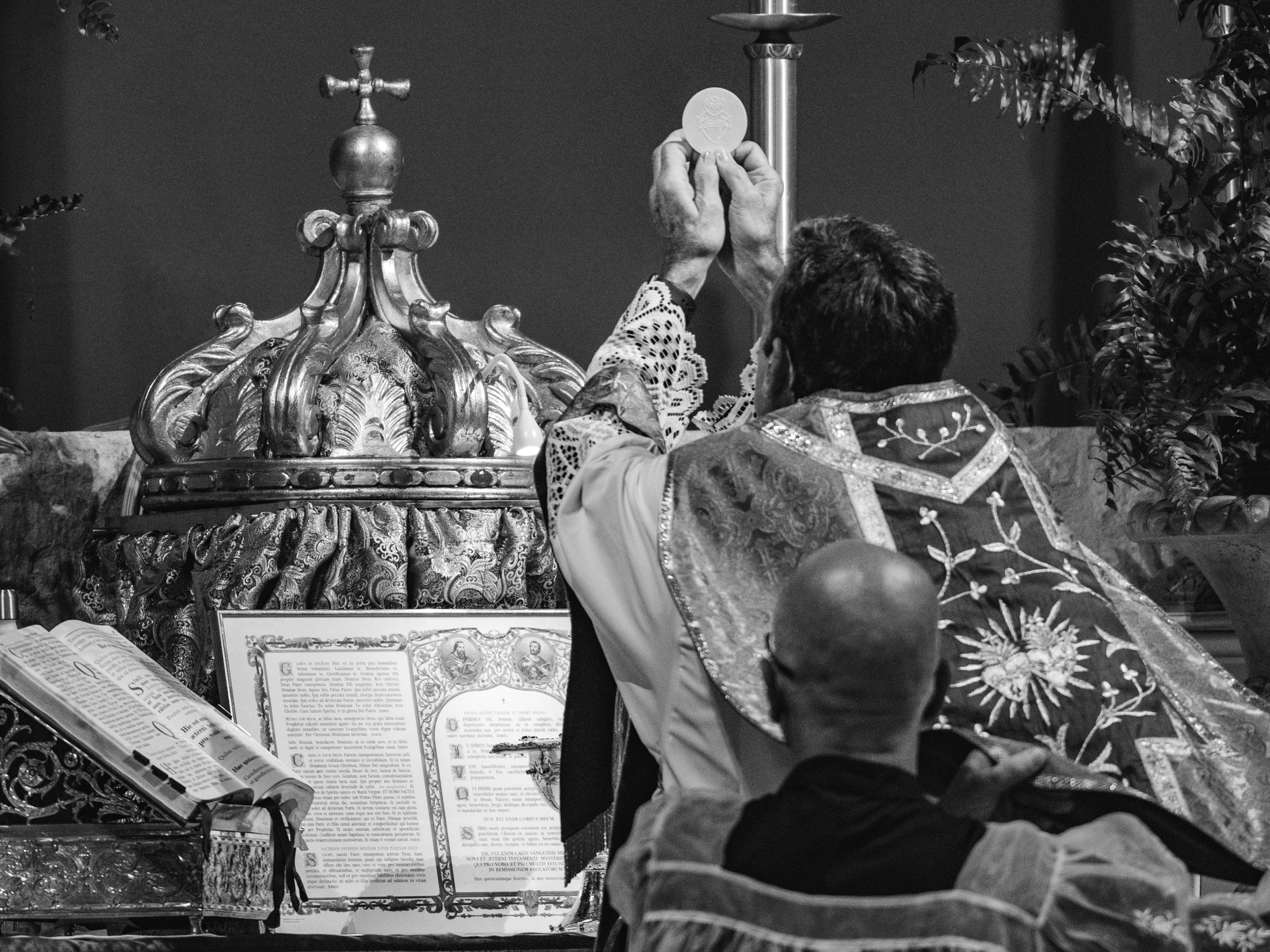
Recently, the German website Certamen sent me four questions, which I agreed to answer. (My answers were written in English, and they prepared a German translation.) The point of departure for the interview was a single sentence in my earlier post “On the SSPX Controversy,” where I argued that there can be no peace in the Church as long as Traditionis Custodes stands and as long as bishops are free to destroy communities of the old rite without consequence. Here are the four questions Certamen posed to me, with my answers. I have made this post free and open to the public, since the same interview can be found in full at the Certamen website as well. —Dr. K
If the key really does lie with the hierarchy, and the Prefect for Divine Worship has now ruled out the one legal change that would turn it—that is, the abandonment of Traditionis Custodes—what is left? Does the motu proprio simply remain in force while exceptions quietly multiply, or is there a path you’d still call realistic?
First, we must understand that Cardinal Roche speaks for himself; it cannot be assumed that he either knows perfectly the mind of the pope (does anyone at this point?), or that the pope automatically endorses everything said by Vatican personnel in interviews or articles. What we do know is that Leo has taken pains to meet with many well-known proponents of the traditional Roman liturgy in order to learn more from them about their concerns—including people to whom his predecessor gave nothing but the cold shoulder; he has told the French bishops to be more pastoral.
Unfortunately, the situation on the ground is increasingly untenable: in one diocese, a bishop creates a new traditional parish staffed by an “Ecclesia Dei” institute, while in the adjacent diocese a bishop discontinues all the Latin Masses. It seems that the Catholic Church is acting more and more like the Anglicans who pretend to have unity in the midst of radical disagreements in life and doctrine. This is not sustainable in the long term. We need a return to the liturgical peace of Summorum Pontificum.
As for Traditionis Custodes, no one who has studied the history of the liturgy in general and, in particular, the history of this motu proprio’s composition, with its foundation in lies and its links to the radicals at Sant’Anselmo (especially Andrea Grillo), is able to take it seriously. It is incoherent both legally and theologically, as Fr. Réginald-Marie Rivoire and many others have shown. At this time it is already being applied, adapted, and ignored in a piecemeal way—the sure sign of failed legislation. It was, however, a gift to the aging ideologues in the Church, who will use it as a weapon for as long as they can wield it.
In March the Pope asked the French bishops for the “generous inclusion” of the faithful attached to the older rite. In July his liturgy prefect ruled out any change in law. German bishops are reading those two signals in opposite directions. Which of them is the real one?
The French and German bishops will do as they please, based on their individual and collective priorities. There will always be a few quiet outliers who are more tolerant or even supportive of traditional Catholics, but until there is a major generational shift, together with a principled rejection of the myth that equates the Council with the liturgical reform, not to mention the fantasy of considering the latter to have been a total success, we will not, I’m afraid, see significant progress on the mainland in Europe.
What is really necessary at this time is firm devotion to the old rite on the part of clergy who celebrate it. They must continue to celebrate it “under the radar” and, when necessary, openly defy the attempted prohibition of it. In other words, they must do what had to be done in the late 1960s and early 1970s to preserve the Roman tradition. Had no one acted then with such courage and zeal, we would not have the usus antiquior today.
The Note appended to the DDF Declaration extends penalties to all clergy of the Society of St. Pius X and to laity who “formally adhere” to it. How far does that Note stand on the same canonical footing as the Declaration concerning the six bishops? And what should a German layman understand by “formally adhere” if he attends a Society chapel because it’s the only old rite Mass within reach?
The Declaration’s penalties apply only to the six bishops, not to the clergy or the lay faithful, and the Note does nothing to change this fact. The reasons are given in several articles (here, here, here, and here); one might also watch the interview with noted canon lawyer Fr. Gerald Murray. The Note is explanatory in nature, and opens the possibility that a priest or a layman who formally adheres to the Society’s schism—if it is indeed schism—would also become schismatic. The more one looks at the details, the harder it is to see exactly who is in schism and who is not, and why, given that some of the classic properties of schism are absent. This much is clear: any layman who attends Mass at an SSPX chapel because he loves the old rite and wishes to worship God through it is by no means a schismatic.
I would add, however, that in my opinion, if another opportunity of assisting at the old rite is already available in the same geographical area, it becomes harder to justify attending an SSPX chapel, given their manfest canonical irregularity (however one assesses the severity of it). Put simply, maintaining living, active, visible communion with the local Ordinary is a real and basic good in the Catholic Church, and the absence of it is an evil. Possessing it is not the sole good, nor is lacking it the sole evil; but if one can have the fullness of the traditional liturgy together with hierarchical union, this is a fuller and more perfect way to live one’s Catholic faith than merely to have one or the other.
The difference between my view and that of many who take the side of the SSPX is that, while I do recognize the doctrinal and moral deviations of the postconciliar period (I have written and published extensively on precisely these deviations!), nevertheless I believe that the liturgical question takes precedence over all others—that we must prioritize the recovery and restoration of the Vetus Ordo and allow it to heal the flock of Christ (not excluding its shepherds). The traditional lex orandi has the power to reorient the Church toward the things of God; anthropocentric disorientation is the gravest and most malformative evil of our times. The lex orandi has the power to restabilize a Church that has lost its bearings. The lex orandi has the power to re-anchor the Church in her dogmatic heritage and the moral demands that flow from it.
Without this first step, nothing else is going to work. We know this already because the so-called “conservatives” have been fighting to reclaim dogma and morality for over fifty years, and our situation at this moment in regard to that campaign is in many ways worse than it has been at any time since the Council—if you look not simply at little pockets of Thomist intellectuals or the minority that still goes to Church, but the hollowed-out institutional apparatus—chanceries, universities, religious orders—and the vast numbers of Catholics who have abandoned and are abandoning the faith altogether. The only “medicine” that can cure this disease is the radical decision to throw oneself into divine worship as traditionally understood and practiced. That is the mustard seed from which renewal can grow. We look in vain elsewhere.
You wrote that anyone who finds either position self-evidently correct might be a simpleton, and that this moment divides not only the Church but the conscience of every attentive Catholic. That’s an unusually honest thing to publish. What does a Catholic actually owe in a situation where he cannot in conscience decide?
Yes, I wrote that in my article “On the SSPX Controversy.” For decades now, I have been convinced that the Church is passing through the worst crisis of her entire history, not only because it is an all-inclusive or comprehensive crisis, leaving nothing untouched, but also because we are not equipped with sufficient principles to disentangle the mysterium iniquitatis at work in our midst. We do have definite principles, to be sure, but I would maintain they are not entirely adequate to resolve the difficulties we face, and they conflict at a practical level.
At this point, I see a huge tension between submission to the hierarchical Church—at least, as regards the programs, priorities, and precepts of some of its representatives—and the full, consistent embrace of Catholic tradition. This is not a dilemma that can be cleared away with a tidy “obedience über alles” or, conversely, with “repudiate the masonic imposters!” All simple solutions are wrong; the simpler, the worse. This is why I consider sedevacantism to be a monstrous phenomenon.
We are dealing with a Church on earth many of whose human leaders are deeply morally compromised, in league with anti-Catholic forces, and using their spiritual offices to manipulate and abuse the faithful. Conversely, we are not Donatists who think that apostolic succession and sacramental efficacy depend on the personal moral rectitude of the office-holders; nor are we in a position to be the judge, jury, and executioner of office-holders we consider to be heretics. We are in the same boat, so to speak, with people who, by all rights, ought not to be in the boat, because they are in fact freeloaders and saboteurs. But there is no way to get off the boat; if you plunge into the water, you will be eaten by the sharks. Your choice must be to stay on the boat—and fight against the usurpers, in the ways open to you as a layman or as a lowly priest (or even as a tradition-loving bishop or cardinal, for such do exist!).
We must form our minds according to Catholic truth, which means, using well the twin gifts of faith and reason. We are asked to go beyond reason into mystery but never to embrace a flagrant contradiction, which would be damaging to mental sanity; nor can we ever be required to violate a sacred mystery, which is impiety or sacrilege. A friend of mine has a metaphor that I like very much. He says that when you are climbing a cliff, you have to nail in a piton as a secure place for your ropes; and that in life there are certain truths we know, or are given to see, that we can “nail in” to the rock and use as supports to climb up further. If we don’t do this, we will not only fail to advance, we might fall to our death.
For me, one of those absolutely secure points is the traditional liturgy, in all its dimensions—not just the Mass, but the other sacraments, the Divine Office, the sacramentals, the pontifical ceremonies, and the theological, spiritual, and cultural riches that belong to them. In short: the Catholic life of worship in its trimillennial integrity and organic growth, for its roots extend far back into Hebrew worship as revealed by God and perfected in Christ. This, for me, is simply non-negotiable; there is no other created good that would ever outweight it.
Hence, if placed in a situation in which I had access only to the SSPX for Mass, I would not hesitate to go. This has nothing to do with schism and everything to do with divine worship, man’s highest moral obligation. If I did not have the old Latin rite to participate in, I would seek out an Eastern rite. For me there are no other real possibilities. My conscience, formed through prayer, experience, and study over many decades, dictates this course of action. But I understand that others have not reached that conclusion, and I would never pressure anyone to accept it, or criticize someone for not accepting it if he is not completely convinced of its rightness. That is just how difficult moral situations are going to be. Conscience is something that must be formed rigorously in the individual, so that it is his or her dictate of practical judgment; it is not a power that can be “outsourced” to another who can exercise it on our behalf.
This is why I strongly advocate as much mutual understanding and tolerance as is compatible with the required beliefs and obligations of the Catholic Faith—and a lot of patience toward our fellow Catholics who do not yet understand what they are required to believe and to do. We are living in dark times, when light is hard to come by, and conflicting authorities put on “light shows” that cause tremendous confusion.
One thing I hope traditionalists will never forget is that nearly all of us were once very much in the dark and, by God’s mercy, discovered the truth; we received special graces of awakening or insight or consolation that we certainly did not merit and for which we must humbly give thanks to the Lord. The idea that “everyone is on a journey,” though often sentimentalized, is nevertheless true. We should act like fellow pilgrims who are trying to help one another as much as possible along the way, remembering St. Francis de Sales’ advice about preferring honey to vinegar as a method of attraction. Traditionalists have been badly treated for a long time and this will probably continue for some time to come, but we can show the world that our reaction is to pray more, to forgive, to show unfeigned charity, to make the joy of the Lord our strength, never to grow weary in doing good, and always to extend anew the invitation, “Come and see.”
You say: "We are asked to go beyond reason into mystery but never to embrace a flagrant contradiction, which would be damaging to mental sanity; nor can we ever be required to violate a sacred mystery, which is impiety or sacrilege. " But then you advise that the only route is to follow the "Ecclesia Dei"/approved Traditional orders and not the SSPX. THAT is embracing flagrant contradiction because all the approved groups, in order to keep the Mass of all ages, had to sign a document saying they believe the Norvus Ordo is also good. Obviously this is untrue. Validity isn't the question here - the document says it is good. It is not. The SSPX is the only group willing to take the necessary steps that reason requires. They cannot and will not sign such a document. And you and others are faulting them for it. I wonder how many faithful and bishops during the Arian crisis, to keep the peace, said that while Arianism isn't the best, it is also valid and good for the unity of the Church requires that we not split into groups. The strength of the Church always depends on good men fighting the particular evil in the world AND IN THE CHURCH during his time - the Franciscans promoting radical poverty and ascetism when the world AND THE CHURCH fell into materialism. We are now drowining in Modernism - we need to support and fight for and with groups, like SSPX, that do not accept to mingle the doctrines of Modernism with true and pure Orthodoxy.