


In addition to Dr. Kwasniewski’s recent article, “Incense: Sacramental of Devotion,” I highly recommend his article “Benedictine Monks on Incense: Sourcing It and Making It” at New Liturgical Movement, as well as Dr. Michael Foley’s “The Offertory Incensation, Part I,” at the same site.
Anyone who has attended a Solemn High Mass in the Traditional Roman Rite can sense that it is angelic. There is something so radiant about its mystery, so arresting about its loveliness, so fearful about its goodness, that we, like children, seem to feel the presence of the holy ones before we ever learn to examine the Mass prayers to chart the number of angelic invocations our missal contains. The majesty and seriousness of the Traditional Roman Rite of the Mass, its great periods of reverent silence, its rubrics so ordered and harmonious, all reflect the presence of the angels, whom the saints assure us assist at Mass in numbers beyond all reckoning.
One important angelic invocation in the Solemn Mass, of which the Novus Ordo is sadly and strangely bereft, is found in the blessing of incense before the Lavabo. The priest prays,
Per intercessiónem beáti Michaélis Archángeli stantis a dextris altáris incénsi, et ómnium electórum suórum incénsum istud dignétur Dóminus bene+dícere, et in odórem suavitátis accípere. Per Christum, Dóminum nostrum. Amen.
May the Lord, by the intercession of blessed Michael the Archangel, who standeth at the right side of the altar of incense, and of all His Elect, vouchsafe to bless + this incense and receive it as an odor of sweetness: through Christ Our Lord. Amen.
Every holy thing is both an unmerited grace for which to thank God, and a doorway to contemplation. Thus, the Fathers wrote whole sermons on single words of Sacred Scripture, and dwelt in awe on the ceremonies of the Liturgy. Likewise, it behooves us to linger for a while in this precious prayer, dwelling on the image of the Angelic Prince offering incense at the Throne of the Most High. May this meditation in his honor lift our hearts as an evening sacrifice, and may the intercession of the angels “fill us with the flame of everlasting charity.”
An Everlasting Offering
The association of the Holy Angels with the offering of incense is equally ancient, biblical and liturgical. In the Book of Exodus, God instructs Moses as to the ceremonies and the adornment required for the Ark of the Covenant:
Thou shalt make also a propitiatory of the purest gold: the length thereof shall be two cubits and a half, and the breadth a cubit and a half. Thou shalt make also two cherubims of beaten gold, on the two sides of the oracle. Let one cherub be on the one side, and the other on the other. Let them cover both sides of the propitiatory, spreading their wings, and covering the oracle, and let them look one towards the other, their faces being turned towards the propitiatory wherewith the ark is to be covered. (Ex. 25:18-20)
The “propitiatory,” or covering for the Ark, was also known as the Mercy Seat. The Mercy Seat lay behind a veil, and in front of the veil was the Altar of Incense, upon which Aaron was commanded “to burn an everlasting incense before the Lord throughout your generations.”
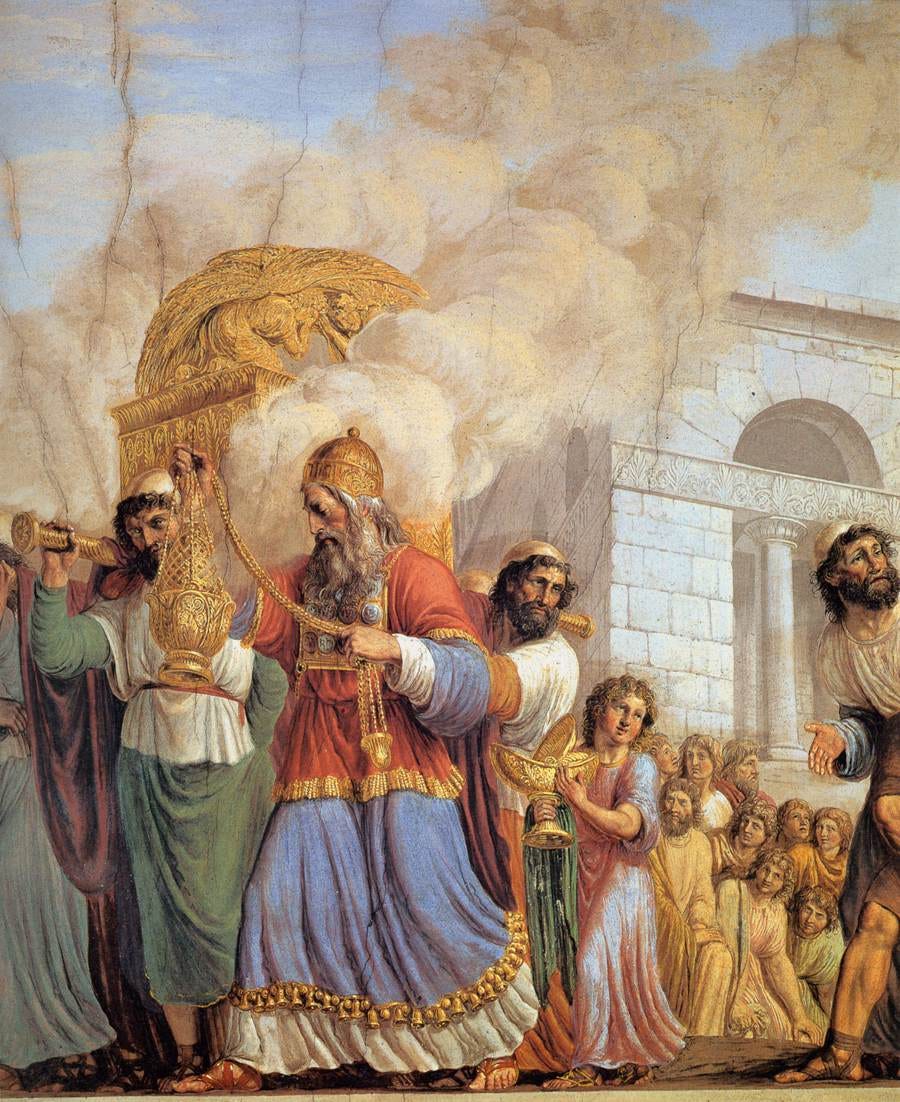
In the building of the Temple, Solomon covered the Altar of Incense with gold. St. Bede associates the offering of incense at this altar with angelic innocence and purity of heart:
[The altar overlaid with gold] signifies typically the life of the perfectly righteous who are, as it were, placed near the oracle and giving up the basest pleasures concentrate all their attention merely on entering the kingdom of heaven. Hence quite appropriately it was not the flesh of victims that was burned on this altar but only incense, because such people no longer need to sacrifice in themselves carnal sins or seductive thoughts but only offer up the fragrance of spiritual prayers and heavenly desires through the fire of eternal love in the sight of their creator.1
The Mosaic-Solomonic type is revealed in its striking fullness in the Book of Revelation, where
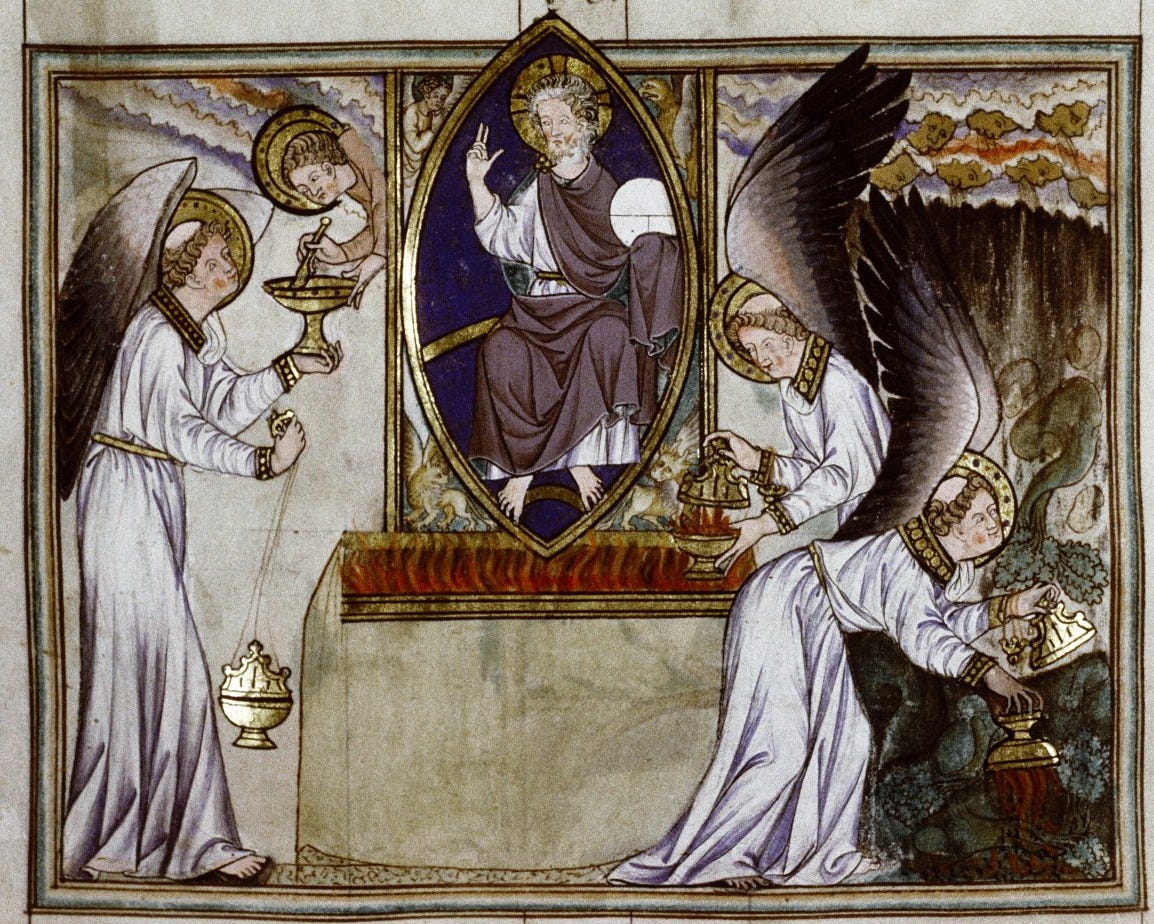
Another angel came, and stood before the altar, having a golden censer; and there was given to him much incense, that he should offer of the prayers of all saints upon the golden altar, which is before the throne of God. (Rev. 8:3)
The celestial service of St. Michael and the angels in Heaven, radiant with God’s own Justice, enflamed with His tender Mercy, alight with wonder and innocence, pure and noble, strong and peaceful, is the pattern of all worship. Thus, incense symbolizes prayer; and prayer is the very breath of the angels. Cistercian Abbot John of Ford wrote,
This is without any doubt the sublime justice of the angels, to contemplate God sublimely and stretch out to him with all their strength. Then this is their peace, that they mutually take delight in the Lord with the most selfless love… Finally, joy in the Holy Spirit, the fruit…of justice and peace, is the fragrance of their same trees. This is a scent most delicious to God and to their own selves, and they never cease to breathe it out from their own very beginning.2
When with St. Michael we contemplate Christ, “the most beautiful of the Sons of Men,” we too are enflamed, purified, and refashioned according to His likeness. Love, like a sweet savor born in fire, arises to Heaven in the form of solemn praise, refashioning us in the depths of our being, until we are of one heart and voice with the glorious angels beholding His very Face before the Throne.


