


Given the relevance of this post for clergy and faithful everywhere, I am publishing it without a paywall.—Dr. K
On October 8, 2026, Most Rev. Jeffrey J. Walsh, Bishop of the Diocese of Gaylord (Michigan), issued three decrees concerning the sacred liturgy.
Let me start with the positive side. The lengthiest decree, entitled “Particular Law Regulating Decorum in the Celebration of Holy Mass in the Diocese of Gaylord,” has much to commend it, within the confines of the Novus Ordo (regular readers here will know where I stand on this liturgical form).
For example, he says the liturgy should be “celebrated with the fullest possible fidelity to the rites and texts approved by the Church, and with a dignity, beauty, joy, and reverence befitting the Mystery it makes present” (Preamble).
He notes that all ministers must act in conformity with the “rubrics and norms” of the liturgical books (Art. 1.1), that no minister may fool around with them (Art. 1.2), and that substitutions and inventions must not be indulged in (Art. 1.3).
He encourages “solemnity” of liturgy on major feasts and Sundays, promotes the chanting of Mass parts, burning of incense, and ringing of bells (Art 2.4; Art. 4; Art. 5), and an appropriate place for silence (Art. 3). (Honestly, I haven’t ever seen a modern bishop promote the use of bells, so this is a pleasant surprise!) He even notes that sensitivity to smoke should not be an excuse to avoid incense, but instead a Mass may be stipulated as incense-free, or the quantity and quality may be regulated.
He calls for vessels of precious metal (Art. 6), and repeats that priests are obliged to wear chasubles (Art. 7). Most remarkably, he echoes St. Pius X in saying “the singing of the Mass, not merely singing during the Mass, is preferred, following the hierarchy of liturgical texts” (Art. 8)—though one might have wished for an explicit mention that the normative chant of the Roman Rite is the Gregorian, as specified by Sacrosanctum Concilium and numerous subsequent documents.
I will come back to the end of this document below. Presently, I will turn to the other two decrees, about which, unfortunately, I can find only a single positive thing to say in each case.
The second decree is entitled “Particular Law Regulating the Celebration of the Mass ‘Versus Populum’ and ‘Ad Orientem’ in the Diocese of Gaylord.” We’ll post the images this time, as there are only two pages:
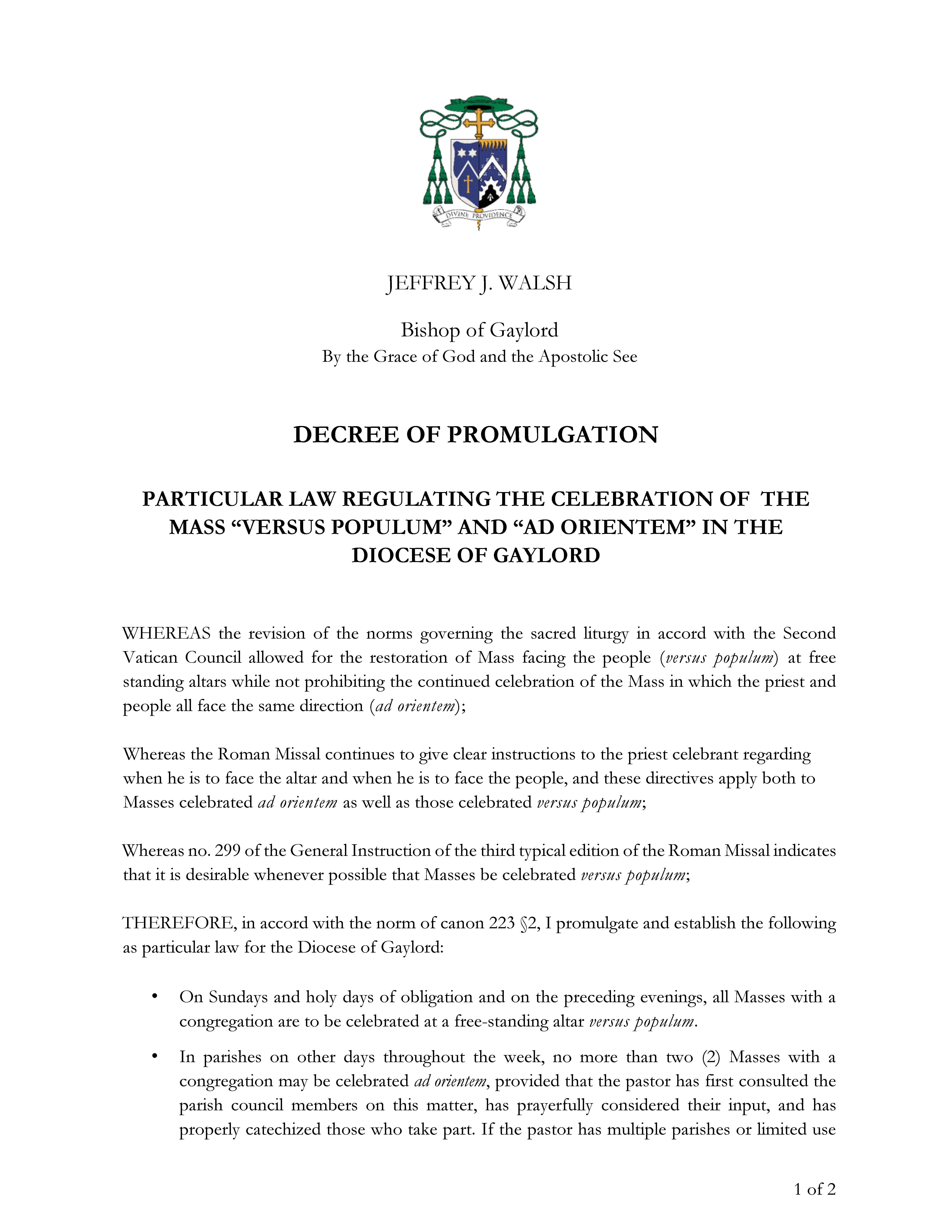
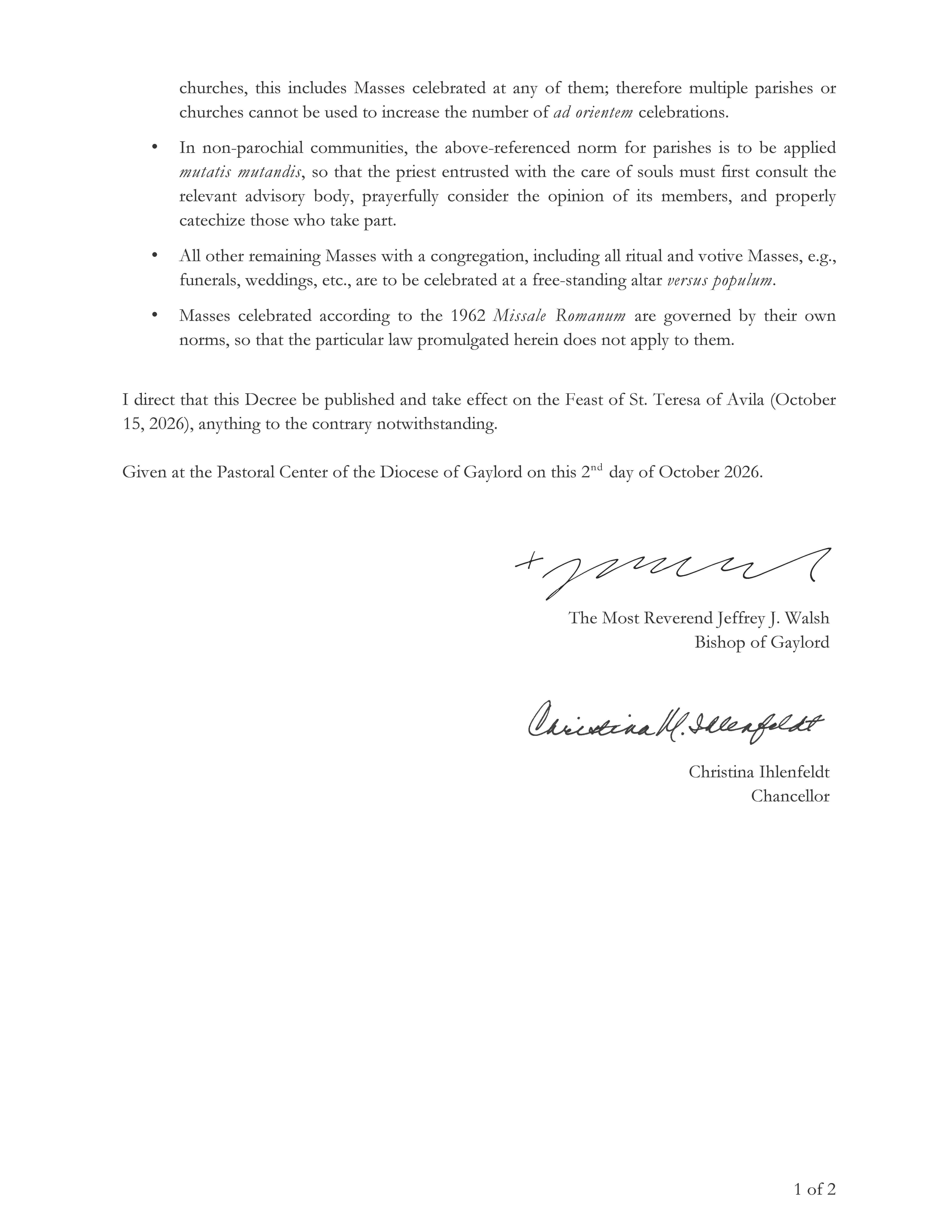
This is a fine example of a decree that can have no legal force, because it is premised on several factual errors.
The practice of versus populum (saying Mass facing the people) was not “restored,” because the original and authentic tradition was ad orientem (priest and people together facing eastward); it’s not like that was a deviation that had to be corrected. For a complete account of why Christians have always faced east in their worship, see either my booklet Ad Orientem: The Direction That Changes Everything (TAN, 2026) or chapter 1 of my book Turned Around: Replying to Common Objections Against the Traditional Latin Mass (TAN, 2024).
As numerous authors have explained, the Latin of no. 299 of the GIRM does NOT mean that Mass must be celebrated toward the people whenever possible. It means the altar should be freestanding so that it can be incensed all around, and so that Mass may be celebrated versus populum. For a full explanation, see Fr. Zuhlsdorf, “What does GIRM 299 really say?” (as well as this, this, and this).
Most importantly, a bishop’s local law cannot trump universal law, and the universal law clearly allows (indeed, presupposes) Mass ad orientem, as I have demonstrated in my article “The Normativity of Ad Orientem Worship According to the Ordinary Form’s Rubrics.” Analogously, a local bishop cannot mandate communion in the hand, given that communion on the tongue is still permitted, indeed is the universal norm.
The other bizarre thing about this decree is that the bishop attempts to forbid ad orientem for Sundays and Holy Days, while allowing it for up to two weekdays! How confusing is that? Once people understand why the priest should be properly oriented, they will simply prefer this all the time; and it will displease everyone to have the priest turning this way or that depending on the day of the week. Does no one think these things through?
Sadly, the way the bishop speaks about ad orientem in the decree makes it sound as if it’s something rather dangerous, slightly naughty, and potentially distressing for the people. Granted, some pastoral preparation is always needed, but it’s not rocket science, and it’s not hard to get used to the traditional way; in fact, it’s far more intuitive.
Then we come to the third decree: “Particular Law Regulating the Use of Ministers in the Celebration of Holy Mass in the Diocese of Gaylord.” Once again, let’s have a look at this two-page thing:
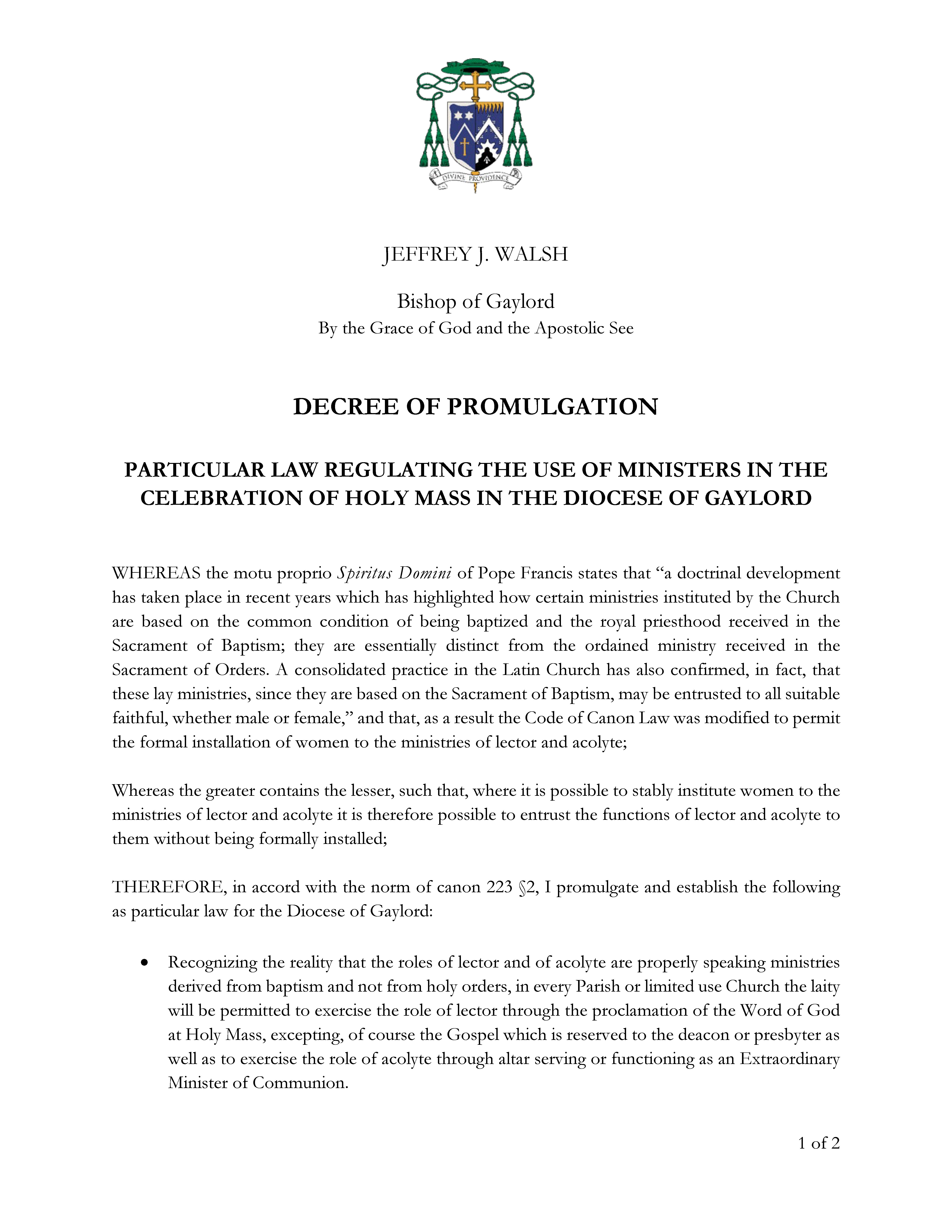
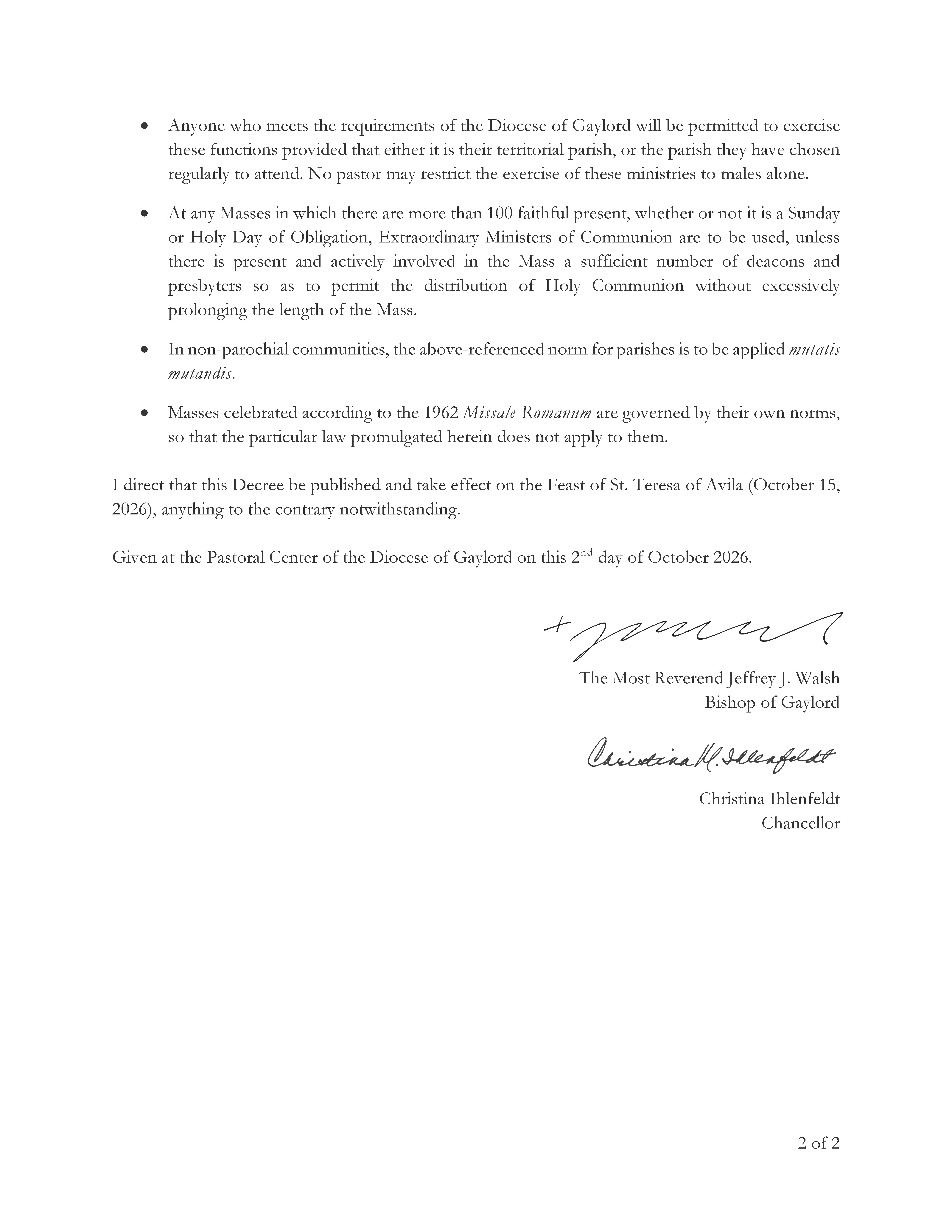
This decree, I’m afraid, is equally baseless.
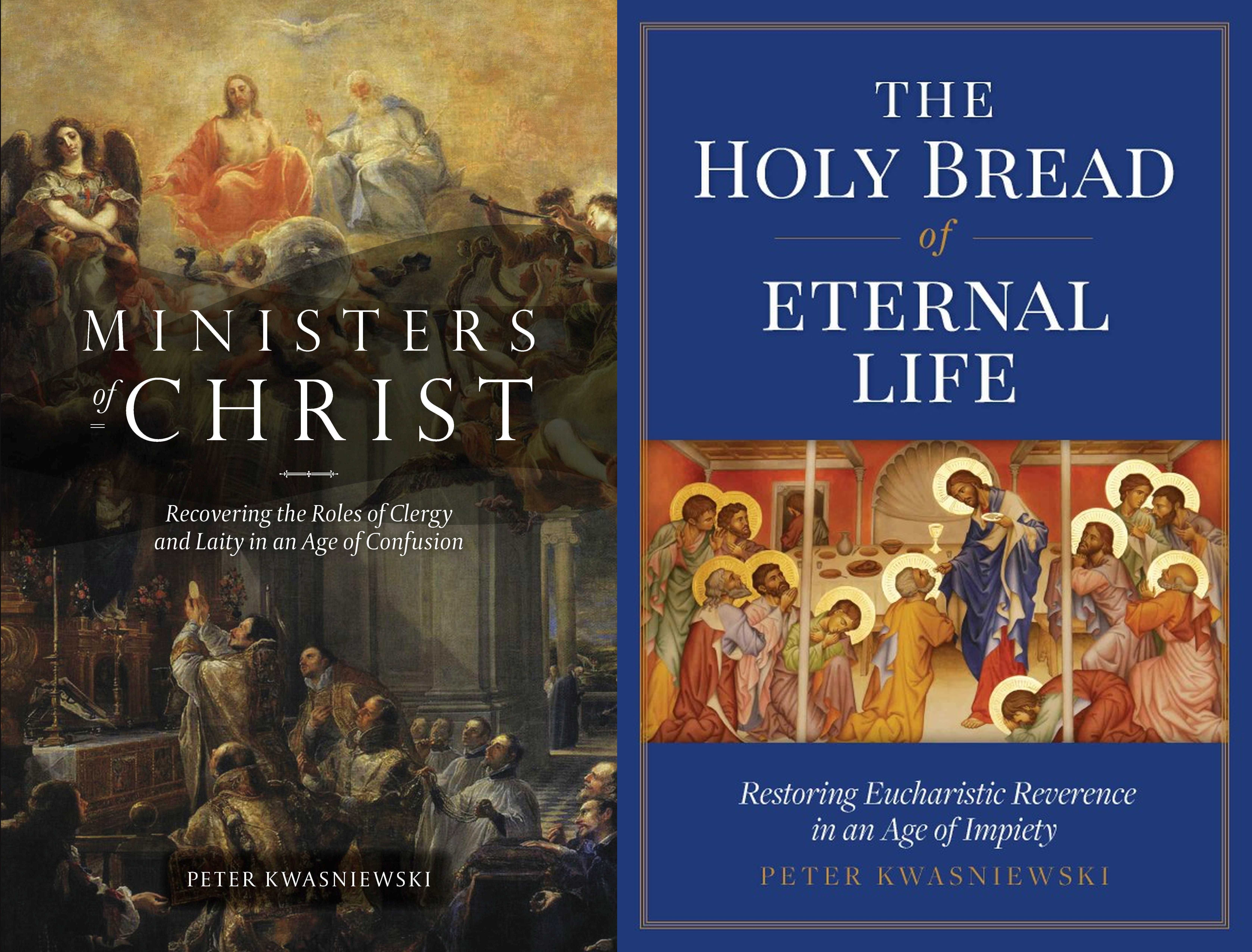
The view that so-called “lay liturgical ministries” stem from baptism and are not related to orders is an error, seen against the unanimous witness of Eastern and Western Christian liturgy and theology. For a detailed treatment of this, see my book Ministers of Christ: Recovering the Roles of Clergy and Laity in an Age of Confusion (Crisis Publications, 2021). For something online, I recommend Bishop Schneider’s “The Significance of Minor Ministries in the Sacred Liturgy.”
The bishop seems to imply that there is some kind of obligation to utilize lay ministers, but existing legislation allows rather than mandates lay ministers—and that makes considerable difference when it comes to pastoral policy at the parish level.
The custom of reserving such ministries to men is ancient and laudable, as was discussed in this post:

Indeed, the standing law of the Church is that no diocese, and no individual priest, is obliged to admit females to altar serving. By taking this step, the bishop once again places himself outside of universal norms.
Most absurdly of all, the bishop specifies 100 communicants (!) as the threshold at which EMHCs (Extraordinary Ministers of Holy Communion) are required in order to avoid unduly prolonging the time of communion. Against this, the 1997 document On Certain Questions Regarding the Collaboration of the Non-Ordained Faithful states:
Extraordinary ministers...may also exercise this function at eucharistic celebrations where there are particularly large numbers of the faithful and which would be excessively prolonged because of an insufficient number of ordained ministers to distribute Holy Communion.... To avoid creating confusion, certain practices are to be avoided and eliminated where such have emerged in particular Churches: ... the habitual use of extraordinary ministers of Holy Communion at Mass, thus arbitrarily extending the concept of “a great number of the faithful.”
Many other documents say the same, as I cover exhaustively in an old article (these errors have been around for quite a while) and in my book The Holy Bread of Eternal Life: Restoring Eucharistic Reverence in an Age of Impiety (Sophia Institute Press, 2020).
I hate to say it, but if your idea of a Mass unduly prolonged is that 100 people have to receive communion from a single priest, you need to see a psychiatrist about impatience struggles, or at least you need to do some more serious spiritual reading. I recently attended a conference where about 500 people received, kneeling down in lines, from a single priest. Yes, it took a while. So what. We prayed.
Thus, this decree has no legal force either.
As mentioned above, I’ve written two books about the topics of these two decrees, demonstrating exhaustively and unanswerably that there is no basis whatsoever in the Catholic tradition for “lay ministers of Holy Communion” and for female ministers of any kind. This is sheer novelty, and harmful novelty at that, the effects of which compound over time like a usurious loan. I challenge everyone who supports these practices to read the books and see what they think afterwards:
***
OBJECTION: So what if the second and third decrees have no force? A priest couldn’t disobey them without suffering punishment. He would be removed, canceled, suspended, etc. The bishop has all the power and the priest has none.
RESPONSE: You’re saying the priests would be hung out to dry; they’d be victims of thuggery. That would not be far from the truth. However, it’s not entirely true that priests have no recourse; they could submit dubia to the Dicastery for Legislative Texts as the priests of the Charlotte diocese did, and this action would suspend the decrees, as far as I understand.
And now I come, at last, to the single positive thing I can say about the second and third decrees:
“Masses celebrated according to the 1962 Missale Romanum are governed by their own norms, so that the particular law promulgated herein does not apply to them.”
The same language is used in both documents.
In this simple sentence, we learn the ultimate solution to the priests’ problems: fleeing the battle-scarred, muddy no-man’s land of the Novus Ordo for the green pastures of tradition.
Surely, very few priests will ever actually do this, but those who already understand the wisdom of tradition know, in their heart of hearts, that they should; that the modern approach has gone badly wrong; that pushing hard on the rupture-points between the tradition of the Church and its attempted replacement is not healthy for the priests or for their people. That all of this is a recipe for frustration and worse—resentment, burnout, loss of vocations, doubts…
Unfortunately, there is a somewhat menacing “Article 11” in the first of the decrees, and its provisions leapt out at me upon a first reading:
1. The Vicar for Clergy, Vicar Forane, or other delegate of the Bishop may, in the course of pastoral or canonical visitation, verify observance of this particular law.
Visitations to parishes to verify observance…
2. Persistent or willful disregard of the rubrics of the Roman Missal, or of this particular law, is to be addressed first by fraternal correction and formation; where this proves insufficient, the matter is to be referred to the Bishop for such further action as the law provides (cf. c. 1364 §2 and related canons, as applicable).
Detailed observance of this bishop’s exact will, when it comes to having altar girls, female ministers of Communion, versus populum Masses, etc. etc….
Them’s fightin’ words, as the saying goes.
P.S. Here’s what a distinguished music director and musicologist said when I shared these decrees with him:
It’s a mixed bag. I can see that he’s trying to do the right thing, and I applaud him for actually legislating rather than supposing that encouragement on its own will achieve the kind of change that is needed. It sets a helpful precedent for other bishops. The decree on versus populum makes an elementary mistake in its reasoning, and since he lacks authority to forbid what the Roman legislation regards as the norm, anyone who wants to appeal would be able to make a case worth hearing (not that I would assume any more). The one about lectors and acolytes... where to start? What he says about music is not so bad, but it would be easy to improve on it.
That was my impression: a well-intentioned bishop who is totally out of his depth on these questions, and/or who is advised by those who are only half-educated (which, to be honest, is about 90+% of the clergy these days, mostly not through their own fault but because the seminary system is so broken, and the accumulated customs are so bad).
Dr. Peter, I can only speak from my experience. My experience suggests that a community based on its sentiment for liturgy is a community that doesn't have very good bones. My community prays ad orientem, and this change was seen as completely radical. How we survived, I don't know. But honestly, I tell my pastors, hey guys, your people are starving; please give them the truth. Well, they seem not to care. I call it the macaroni and cheese Mass because it is quick and efficient rather than a time of prayer on your knees. Then you go to an FSSP chapel, and the sacrifice of the Holy Mass is like having roast beef, real gravy and potatoes. This takes a lot more work. Honestly, my soul has put on some real weight, so to speak, from attending the FSSP community, and I have never been so healthy.
Annnnnd the boiling of the frog continues.
Although I've never attended Holy Mass at an SSPX chapel, I totally understand why so many of the faithful do so.
Pax Christi...