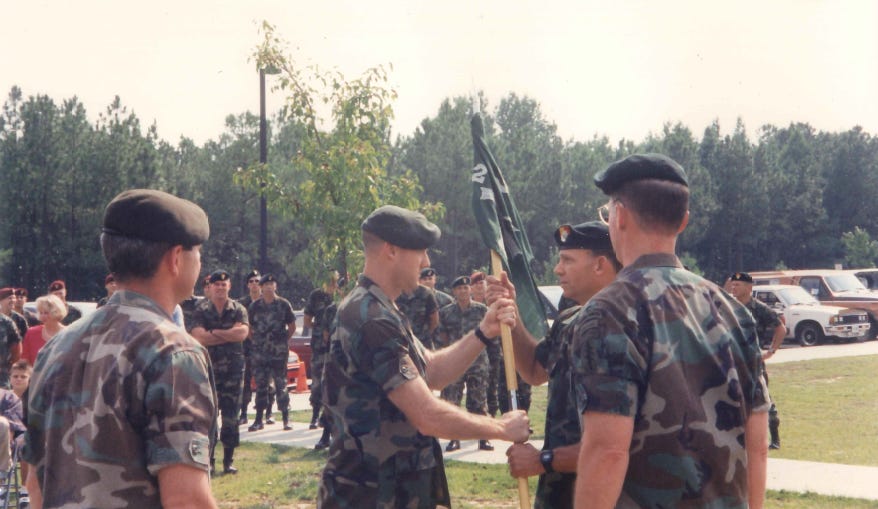
“You are dismissed, major! This meeting is over! Now get out! Go!”
The Professor’s Bookshelf #8: Hard life lessons and the TLM

Today, I am pleased to present to Tradition & Sanity’s readers a number of representative excerpts from David Sonnier’s newly-released memoir Rites and Wrongs: One Man’s Struggle for the Latin Mass in the U.S. Army (Os Justi Press). Enjoy! —PAK
Chapter 1: The End of an Era
On a hot August afternoon in 1997 I was standing in the office of the senior Fort Bragg chaplain, a Colonel and a Catholic priest. By all expectations our meeting should have been cordial. I have always had the highest respect for priests, and the two of us seemingly had everything in common. We were both serving in the U. S. Army, we were both Catholic, and both of us were field grade officers assigned to Airborne units at Fort Bragg. It should have been a pleasant encounter, but instead he was shrieking at me like a raving lunatic. He was frothing at the mouth and spit was flying. A vein in his forehead was popping out. He wiped his profusely sweating brow.
“I just want to talk about our request,” I said. “There’s nothing to talk about!” he shouted back. “But Cardinal Ratzinger...”
“I don’t answer to him! Go to him! Don’t come to me!” Spittle was flying.
I stared at him, speechless, waiting for some inspired words to come to me, or maybe time for him to gather his wits. He quit panting, sat down behind his desk and pretended to be reading a report. After a few seconds he looked up:
“This meeting is over. Finished! Get out of here!” he barked. I didn’t leave. He stood again.
“Get out of here!” Now he was screaming. “Get out of my office! You piss me off!”
I still didn’t leave.
“You are dismissed, major! This meeting is over! Now get out! Go!”
I just stood there until he reached for the phone. “Listen, Major, you get the hell out of my office now or I’m calling the military police!”
I turned slowly and left, walking absentmindedly out the door and back to my pickup truck.
Maybe I should have stayed and allowed myself to get arrested. That would have caused a stir! The headlines would scream “Green Beret Arrested for Harassing Chaplain!” News involving deranged Green Berets were a hot item, guaranteed to boost newspaper sales. It would have been a huge embarrassment for the commander of Army Special Operations Command (SOCOM) to have his executive officer show up on the blotter report. The general would probably fire me, but that was the least of my concerns.
The larger concern was that any such publicity would be turned against our efforts to have a Latin Mass held in a Fort Bragg chapel. In 1997 there were very few Catholics who even knew that the traditional Latin Mass was an option, and far fewer still who were dedicated to making that option a reality. There was no Latin Mass authorized by any diocese anywhere in the Carolinas, and for some time we had been sending petitions to anyone who would listen. Most people who would hear about a confrontation between a Catholic chaplain and someone inquiring about a Latin Mass would put the blame squarely on “those Latin Mass people.” I had seen how the media was used to manipulate public opinion. Thanks to their efforts, the old rite was largely unheard of and it would remain so for many more years until the election of Cardinal Joseph Ratzinger as Pope Benedict XVI and his 2007 motu proprio Summorum Pontificum.
I stood awkwardly by my pickup truck staring into space, wondering what to do next. An enlisted soldier saluted as he passed, jarring me back to reality. But the drive back to my office pulled me back into a dreamy reflection on the past sixteen years, which had landed me here in this confrontation on this day.
Chapter 3: A Spiritual Awakening
“I’m telling you for the last time. You should go to the Latin Mass.”
Yes, he had suggested this several times already, and for one reason or another I had never really heard him. Maybe I had not taken it seriously because we already had a parish, and we had deliberately selected a house to rent that was close to it. It was conveniently located, so I didn’t want to think about going elsewhere.
But I was all ears now. A Latin Mass! His suggestion evoked images from my youth: a priest facing a high altar, clouds of incense hovering over him, stained glass windows, bells, music, silence, and prayers whispered at the altar.
Lorri was leaving the next day with the baby to spend a week or two with her parents on the Mississippi coast. She would not even be home on Pentecost Sunday, so this was a convenient time to take Will up on his suggestion. I wouldn’t have to worry about running late, the baby crying, or having to look for a good place to park. I could do a reconnaissance by myself, and maybe it would turn out to be something good for us. We were ready for anything that was both Catholic and an improvement on our current situation.
I thanked Will for the kind invitation and wrote down the directions. He suggested that I arrive fifteen minutes early for the Rosary. This was a devotion that my family had sometimes practiced when I was young, and that I had not seen practiced in a church for many years. I already felt drawn to this parish. Holy Family Catholic Church in downtown Dayton looked like any typical Catholic Church built before the 1960s and 1970s. In other words, it looked like a church. As I entered, it also felt like the Catholic Church I vaguely remembered from my childhood. There were no felt banners, there were no lay people running around at the altar preparing for their various ministries, and there was no noise aside from an occasional cough. The only babbling came from a baby in a pew somewhere in front of me. The women were all modestly dressed and veiled. Someone began leading the Rosary, and I heard a few familiar thumps as kneelers were dropped.
Perhaps the most significant date of my life was Pentecost Sunday, 1993. I was unprepared for what followed. The Rosary having concluded, the priest processed in wearing vestments of a type that I hadn’t seen in ages, following altar boys wearing what I now know to be cassocks and surplices. It was when the choir began singing the Vidi Aquam that I was instantly transfixed. I had not heard Gregorian chant since I was a young child, but it was nostalgic and familiar. It sounded magnificent with the subtle organ accompaniment, and it brought back memories of how the Church was when I was in the first grade. The nuns who taught at my school sang at High Mass, and it sounded like this. As the priest began the Prayers at the Foot of the Altar, the Choir began singing the Kyrie of the Mass of the Angels, or Mass VIII. I quickly found this sung prayer in a small red missalette in the pew, with the text of the Mass on the left page and the translation on the right.
Kyrie eleison, Kyrie eleison, Kyrie eleison. Christe eleison, Christe eleison, Christe eleison. Kyrie eleison, Kyrie eleison, Kyrie eleison.
As the Gloria in excelsis Deo began I got chills. There was something supernatural happening. I didn’t know any Latin at all, but that minor detail seemed to be of no consequence. The prayers were directed to God, and the translations were readily available. Unlike the indecipherable babbling noises that I had heard the previous weekend which were supposedly directed to God, it was now clear that these prayers really were directed to God, weighted with centuries and millennia of meaning. The priest and the congregation all faced in the same direction as he led the congregation in prayers. To God.
The priest chanted the Epistle and Gospel. None of it was delegated to the laity. There were no short-skirted women flitting around the altar. There were no announcements of birthdays, no suggestions to turn and meet our neighbors in an awkward “sign of peace,” and no requests for all visitors to stand. There was no applause. There was no guitar music.
Within moments I knew I had found my spiritual home. This was absolutely, without a shadow of a doubt, exactly where I belonged and God, in His infinite mercy, had led me here.
The priest gave a homily that didn’t include the slightest trace of ideology. In the 1990s it was typical for priests to use the pulpit to condemn the sins of bigotry, intolerance, and not being open to change. It was acceptable for priests to elaborate endlessly on the same political narratives that were already being trumpeted by the media, and hearing them repeated from the pulpit always put me to sleep. We all knew by then that abortion was murder, but we had never heard a priest condemn it in the setting of a homily. I breathed a sigh of relief because today I wasn’t going to have to tune out some secular political agenda. I remained transfixed until the end of Mass. When it ended, there was no rush for the door, there was no talking, and it was several minutes before people began quietly leaving.
I waited outside the church for Will and his family. As it turned out, they were all members of the choir, and I met one or two other choir members that day. Will invited me to lunch, and since my wife was out of town and I was full of questions, I gladly accepted the invitation.
Will and his family lived in officer housing at Wright Patterson Air Force Base. He fired up the grill on the back porch and began cooking while I peppered him with questions. My curiosity was overwhelming, and he probably felt that I was interrogating him. Each answer he gave led to a dozen new questions….
“Didn’t Vatican II do away with Latin?”
“No. The Vatican II document on the liturgy clearly states that Latin and Gregorian chant should remain in the Mass.”…
As he continued, I found it difficult to believe that everything he was telling me was true. The Second Vatican Council had never required that Latin be removed from the Mass, and Gregorian chant was also to have been retained. Really? He sent one of his daughters to fetch a large, yellow book with “The Second Vatican Council” written on the cover, and read directly from it: The use of Latin is to be preserved in the Latin rites. (Constitution on the Sacred Liturgy, no. 36)
The treasury of sacred music is to be preserved and fostered with great care. (Constitution on the Sacred Liturgy, no. 114)
The Church recognizes Gregorian chant as being specially suited to the Roman liturgy. Therefore, other things being equal, it should be given pride of place in liturgical services. (Constitution on the Sacred Liturgy, no. 116)
Latin and Gregorian chant were both supposed to have been preserved? Until that day, I had not heard the first word of Latin or the first note of Gregorian chant in any church that I regularly attended since I was a child! Instead, we had been told repeatedly that Vatican II changed the Mass from Latin to the vernacular, that is, the local, commonly spoken language. We had been told this repeatedly. My head was spinning, and a dreadful thought began to cross my mind. Had we been lied to for all these years? Was it possible that Catholics knew their Faith so poorly that we had all been tricked? Unless someone had access to the actual documents of the Second Vatican Council, how would they know?
Perhaps Will was lying. I watched him as he fiddled absent-mindedly with the grill. It didn’t seem possible that he was making this up. He had been so knowledgeable about all things Catholic. But either he was lying or most of the hierarchy of the Church had been lying to the faithful for years. If what he was saying was true, why was I hearing it from him, and not from a priest or bishop? Or why wasn’t it in Catholic magazines and newspapers?
Will explained: “It was the way these documents were written. That was the catch. There was ambiguity built into these declarations leaving loopholes big enough to drive a truck through.”
He picked up the large book again [the Documents of Vatican II]. It was about the size of the Dayton phone book.
“Let me give you an example: ‘The use of Latin is to be preserved in the Latin rites, but since the use of the vernacular, whether in the Mass, the administration of the sacraments, or in other parts of the liturgy, may frequently be of great advantage to the people, a wider use may be made of it, especially in readings, directives and in some prayers and chants.’ See? There’s a loophole. The Mass is supposed to be in Latin, but . . . and that word ‘but’ gives them license to do whatever they want.”
From that moment on, I have never been able to reconcile what was written and proclaimed in the Second Vatican Council document on the liturgy with what actually happened. It made no sense then, and it makes no sense now. For centuries people are praying in Latin every Sunday, and then suddenly the highest authority in the Church says, “You can use more vernacular language in your prayers if you want.” And then the bishops take that new guidance and proclaim: “Latin is now forbidden!” It’s all a lie. There is no way that anyone could interpret the clear text of the Second Vatican Council document to be a call for the elimination of Latin from the liturgy, but that is what had been done.
Will continued, “Here’s another example: ‘The Church acknowledges Gregorian chant as specially suited to the Roman liturgy: therefore, other things being equal, it should be given pride of place in liturgical services. But other kinds of sacred music, especially polyphony, are by no means excluded from liturgical celebrations, so long as they accord with the spirit of the liturgical action . . .’ See? Another loophole. Other kinds of music can include guitars or bongo drums.”
“Polygamy? What?”
“No, polyphony. It’s a type of music, usually in four parts that go in different directions, but with the same text, and the parts harmonize with each other. You’ve probably heard it in recordings or concerts. But probably not at Mass.”
So, according to the highest authority in the Church, Gregorian chant was best for the liturgy, but other types of music could be allowed. That had somehow been interpreted as a call for the complete elimination of Gregorian chant. This wasn’t someone taking advantage of a loophole, it was an outright lie.
I was getting a headache. It was too much. How was this even possible? There had to be more to it. Intellectual honesty requires humility, and obviously there were some additional facts bearing on this situation that I would have to research. Now that I was awake, I resolved to do whatever was necessary to find out what was going on.
As for the Catholic magazines and periodicals that had all along been reporting on what was happening as events unfolded after Vatican II, they did exist. Will gave me some copies of The Wanderer and The Remnant as I was leaving.
I was still skeptical, and I had a headache.
Chapter 11: De Oppresso Liber
Any correction to the situation would have to come from the pope himself. For now, those Catholics at Fort Bragg who longed for the traditional Mass had few good options. However, by now we had discovered how to find the many private chapels scattered across the landscape. While driving home on vacation or visiting relatives or friends in other states, we would find a group of Catholics that had established a private chapel so that on one or more Sundays a month Mass would be held in a storefront, the conference room of a hotel, or even in someone’s home. We attended a number of these in various locations while traveling. In each case, the diocese in which the private chapel was established was a diocese in which the bishop had not made provisions according to the guidelines of Ecclesia Dei. We timed our visits to Mississippi to be there on a weekend when Bishop Howze was offering the Latin Mass in the Cathedral in Biloxi.
Bishop Joseph L. Howze gave us the moral courage and strength to not be intimidated by the meanness and intolerance of the chaplains we encountered. He was quite unusual. He had grown up as a Protestant in the Deep South, but due to the excellent influence of Catholics around him he eventually embraced the Catholic faith and pursued his calling to the priesthood. After a series of assignments, he became auxiliary bishop in the Diocese of Natchez-Jackson in 1972, and then became the first bishop of the Diocese of Biloxi when it was created in 1977. Immediately after Pope John Paul II issued the 1984 indult Quattuor abhinc annos, allowing bishops to authorize the Latin Mass, he began offering the old Mass in the Cathedral. He then gave a universal indult for the priests in the Diocese of Biloxi. In a 1992 interview with The Latin Mass magazine he said, “I announced in my clergy bulletin that any priest who wanted could say it [the TLM] any other Sunday but the Sunday that I do, the first Sunday of the month. But . . . I haven’t gotten one response.”
He also told me this personally, adding that he was hoping that some Latin Mass communities would form within the diocese, and for that one Sunday every month they could all go to the Cathedral for a High Mass. He was disappointed that it never happened.
“I think the priests in the diocese didn’t like me very much because I’m black,” he once told me, after he retired in 2001.
“They didn’t like you because you’re Catholic,” I muttered.
He also said that he was ashamed at the treatment of the “Latin Mass people” by other Catholics.
“It reminds me of the way our people were treated,” he said.
The meaning was clear. It reminded him of the way blacks were treated in the Deep South when he was growing up. We often visited him during our trips home to Mississippi, even when we couldn’t get there for his monthly Latin Mass. We continued to correspond with him long after he retired.
We also continued to periodically host a circuit priest who was willing to visit our residence once a month and offer Mass for one or two other families and a few servicemen. God finds ways to turn evil into something good. I began studying Gregorian chant on my own, with no guidance, and learned to play the “organ,” which was just a keyboard that had organ settings. I had studied music only for a few years in my youth, but it came back quickly. Had a public Fort Bragg Latin Mass Community actually come together, I would have been too busy organizing altar boys and scheduling events to have discovered that I had been blessed with a gift of understanding music. We had the clandestine Latin Mass once a month, at most, but it always brought us a great sense of relief. When our fourth child, Louis, was born we had him baptized in the Maronite rite. As is the case in many of the Eastern rites, one receives the Sacrament of Confirmation at the same time, so he was confirmed as well as baptized. We invited the Bonomettis, our friends from Alabama, to be his godparents. The fact that this baptism included the rite of exorcism, as the preconciliar Latin rite did, was not lost on us. From that time on, the rest of our children would be baptized in the traditional Latin rite.
Chapter 20: Farewell
Lorri and I had become friends with many of the Belgian Catholics while living there. Most of the families at L’Institut Saints Pierre et Paul, where our oldest three children went to school, were dedicated to the traditional Mass, and they were all invited to my retirement ceremony. We had met numerous Catholics at a small parish church we attended on Sundays in Cortil-Noirmont, a remote location with a particularly good priest. We had made new friends on an annual pilgrimage that started in Dinant and ended about ten kilometers away at Notre Dame de Foy, a church built in 1623 that had become a pilgrimage site.
The SSPX was renovating an old church in the downtown area of Brussels as we were preparing to leave Belgium. Saint Joseph’s was an Italian-Renaissance-style church built between 1842 and 1849, in the Leopold district. From the time it was consecrated in 1849 until sometime in the 1980s it was entrusted to the Redemptorists. As religious life and Mass attendance plummeted after the Second Vatican Council, the Syrian Orthodox took it over for a few years. In 2001 the SSPX bought it.
Sometime before departing the country we heard about their first Mass and we made it a point to attend. We had never attended Mass with the SSPX until now. As we entered the packed church and looked around, to my surprise there were dozens of people that we knew. Apparently, attendance at Mass with the SSPX was something that many of our Belgian Catholic friends did but nobody discussed. People that I knew from our choir at Cortil-Noirmont were participating in the choir, which sang a beautiful polyphonic Mass. People we knew from our children’s school, L’Institut Saints Pierre et Paul, were seated next to us. The SSPX bishops would not have their excommunication lifted for a few more years, but it was then and there that I began to fully comprehended the extent of the injustice that had been done. This was where the large families were. This was the vibrant, youthful crowd that would be the future of the Church. These Catholics had managed to aquire a beautiful old church and preserve the traditional Catholic liturgy, doctrine, and prayer life without the blessing of the hierarchy, but they were supposedly the culprits. Meanwhile, so many other magnificent churches and cathedrals throughout Europe sat empty because the liturgy and spirituality that they had been built for was now forbidden.
Epilogue
The recommendations [for the military archidiocese] thus far have focused on the liturgy, the Mass, and the urgent need to lift restrictions on traditional forms of Catholic worship of both the East and the West. The primary reason we have chaplains in the armed forces is for battlefield ministrations. As important as the Mass is, Catholic chaplains are irreplaceable on the battlefield to offer baptism, confession, and extreme unction. Unlike with the Mass, these sacraments, even in their traditional form, can be administered in the vernacular, except for prayers of exorcism and absolution. Last rites are sometimes administered to those who may not even be conscious. To restrict traditional priests from the military chaplaincy is to potentially deny battlefield sacraments to injured or dying servicemembers. An injured or dying soldier would not complain about Latin or any other language used to apply sanctifying rites.
Finally, there is something even more important at stake, and that is the loss of a traditional Catholic understanding of morality in the declaration and conduct of war and the use of deadly force. The contemporary understanding of moral conduct in the profession of arms is at an all-time low. A young Catholic officer recently pointed out to me that nobody in his chain of command seemed to know anything at all about the just war criteria laid out by St. Thomas Aquinas, and in some cases, they have never even heard of it. There are, in fact, very strict limitations on the use of deadly force that go beyond the laws of warfare laid out by the Geneva Conventions, UCMJ, and other U. S. laws. Those restrictions should be well known and understood from the highest level of national command authority down to the platoon level. Instead we find that deadly force is thrown around at the whim of whoever happens to be president at the time, with no apparent consideration for the loss of human life. There is no way that this would be supported or even tolerated by our armed forces if the ranks were full of tradition-minded Catholics having a proper understanding of the just war guidance given to us by St. Thomas.
Where, among the senior officers, do we find any Catholics voicing objection to the improper use of military force? One of the unfortunate results of this free-for-all prevailing in the post-conciliar era is the widespread notion that rules are optional. The blatant disregard of liturgical laws, and the inclusion of practices condemned in the strongest terms throughout the history of the Church, including in 1970, 1980, and 2004, are just a symptom of the ongoing post-conciliar corrosion of Catholic influence within our military. This book described a pattern of the type of misbehavior that further corrodes the desperately needed Catholic influence on our use of military force. The behavior of the senior chaplains and the AMS during the period covered in this book was somewhat like that of petulant children who, upon discovering that there were no consequences for their disobedience to the pope, did what they wanted.
How can the officers and senior NCO leadership of a large and dangerous military be spiritually guided by priests who don’t honor the spiritual authority over them? If these priests disregard the guidance of the Church in what they wrongly consider to be “little things,” such as liturgy, will they be up to the task of providing spiritual guidance in questions of life and death in the use of deadly force? Lex orandi, lex credendi, lex vivendi — how we pray shows and shapes what we believe and the way we live. The doctrinal and liturgical traditions of the Church come as a package deal. Discarding the traditional liturgy has brought America to a dark place, where the most monstrous behavior and barbaric acts are tolerated by our military because the Catholic understanding of just war and the value of human life have become collateral damage.
The contempt and disregard that the AMS had for Ecclesia Dei (1988) as described in this book was followed by a similar disregard for Summorum Pontificum (2007). It is absolutely time to end this kind of thinking, and time for the AMS to understand that a greater respect for Catholic tradition is demanded by circumstances. The tradition of the just war has been nearly completely lost through the past decades of post-conciliar chaos. The U. S. military can be influenced in the direction of a greater respect for human life if the AMS will take the simple step of inviting traditional priests into the Catholic chaplaincy and promoting a traditional form of worship. Such a step would undoubtedly end the lamentable shortage of Catholic chaplains. The spiritual health of our service personnel is at least as important as their physical health. We cannot continue to deprive them of the ministrations of excellent traditional Catholic priests out of slavish obedience to an agenda from the 1970s.
I hope and pray that those able to remedy this situation will be emboldened to fight the good fight.
To find out more about David Sonnier’s eloquent memoir, visit its page at Os Justi Press. The book is also available at all Amazon sites around the world (e.g., here in the USA).


Seems simple enough: REVOKE THE COUNCIL.
Please sign the Petition: Urgent appeal to Pope Leo XIV to support the Priestly Society of St. Pius X…
https://lifepetitions.com/petition/sspxschneider
