


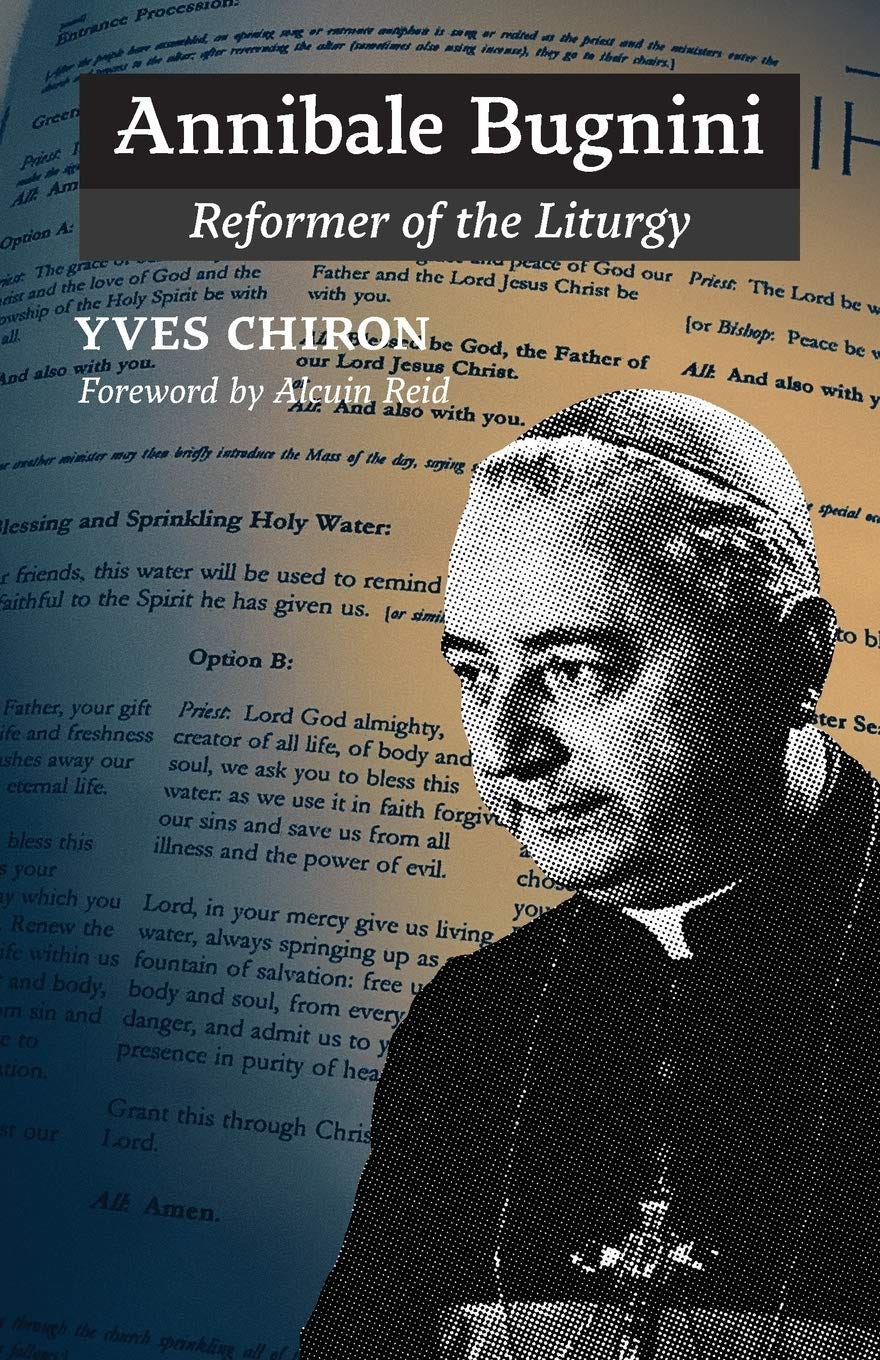
In my post last Saturday I offered an introduction to this biography of one of the most influential figures in modern Catholicism, and shared excerpts from the first half of the book:

Let’s pick up where we left off.
115 — On the 1964 Instruction Inter Oecumenici:
“The Instruction ensures the transition between the preconciliar liturgy and the deeper restoration; it is not an ad hoc adaptation, but a step along the way” [introduction to the French edition of the Instruction]. Although its object was the same as that of the motu proprio Sacram Liturgiam of January 1965, the Instruction was far more detailed. Certain points were taken over nearly verbatim while others had not been mentioned in the motu proprio at all.
Chiron goes on to list many things in Inter Oecumenici that are either not mentioned in Sacrosanctum Concilium or even contrary to it: recitation of the Lord’s Prayer in the vernacular by everyone; the Last Gospel and Leonine prayers are suppressed; vernacular is authorized for all readings and the Ordinary of the Mass (even though the unchanging Ordinary is one of the most obvious candidates to leave in Latin, as the Council notes: SC 54); and, most tellingly, Mass versus populum is introduced.
116 — Paul VI driving all this forward:
This possibility of Mass “facing the people” was given with no reference to the conciliar Constitution because such a possibility is not to be found in it. Yet this concession was soon to become the norm, the pope himself giving the example. The September 26, 1964 Instruction was presented as coming into force on March 7, 1965, the first Sunday in Lent. In January 1965, a new Ordo Missae in keeping with these new norms was published by the Vatican Polyglot Press, along with a new Ritus servandus. Both of these, much rather than the Instruction, gave the Mass a new configuration.
What a Lent! The first “new Mass,” as people called it then—little knowing what was yet to come.
116-17 — We discover what a serpent Bugnini was, as he suavely reassured people that “the Canon had not been modified and still had to be said in a low voice,” precisely when he was already fully planning to modify the Canon, add more anaphoras, and abolish the sotto voce Canon:
On January 29 [1965], Fr Bugnini presented it in a long article published in L’Osservatore Romano. In it he insisted on the fact that despite his article’s title (“The New Ordo Missae”), “it ought to be called renewed, updated, for, despite its touchups, adaptations, and corrections, the Ordo Missae has not changed its appearance substantially.” He added that the adaptation was done according to two “imperatives”: the distinction between the “liturgy of the Word” and the “liturgy of the Eucharist,” and the “devout, active, and conscious participation of the faithful.”
Fr Bugnini insisted on the fact that the Canon had not been modified and still had to be said by the priest in a low voice (“the rubrics and the formulas of the Eucharistic Prayer remain unchanged”). But he also used blunt expressions: “The Gospel is reserved to the celebrant, or to the deacon in sung Masses. The latter incenses the Book of Gospels, but from now on he will skip the censing of the celebrant, which is a rather recent and out-of-place ceremony.”
Regarding the use of “the people’s language” that was now to become the language of most of the Mass, Fr Bugnini acknowledged practical difficulties due to the fact that definitive translations were not yet ready in every language or approved by the Holy See. He granted that there would be a time of uncertainty: “The lack of time and sometimes the lack of technical means and personnel have added to the difficulties. Be that as it may, even if they are not perfect, translations are in force or will be. Experience, time, and use will allow the texts to be polished and perfected in the years to come so that they may garner the greatest possible approval and worthily express the Church’s prayer.”
What was the almighty rush? The devil is always in a hurry. And… will the texts ever be polished? In point of fact, the English mistranslation lasted for forty years, and the French likewise. I have heard that most translations of the Novus Ordo are still very bad; plus, new mistranslations have been introduced, such as when Pope Francis insisted on the false translation of the Our Father.
117 — Speaking of Paul VI’s March 7, 1965 Mass at All Saints’ church in Rome:
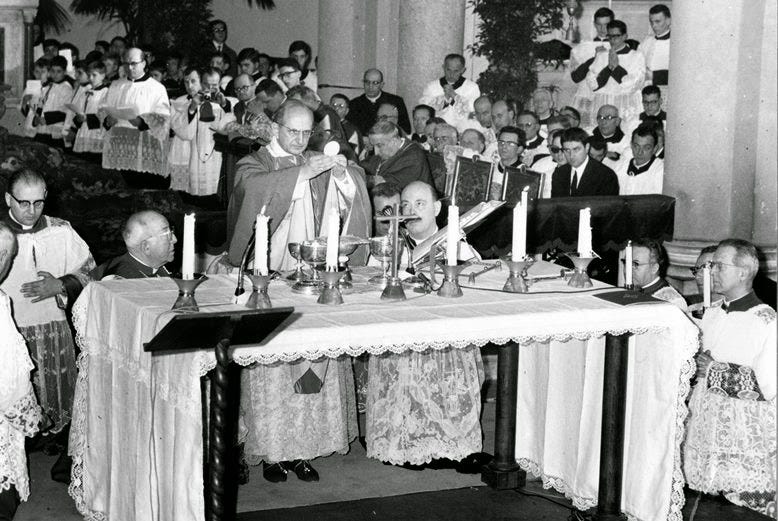
The Mass, for the first time, was celebrated in Italian (only the Canon was in Latin) and facing the people; the altar stood on a wooden stage built in the church’s sanctuary for the occasion. In the allocution he gave a few hours later for the Angelus on Saint Peter’s Square, the pope justified “the sacrifice of centuries-old traditions” that had just taken place:
In other words: in its main features, unrecognizable as the Roman Rite or the fulfillment of Sacrosanctum Concilium.
118 — The Party confronts lack of enthusiasm:
The Consilium president had in the first instance deplored the “negative reactions . . . of persons and circles who consider the reform to be harmful to the Church and to souls, are reluctant towards it, or accept it begrudgingly and without conviction.”
Cardinal Lercaro explained these reactions by a “doctrinal insufficiency, a phenomenon of ignorance” and by “the force of tradition (not however of authentic tradition, which maintains the spirit of institutions, but of shortsighted tradition) and the force of habit, ‘routine’, which all of us know how hard it is to get rid of.”
If all this was so obviously good and necessary, why were so many without enthusiasm for it? Were they just stubbornly opposed to all change or dead-set in their ways? Or did they sense that something important, something valuable, was being damaged or destroyed?
119 — Here’s what lawyers call an “admission against interest”:
Cardinal Lercaro, while he did not mention any group explicitly, judged that no unilateral and unconditional attachment to Latin and to Gregorian chant was justified any longer, on the grounds that “the historical period that we call Tridentine is closed.” The “new imperatives of new times” required “sacrifices,” one of which was that of the omnipresence of Latin in the liturgy.
119-20 — The Hamletesque pope takes action:
Besides aberrant or “fanciful” liturgical practices, there was a proliferation of writings (books and articles) in which theologians outlined new conceptions of the Eucharist. Paul VI found it necessary to intervene solemnly in an encyclical, Mysterium Fidei, published on September 3, 1965. In this encyclical “on the doctrine and worship of the Eucharist,” the pope expressed his “concern and anxiety” about “opinions that upset the faithful and fill their minds with great confusion about matters of faith.” He vigorously condemned the theory according to which “the Mass ‘of the community’” had greater value than the so-called private Mass, since “every Mass, even though a priest may offer it in private, is not a private matter; it is an act of Christ and of the Church.”
Gee, I wonder why there would have been so much theological turmoil at the time concerning the Holy Eucharist. Surely, it had nothing to do with massive liturgical change swirling all around.
120 — Quotes Paul VI’s Mysterium Fidei:
We must religiously respect the rule of terminology; after centuries of effort and under the protection of the Holy Spirit the Church has established it and confirmed it by the authority of councils; that norm often became the watchword and the banner of orthodox belief. Let no one arbitrarily or under the pretext of new science presume to change it. Would we allow the dogmatic formulas of the ecumenical councils concerning the mysteries of the most blessed Trinity and the Incarnation to be declared unsuited to our contemporaries and other formulas to be rashly substituted? In like manner, we must not put up with anyone’s personal wish to modify the formulas in which the Council of Trent set forth the mystery of the Eucharist for belief.
It’s baffling that the pope does not see how exactly the same reasoning applies to the liturgy! Why would we rashly substitute “new formulas under the pretext of new science” rather than “religiously respecting” the age-old formulations of the Roman rite?
121 — Paul VI at the Consilium’s seventh plenary session stated that those working on the reform must possess
certain qualities of spirit. One is a reverence for the sacred that prompts us to honor the ceremonies used by the Church in worshiping God. Another is respect for tradition, which has passed on a priceless heritage worthy of veneration. Necessary as well is a sense of history, which has bearing on the way the rites under revision were formed, on their genuine meaning, either as prayer or as symbol….
Talk about schizophrenia! The entire project was based on rejecting the idea of a heritage worthy of veneration that must be honored by all as sacred. This heritage was critically examined, judged wanting, and replaced with new or redacted ancient texts, and as the entire ceremonial was deconstructed. There is no “respect for tradition” at work.
(continued below)
I have talked about what is fundamentally wrong with this hubristic approach in my series “The Reign of Novelty”:
The Reign of Novelty and the Sins of the Times: Why the Novus Ordo Is Solely Modern in Content (Part 1)

As promised, I am sharing with readers of Tradition & Sanity the full text of the lecture I gave last month at the Roman Forum in Gardone, Italy. I consider this to be one of the most important papers I have ever written; the drafting of it brought several new realizations that will be decisive for my future work (and for my life). For ease of reading, it has been divided into four parts, which I will publish today, Thursday, next Monday, and next Thursday. I sincerely hope you will read (or listen to) them all!

The Reign of Novelty and the Sins of the Times: Why the Novus Ordo Is Solely Modern in Content (Part 3)

In the second part, we saw that a mature liturgy is the fruit of an entire civilization, and that neither a high civilization nor the refined liturgy developed within it can be the product of a particular moment in time or of a narrow clique. Moreover, established liturgy bears within it principles and contents that each generation is obliged to receive with homage and pass on with fidelity, in order not to distort or defile the inheritance with the preoccupations or enthusiasms of any given moment.
The Reign of Novelty and the Sins of the Times: Why the Novus Ordo Is Solely Modern in Content (Part 4 - Conclusion)

In the last part, we refuted the notion that the Novus Ordo is “more ancient” or that it resembles early Christian liturgies; on the contrary, its (1) con…
Similar criticisms of the liturgical reformers’ modus operandi were made by such luminaries as Bouyer, Luykx, and Antonelli. And as for the “genuine meaning” of “symbols,” one consistently sees in such authors as Jungmann and his disciples the absence of a symbol-capacitated mind: the reformers tend to be literalists and pragmatists who lack the theological imagination that powered generations in their engagement with the liturgical rites.
Paul VI continued:
Your own Consilium has a responsibility of vigilance during this period when new forms of divine worship are being tested and introduced in the different regions of the Church. You must check misguided attempts that may here and there appear and constrain those who follow their own preferences at the risk of disturbing the right order of public prayer and of occasioning doctrinal errors.
How ironic that he should censure those “who follow their own preferences,” when this is exactly what the reformers themselves did.
Mention is made of Tito Casini’s Torn Tunic, “the first manifesto of resistance to the liturgical renewal.”
123 — Paul VI showing his true colors:
Two days later, April 19, Paul VI received the members and consultors of the Consilium and gave a long speech in which he renewed his trust in the organization and defended its president. He denounced an “unjust and irreverent attack” and wished to “express to Cardinal Lercaro [his] regret and [his] support.” The pope also refuted Casini’s accusations. Paul VI stated:
“Obviously, we do not agree with this publication, which surely in no one inspires piety nor helps the cause it pretends to advance, namely, that of preserving the Latin language in the liturgy. Latin is an issue certainly deserving serious attention, but the issue cannot be solved in a way that is opposed to the great principle confirmed by the Council, namely, that liturgical prayer, accommodated to the understanding of the people, is to be intelligible. Nor can it be solved in opposition to another principle called for by the collectivity of human culture, namely, that peoples’ deepest and sincerest sentiments can best be expressed through the vernacular as it is in actual usage.
Nowhere did the Council establish this “great principle,” even if it emphasized participatio actuosa; and the nice historical determinism of the last sentence is its own hangman.
124 — Balancing act:
Paul VI asked the bishops to “keep a close watch on such episodes and [to] safeguard the balance proper to Catholic worship in the liturgical and religious domain.”
Since when did “balance” become a theological principle? I’ve noticed in postconciliar discourse, especially recently, that the #1 principle has become “balance”: a balance between tradition and innovation, between sacred music and new religious music, between the vertical and the horizontal, between hierarchy and equality, etc. This vague “balance” is conceived of largely in political terms as a compromise between different factions or emphases. I see no support for this notion in the Catholic tradition; it seems to have been invented whole cloth.
124-25 — On the Second Instruction, Tres abhinc annos of 1967: we see piece by piece destruction, as one “taboo” after another is violated in a kind of institutional rape, whereby those who should be disciples (see Vincent of Lérins) put themselves into the position of masters—or, rather, dominators:
This Instruction, again with a view to encouraging the “participation of the faithful in the liturgy”—the expression recurs several times throughout the document—and “to make the liturgical rites, especially the Mass, clearer and better and better understood,” introduced significant modifications to the celebration of Mass. On the one hand it continued to simplify the rite of the Mass by reducing the number of the priest’s genuflections (n. 7) and the number of kisses given to the altar (n. 8), and by retaining only one sign of the cross over the offerings (n. 11). On the other hand, the Instruction completed the introduction of the vernacular into the Mass by allowing the Canon to be said aloud (n. 10) and in the vernacular (n. 28).
N.B.: This was against what all the Fathers at V2 had been assured was the definitive meaning of the constitution they voted on, as I have shown here.
He [Bugnini] justified the simplifications by minimizing their importance; he did not consider that they might contribute to any further desacralization of the Mass: “These modifications are not important.” Fr Bugnini was also somewhat nonchalant when speaking of the genuflections and signs of the cross: “The celebration in the language of the people is often done facing the assembly; this makes certain gestures seem anachronistic or superfluous . . . which, especially in certain circles, causes incomprehension and weariness.” [Who, exactly?]
Like the elders in the book of Daniel, we see Bugnini caught in his own scheming: If “these modifications are not important,” then why were the changes made in the first place? Note, moreover, how the tail wags the dog: given celebration facing the people, therefore we must change the gestures of the priest. Besides, whose incomprehension and weariness are we talking about? I suspect it is the reformers’ own!
127 — The saga continues:
The incremental reforms brought about by the September 1964 and May 1967 Instructions opened the way to a general reform of the Mass. They lay the groundwork for it in two transitional phases, as it were…. The first complete draft of a new Ordo Missae was ready for the sixth plenary session (October 18–26, 1965).
Wow—while the Council was still in session!
128 — We learn that Paul VI asked for the retention of the Roman Canon and of the Kyrie, which the new Mass was going to drop out or rewrite (!!!). So much for respecting tradition.
129-30 — The Missa Normativa of 1967 was already the full bag of stuff we see today:
Besides the changes that were already in force since the 1964 and 1967 Instructions (Mass celebrated facing the people in Italian including the Canon, fewer genuflections and signs of the cross, etc.), the “normative” Mass that Fr Bugnini celebrated with a large choir added other new elements: a longer Liturgy of the Word (three readings total), a transformed Offertory, a new Eucharistic Prayer (the third), and a great number of hymns.
130-31 — Thank God one man had the guts to speak the obvious:
On October 25, at the Synod, Cardinal Heenan, Archbishop of Westminster, took the floor to accuse the Consilium of technicism and intellectualism and to blame it for lacking pastoral sense….
The vote on the Missa Normativa was not encouraging:
More spectacular yet was the refusal to give unreserved approval to the general structure of the normative Mass: 71 placet; 43 non placet; 62 placet juxta modum; 4 abstentions.
Note that this was largely ignored and the project was still pushed forward by the Montini-Bugnini dynamic duo.
132-33 — Trust misplaced?
Paul VI still had full confidence in Bugnini, however. During the audience that followed Lercaro’s resignation, Paul VI told Bugnini: “Now you alone are left. I urge you to be very patient and very prudent. I assure you once again of my complete confidence.” Fr Bugnini answered: “Holy Father, the reform will continue as long as Your Holiness retains this confidence. As soon as it lessens, the reform will come to a halt.”
Meanwhile, as we learn from Louis Bouyer’s memoirs, Bugnini was double-crossing the pope and the Consilium alike, in order to advance his project of a utopian refounding of the entire liturgy.
133 — More experiments early in 1968:
On January 11, a read Mass with hymns celebrated by Fr Carlo Braga; on January 12, an “entirely read Mass with participation of the faithful” celebrated by Fr Gottardo Pasqualetti; and on January 13, a sung Mass, once again celebrated by Fr Braga.
I.e., the preconciliar “low Mass with hymns” remained the norm. Again, an irony, considering that Sacrosanctum Concilium had asked (in line with the Liturgical Movement) that the chanted solemn Mass be considered the norm and the ideal.
134 — We learn that the Consilium was going to get rid of the Agnus Dei!
Here’s a cynical appeal to absolute authority and clerical subservience:
Also on January 22, Paul VI asked that the schema of the new Mass be sent, after revision, to all the Curia dicastery heads, a number of whom had expressed reservations or criticisms of the Synod “normative” Mass. “We must win them over and make allies of them,” the pope explicitly said, even if this entailed the argument from authority: “You saw, didn’t you, what happened when St. Joseph’s name was introduced into the Canon? First, everyone was against it. Then one fine morning Pope John decided to insert it and made this known; then everyone applauded, even those who had said they were opposed to it.” To the objection “And if the response is still negative?,” the pope answered: “Don’t worry, I have the final say.”
134 — Note the “pincer strategy”: change the old rite while simultaneously building the new one.
The following May 23, Cardinal Gut, prefect of the Congregation of Rites and president of the Consilium, published a decree authorizing the use of the three new Eucharistic Prayers and of eight new Prefaces. They could be used starting on August 15, 1968. Once again, the traditional rite of the Mass was emended on important points before the new rite was completed and promulgated.
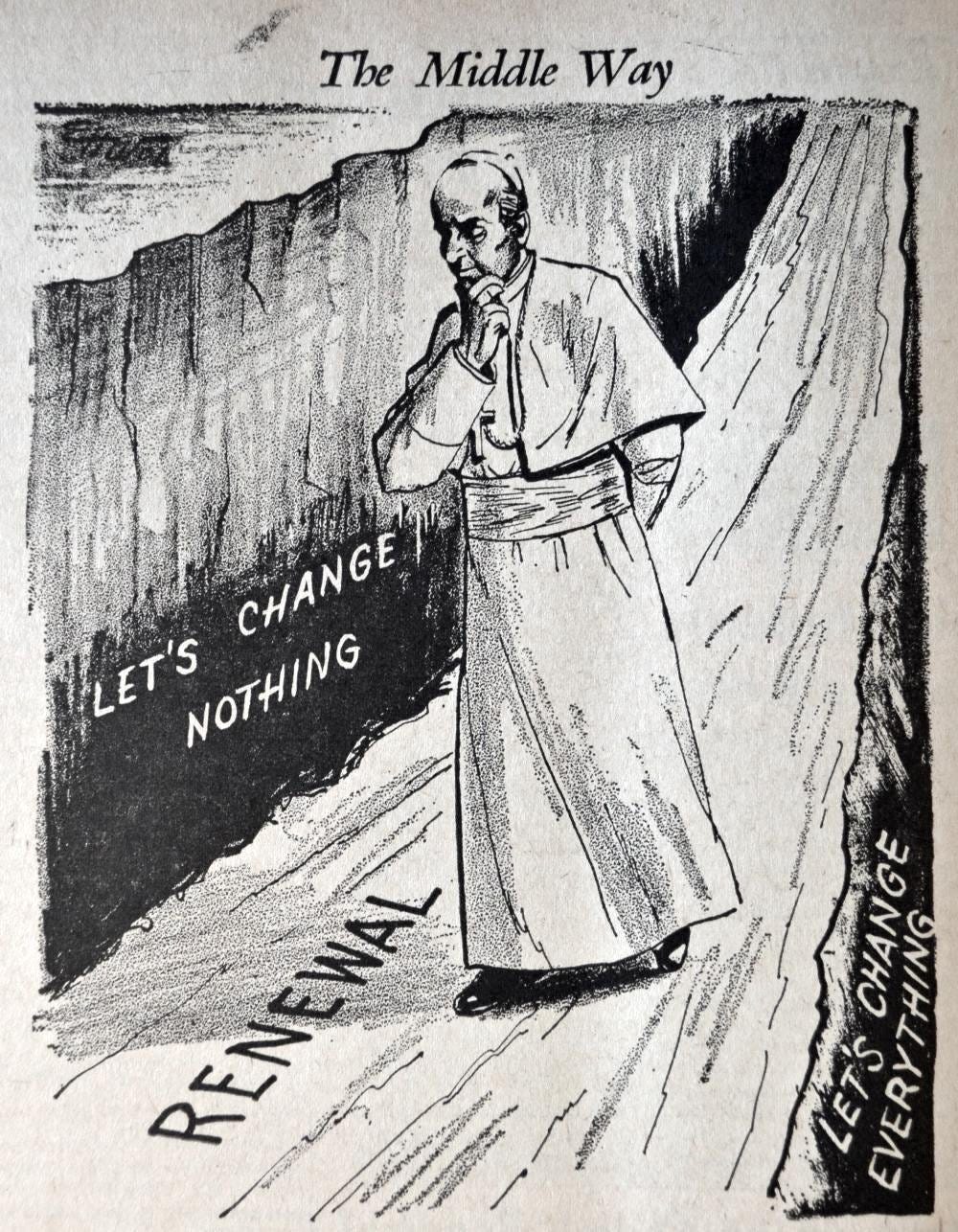
135 — Honestly, there are times when I wonder if Paul VI was completely mentally sound. He speaks like a Dr. Jekyll and Mr. Hyde, at one moment promoting the most outlandish overturnings of a thousand years of tradition, and the next moment warning the Consilium against reckless novelty.
The pope issued several warnings: “Reform of the liturgy must not be taken to be a repudiation of the sacred patrimony of past ages and a reckless welcoming of every conceivable novelty.”
Surreal, like Kafka. Even as everything is being dismantled and all kinds of new stuff is being fabricated, he fulminates in such language. Was he trying to anaesthetize a throbbing conscience? Was he trying to put up a smokescreen of orthodoxy to cover the ongoing behind-the-scenes work? Was he so conflicted that he had to speak out of both sides of his mouth to maintain some sort of psychological dialectic? It is very difficult to say, but one thing emerges for sure: this is no papal saint.
How remarkable that, at this time, Bugnini’s judgment was still sovereign. He was master of the house.
136
On November 6, 1968, Paul VI, after rereading the new Ordo Missae one more time, gave it his written “approbation.” The Apostolic Constitution Missale Romanum of April 3, 1969 was announced in Consistory on the following April 28 and presented to the press on May 2, the publication day of the new Ordo Missae, which was soon called the “new Mass” or the N.O.M. (Novus Ordo Missae).
138 — Another good example of Paul VI’s bifurcated nature:
Cardinal Oddi reports that, from a concern not to restrict the freedom of episcopal conferences and to respect the diversity of opinions, Paul VI refused to impose a single law in the matter, although he was personally opposed to communion in the hand.
Sounds like the reasoning of politicians who say: “I’m personally opposed to abortion, but I won’t impose my views on anyone else.” Well, Holy Father, your job is to do the right thing and to prevent episcopal conferences from undermining the faith of the people.
139 — Pierre Lemaire, complaining in September 1969:
The aberrant liturgies invading our churches—now as bare as Protestant houses of worship—are having a disastrous effect. Communion in the hand, often distributed in baskets to all takers, represents the nadir of the innumerable profanations spreading in progressive parishes because of the multiplying sacrilegious communions of the “faithful” who never go to confession. In this climate, the new “Ordo Missae” is received not as a step forward but as the herald of further degradations, since the clergy, which is badly formed and badly taught in wayward seminaries, is open to any and all experiments.
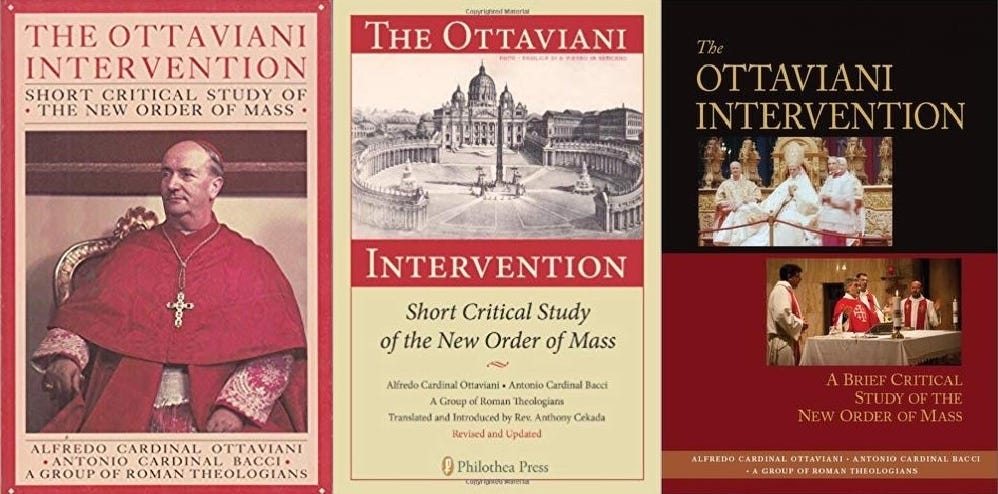
142 — On the incisive “Ottaviani Intervention”:
The Short Critical Study spoke in scholastic categories when it also regretted that the “ends or purposes” of the Mass (ultimate, ordinary, immanent) did not appear clearly. It also questioned the formulas of consecration and the place of the priest in the new rite: a “minimized, changed, and falsified” role.
This relentless critique ended in a total rejection of the “new Mass” which “due to the countless liberties it implicitly authorizes, cannot but be a sign of division—a liturgy which teems with insinuations or manifest errors against the integrity of the Catholic Faith.”
Two cardinals, Bacci and Ottaviani, who no longer had any official functions in the Curia, agreed to present this Short Critical Study to the pope. They did so in a letter accompanying the document. In this letter, dated September 25, 1969, the two cardinals judged that “the Novus Ordo Missae—considering the new elements susceptible to widely different interpretations which are implied or taken for granted—represents, both as a whole and in its details, a striking departure from the Catholic theology of the Mass.” In consequence, they were asking for the new rite of the Mass to be “abrogated.”
Some say that the objections of the Short Critical Study were directed primarily at the poor definition of the Mass in the GIRM. But this is obvious untrue; it critiques many aspects of the proposed rite. Sire in Phoenix from the Ashes rightly observes that the original GIRM simply explains what the new Mass is.
143 — N.B.: there is no real engagement, just a smearing of it:
Cardinal Seper, the Congregation prefect, gave his answer by November 12: “The pamphlet Breve esame [Short Critical Study]…contains many superficial, exaggerated, inaccurate, biased, and false statements.”
143 — Hyperpapalism, courtesy of Cardinal Siri:
The Council did not ask for any such revolution. The liturgical reform was done, the pope approved it, and that’s enough: I take the position of obedience, which is always owed to the pope. If he had asked me, I think I might have made some observations—several. But once a law has been approved, there is only one thing left to do: obey.
Recall Chesterton’s quip: “‘My country, right or wrong,’ is a thing that no patriot would think of saying except in a desperate case. It is like saying, ‘My mother, drunk or sober.’”
143 — Some claim that Ottaviani later accepted the NOM after the pope made clarifications. This seems questionable for multiple reasons, but even were it true, it would show no more than what Siri’s hyperpapalism does: they would be examples of how prelates faltered in the moment of crisis and fell back into conformity even when what was called for was steady and determined opposition.
142-45 — Chiron details all the damage control around the GIRM.
147 — Much of the initial opposition to the NOM died away as people convinced themselves on theological, not liturgical, grounds that “the Mass was still the Mass”:
Fr Luc Lefèvre retracted his initial critical stance and, in an editorial in La Pensée catholique, affirmed: “All the ambiguities have definitively and officially been set aside, then. Bene. Recte. Optime.”
Insane. How superficially they were thinking about all this. Not “healthy or unhealthy,” but “alive or dead” was all they were looking for—valid or invalid! Mass or no Mass! when they should have been asking, is this a Catholic rite? Is it traditional, in continuity with our tradition? Is it ambiguous or inadequate for its purpose? To be fair, they hadn’t had a lot of time to notice details or to think through more subtle points. Still, one can see the utterly impoverished neoscholastic reductionism at work, about which Ratzinger complained.
149 — Discusses the well-known Agatha Christie petition that won for England and Wales an opening for continued use of the old rite. Should it have taken a petition of prestigious intellectuals to make Paul VI aware of the value of tradition and ready to do his job by acting to preserve it? Absolutely typical of this wretched pope, to defend a treasure of the Faith when non-Catholics express their appreciation, but to insult the ordinary faithful for their “lazy passivity” at the TLM, and trample them underfoot.
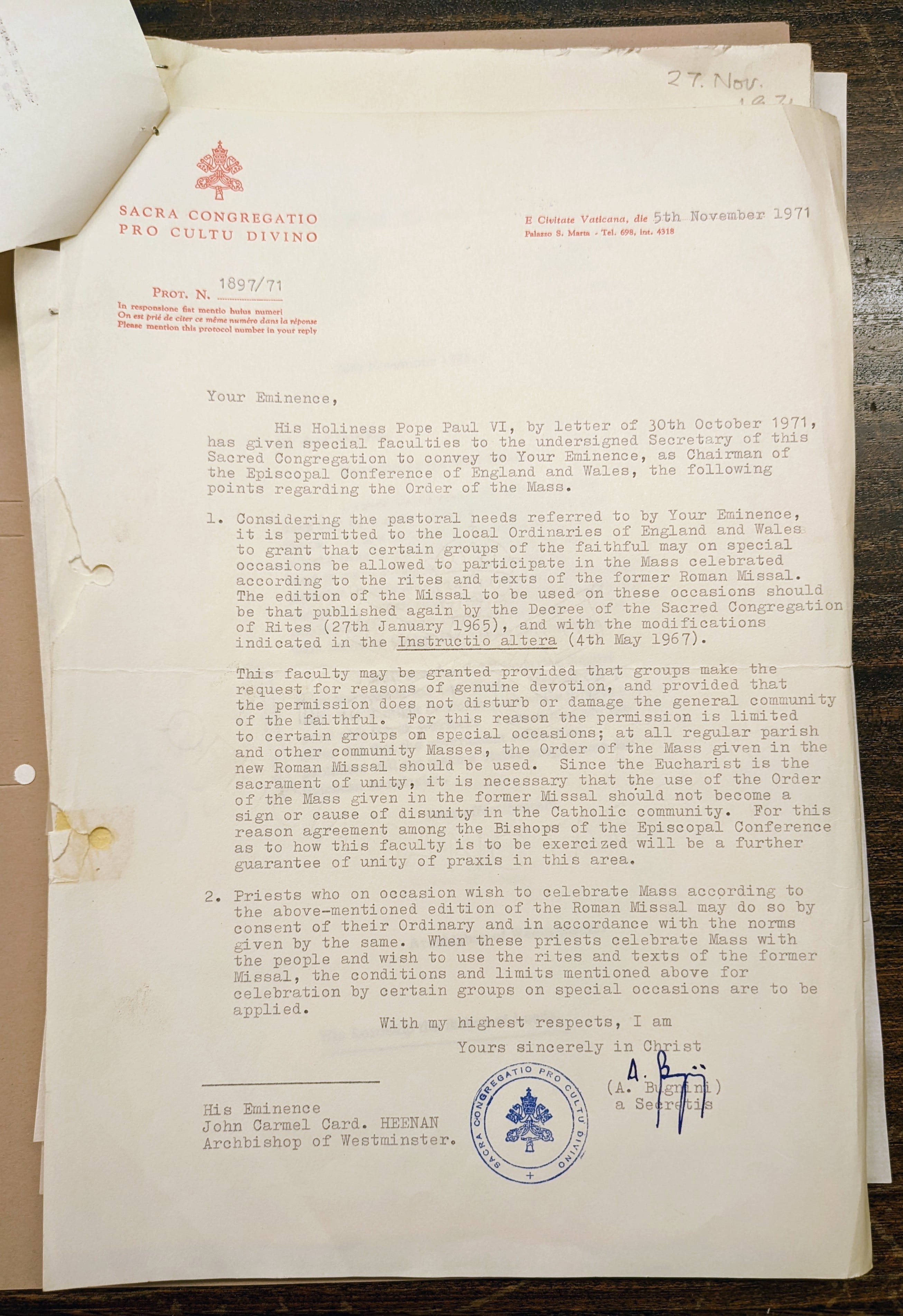
151 — But only for England and Wales; for no one else.
“The pope was inflexible and unwilling to grant the indult to any other conference,” observed Archbishop Bugnini, somewhat enigmatically adding: “The reason for this, I think, is to be found in personal considerations, in a subjective relationship between the pope and Cardinal Heenan, rather than in any rational causes of the matter.”
So, the spiritual welfare of millions of people depends on the personal whims of Paul VI, not on “rational causes”; he likes Heenan, so congratulations, Great Britain! Touch luck, France and America and everywhere else. Pope Francis behaved in exactly the same arbitrary manner, bestowing personal favors and nursing personal grudges.
154 — Paul VI as innovator again:
Bugnini submitted the question to Paul VI, who answered: “It seems better to choose psalms more adapted to Christian prayer and omit the imprecatory and historical psalms (while allowing that the latter may be appropriately used on certain occasions).”
A single pope canceling out the entire history of the praying of the psalms. Who would believe it? And yet, it happened.
156 — One man was responsible for pushing through a major change in something that goes back well over 15 centuries. This indicates the “out of control” nature of the reform.
The issue of minor orders provides a good illustration of the way in which bold reforms could turn out. The four minor orders (porter, lector, exorcist, acolyte) were the first degrees of Holy Orders, ahead of the three major orders (subdeacon, deacon, priest). Dom Bernard Botte had long been militating for a reform of this clerical hierarchy and the abandonment of some of the minor orders. He had brought up the matter during discussion at the preparatory commission, then drew up a daring proposal during the Consilium’s labors. He was presenting a general plan that provided for the suppression of several minor orders “that no longer corresponded to real usage.” When he presented it to Archbishop Bugnini, the latter, without opposing it, counseled caution: “Fr Bugnini let me know that, if I maintained this position, my report would go nowhere. Only one thing could be done: leave aside for a while the minor orders and begin with the major orders.”
In point of fact, as time went by and other bold reforms were gaining approval, the matter could be brought up again, and Dom Botte’s proposals were, in the main, adopted. Canon Martimort reports that Paul VI wanted minor orders to be “entirely retained, but improved.”9 Yet, on August 15, 1972, he signed the motu proprio Ministeria Quaedam suppressing the orders of porter, exorcist, and subdeacon…
157 — At Paul VI’s behest, the following was stated: “The major order of subdiaconate no longer exists in the Latin Church.” Appalling. Imagine how newly ordained subdeacons would have felt at the time—was all this just made-up stuff, invented by the medieval Church to add further obscurity, complexity, mystification, and superiority over the laity?
159 — Music was a huge battlefield:
There was constant antagonism between group 25, which had the encouragement and support of Fr Bugnini, and the institutions attached to Gregorian chant and Latin in the liturgy. … Fr Bugnini sought to counterbalance the influence of those defending Gregorian traditions. Thanks to his support, Universa Laus, the International Study Group for Liturgical Singing and Instrumental Music, was created in April 1966. It was to organize training sessions and, in the event, was destined to compete with the Consociatio Internationalis. The shift from “sacred music” to “liturgical singing and instrumental music” is significant. The principal Universa Laus organizer was Fr Joseph Gelineau, SJ, who had “invented” French-language psalm-singing already in 1947 and had composed many French liturgical songs.
161 — The whole mentality in a nutshell. Bugnini asserts:
The original simplicity and dignity of the altar must be restored by removing the clutter from it (spogliandolo di quanto lo ingombra)—candlesticks, reliquaries, miters, tiara.
Note the contrast when Mother Mectilde de Bar (1614–1698) talks about about the Jansenists of her day:
Jesus Christ, Our Lord, was supposed to make His entrance into His house. The next day, the feast of All Saints, she said, as if all in amazement: “What inconceivable goodness in Our Lord, to want to dwell with us! Oh! How great a day is tomorrow, a great feast for us! Let all that is most beautiful, most magnificent, be brought, so that I may adorn the altar with it. I am truly astonished that from every part of the world is not brought all that is most rich and rare to put upon the altar. What! When kings make their entry into their towns and kingdoms, every sort of pomp is prepared to receive them. And what! My God will come to dwell among some poor little wretches and paltry creatures, and no one thinks about this? It is amazing. I cannot bear it, and I do not know how to be astounded enough at these Jansenists who do not want to adorn their altars.
Given the tight connection between the Synod of Pistoia and the Second Vatican Council, perhaps we should not be too surprised to find such Jansenist leanings in Bugnini as well.
162 — Here we learn that “Msgr Bugnini profoundly reformed the papal ceremonies between 1968 and 1970.” O quam tristis… the ceremonies that were once the splendor of Christendom, the ne plus ultra of public divine worship, were chopped down into a slightly modified version of an already stripped-down episcopal liturgy.
164 — Lectionary critics:
Cardinal Stickler judged it [the multiyear cycle] to be “a sin against nature…. The yearly liturgical cycle could have stayed as it was and the enrichment of the readings still have been achieved.”
168 — Bugnini’s fall from grace:
In his memoirs he underscores the trust he enjoyed (until 1975): “he had asked me for advice every time there was a change in the Congregation, often on matters of detail.” His sudden fall from grace was incomprehensible to him. He wrote to Paul VI several times to ask for explanations. He never received an answer.
He wrote at least three times, as Chiron documents. No answer. Is that Paul VI’s mercurial temperament again, or is there some plausibility to the detailed allegations of Freemasonry? (Chiron at the time of writing thinks there is insufficient evidence for the latter, but since the time of his biography’s appearance, more evidence has come to light, as I discuss in my book Close the Workshop.)
178 — Bugnini at home among the Muslims:
In the letter addressed to Dom Adalbert Franquesa, his dear friend at the Abbey of Montserrat, he added a few handwritten lines: “Oh! how rare true friends are! We added ‘Ubi caritas est vera’ in the famous hymn but oh! how rare it is in the Church. I hope to find more of it [viz., charity] among the Muslims…”
No comment.
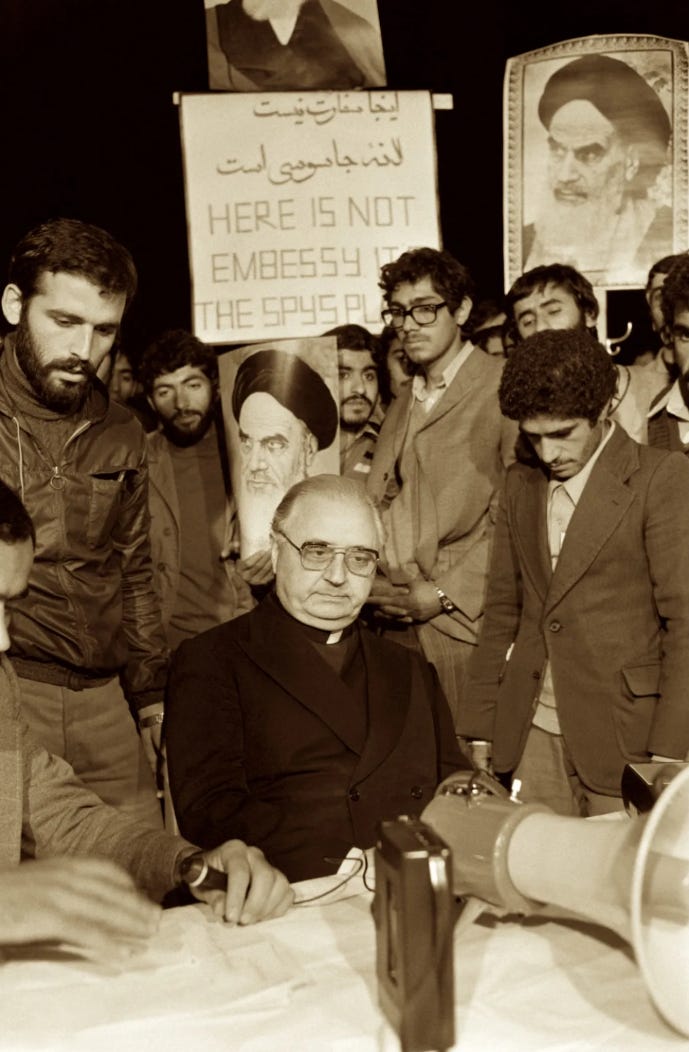
181 — Bugnini’s attitude towards the Iranian demonstrators in 1978 is curiously the same attitude he has toward the old liturgy and the reform!
We are so glad. These people had for centuries been “coerced,” “oppressed.” Now that they’ve been able to vent their frustration for eight hours straight: Abbasso [‘down with…’], Eviva [‘long live…’], A morte [‘death to…’], now they are happy. Yesterday, today, they were relaxed, joyful, as if now everything can be fixed. How true it is that everyone loves freedom!
183 — Practically the only time in the entire book that Chiron lets his guard down, just a little:
Did Archbishop Bugnini truly “love” and “serve” the liturgy? Or did he, by dint of his conception of the liturgy—true liturgy has to be “parochial” and “dynamic”—and of his constructivist will, contribute to its “disintegration”? This last expression is Cardinal Ratzinger’s in 1997. The future Benedict XVI did not explicitly name Archbishop Bugnini, but he questioned the break introduced by the “new Mass”: “But I was dismayed by the prohibition of the old missal, since nothing of the sort had ever happened in the entire history of the liturgy.” He also incriminated the manner in which this “new Mass” had been put together:
“Pius V had simply ordered a reworking of the Missale Romanum then being used, which is the normal thing as history develops over the course of the centuries . . . it was a continual process of growth and purification in which continuity was never destroyed. . . . There is no such thing as a ‘Missal of Pius V,’ created by Pius V himself. There is only the reworking done by Pius V as one phase in a long history of growth.” On the other hand, the liturgical reform enacted after Vatican II made “the liturgy appear to be no longer a living development but the product of erudite work and juridical authority; this has caused us enormous harm.”
It is telling that Chiron gives the last word to Benedict XVI.
You’ve been reading excerpts from this book, which is available from the publisher or from any Amazon outlet.
My First Holy Communion Day, our parish said the new Mass. the dear Sister rehearsed all the responses with us. It seems all went downhill from there. That same order of nuns is concerned with climate change and no longer dress like nuns. I know because I get their glossy colored newsletters.
God reward you for this brilliant presentation and analysis. Despite the fact that it is absolutely essential to engage if we are to correct course -- eventually -- it represents the agony endured by the faithful, most of whom are now dead, during those wretched days. The "renewal" was spooned out by clerics and religious with smirks on their faces. For those willing to see the truth of the events it was quite clear that it was an exercise in self-gratification. So many of them abandoned their vocations while and shortly after the machine went into motion. They themselves became evidence of the character of the operation.
We live with the consequences, and the worst appears yet to come.
The vocation director in our Archdiocese just put out an analysis of the state of our priesthood.
+ 93 parishes and only 93 active priests.
+ Current data shows 53 priests will retire in the next 15 years -- 3.5 per year.
+ Current trend data indicates an average of 0.7 priests ordained per year over the next 10 years.
+ No priestly ordinations predicted in 2028, 2030, 2031, 2032, 2033.
Our current Archbishop is a year beyond 75 and we wait, and wait, and wait for a shepherd to whip this place into line.
The clerical egoists who confected this disaster surely thought "What could go wrong?'
Everything.