


Yves Chiron hardly needs an introduction to readers of Tradition & Sanity: he is one of the finest and most well-regarded French historians, with dozens of biographies and studies to his credit. With a steady hand and extremely thorough scholarship he has tackled some of the most controversial figures of modern times, without alienating any portion of the Catholic readership: conservatives, traditionalists, and progressives alike praise and utilize his work. I find this extremely admirable and praiseworthy.
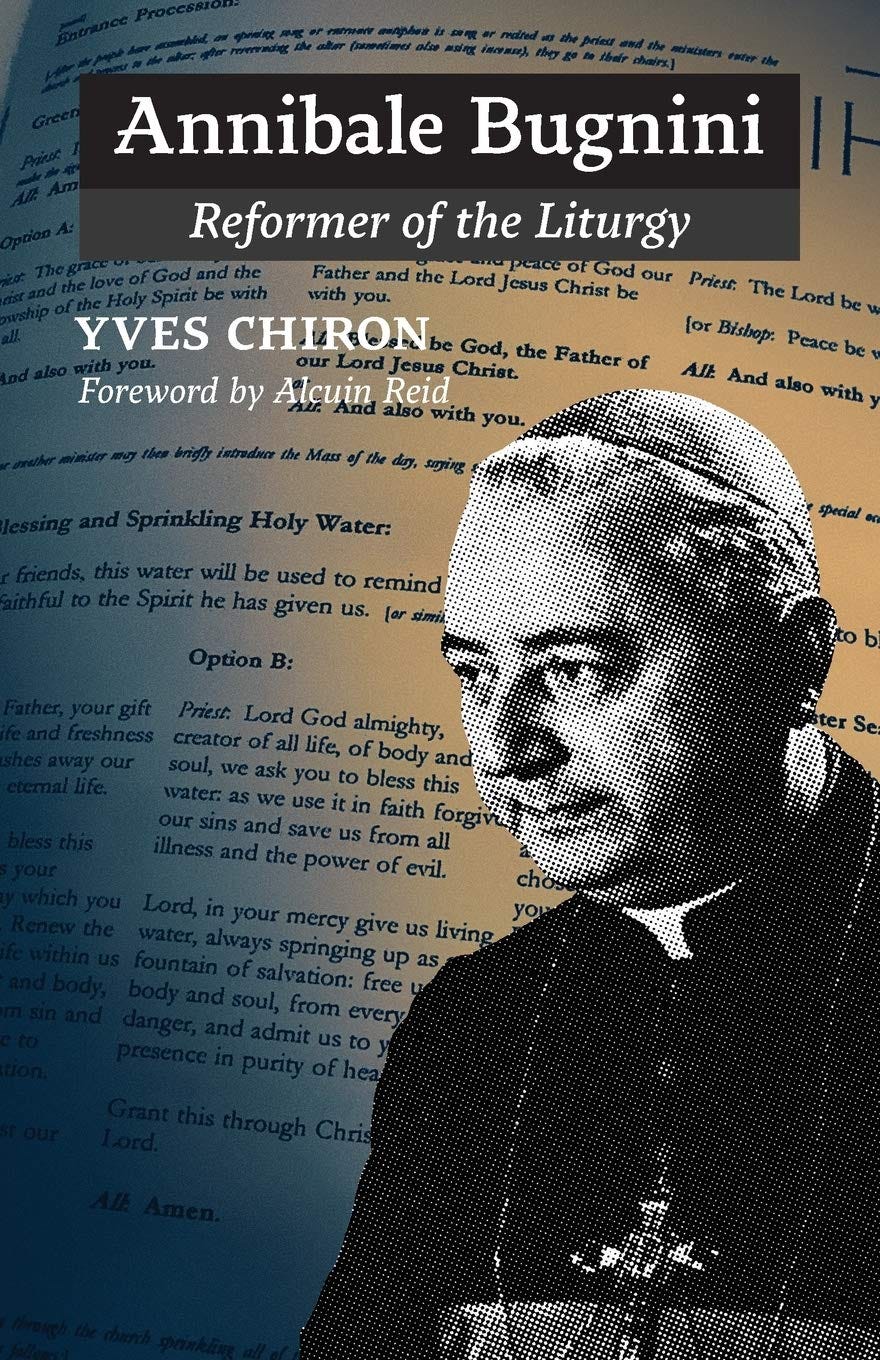
One of Chiron’s handiest books is the object of today’s and next week’s posts: Annibale Bugnini: Reformer of the Liturgy (also available from Amazon), a work originally published in French in 2016 and released in John Pepino’s elegant English translation by Angelico Press in 2018.
Although quite brief—perhaps just a little too brief, which is the only complaint I’ve seen registered against it—the book not only does a fine job presenting the life of the ultimate Vatican bureaucrat whose work has touched the lives of billions of souls, but also serves as a compact introduction to the whole history of liturgical reform in the second half of the twentieth century. For this reason, I often recommend this book to anyone who wants to know “What happened?!?”
We’re already showcased Chiron’s work in several earlier posts:
Understanding the Conflicted Soul of Paul VI

Many readers will have heard of the name of French historian Yves Chiron (b. 1960), who has written over fifty highly-acclaimed works, especially in the field of modern Church history. He has written full-length studies of (inter alia) Urban V, Pius IX, Pius X,…
“Between Rome and Rebellion”: Learning Our History as Traditionalists (Part 1)

I would say that I have been a traditionalist, in thought and feeling, for a lot longer than I have used that specific term to characterize the movement to which I belong. Now, there are some who object to the term in principle, but I think we can use it in a pragmatic way; after all, language is meant to b…
“Between Rome and Rebellion”: Learning Our History as Traditionalists (Part 2)

Last week, I began sharing excerpts from Chiron’s remarkable history of traditionalism. Let’s continue. Any of my commentary is in italics; the rest of the text is from Chiron, with page numbers in parentheses.
History Repeats: How the Dutch Council of the 1960s Anticipated Bergoglian Synodality

I’ve been surprised at the extent to which Catholics nowadays seem to be unfamiliar with the fact that all the business on synodality as promoted by and under Pope Francis is simply a warmed-over, church-wide application of a model that was already (disastrously) implemented in the Netherlands in the 1960s.
Another historian, Henry Sire, once famously said, as he introduced the subject of the liturgical reform in his exceptional book Phoenix from the Ashes, that he wished he had a more believable tale to tell, since what actually happened beggars belief. That is a fair point, as I said to Matt Fradd; and yet Chiron’s book on Bugnini makes it just a bit more believable. For inscrutable reasons hidden in the depths of Divine Providence, the stars in the 1960s seemed to have aligned in favor of busy, highly confident, highly destructive bureaucrats—perhaps as a trial to purify and galvanize the rest of us in defense of a tradition that had become routine and underappreciated?
As usual with my Professor’s Bookshelf installments, I will share passages from the chosen book for your reading pleasure. But I do encourage you to pick up a copy of it and read it cover to cover. In the selections below (page numbers in bold), I will offer some commentary of my own along the way.—PAK
24-25 — Bugnini in 1943, at the age of 31. Note the verbalist/rationalist assumptions from the very beginning: prayer only happens when people are talking or being talked to; to be spiritually alive = to be thinking and speaking:
Fr Bugnini would go much further to encourage the participation of the faithful at Mass: he had the assembly say aloud a sort of paraphrase of the text of the Mass. He described the liturgical innovation he introduced in the Borgata Prenestina as follows:
“I suddenly wondered: how could I have this people, with their elementary religious instruction, participate in the Mass? Above all, how could I make the children participate? I started out by painting big signboards with the easier responses for the people to say in Latin, and after a few tries I succeeded in having them said in unison. Then I did the same with signposts in Italian. This way, as the celebrant went ahead with the Mass in Latin on his end, a reader, generally one of the young catechists who came to help me on Sundays, made the people participate with Italian paraphrases based on the text. I knew that I had found the formula: the people willingly followed the Mass. The ‘inert and mute’ assembly had been transformed into a living and prayerful assembly.”
This, of course, was in total disobedience to the permissions in force. It was, as Chiron says, a “liturgical experiment” (24).
30-31:
“For years [says B.] I’d been wondering whether it wouldn’t be possible to rejuvenate the liturgy, ‘ridding’ it of the superstructures that had weighed it down over the centuries [‘sbaroccandola’ dalle sovrastrutture che nel corso dei secoli l’avevano pesantemente aggravata].”
The onset of his reflections on the subject dates to 1947. He would soon evoke as a general possibility “a streamlining of the liturgical apparatus [what a phrase!—PK] and a more realistic adaptation to the concrete needs of the clergy and faithful in the changing conditions of our day.”
34:
Fr Bugnini describes the liturgy of the time as “a mosaic, or if you prefer, an old building that has been erected little by little, at sundry times, with various materials and by diverse hands.” He deems that “problems of a pastoral nature” require a liturgical reform that will “either be general or will end up leaving no one satisfied because it will have left things as they are with their deficiencies, their inconsistencies, and their difficulties.”… Among his more salient proposals, Bugnini deemed necessary “a reduction of the Sanctoral…which requires not only a reduction of the present calendar, but also fixed and prescriptive norms to prevent new Saints’ days from piling up again.”
42 — marked by hubris from the start:
The commission held eighty-two meetings, from June 22, 1948 to July 8, 1960. At the very first meeting, it was established that the endeavor was to be a “general reform of the liturgy,” although there existed no general plan.
42 — Hegelian dialectic:
Its first chapter presented the “need for a liturgical reform.” The second chapter defined the “fundamental principles” to guide it: “to strike a balance between the opposite demands of the conservative tendency and of the innovating tendency” and to make the Temporal and ferial cycles “predominate” over the Sanctoral.
43 — there was a Decree of March 23, 1955 for the simplification and reduction of the rubrics for Mass and Vespers. Reductionism is a leitmotif of the entire reform, except in those areas where they went for bloating the books with tons of content: the Prefaces; the Lectionary.
49 — Bugnini was always one step ahead:
He taught in several pontifical universities and religious institutions. From 1949 on, he was liturgy professor at the Pontifical University Urbaniana, which depended on the Congregation for the Propagation of the Faith in charge of missions. He taught there until 1964 and formed many priests from different continents. When, in 1967, he accompanied Paul VI to Kampala, Uganda, as delegate to pontifical ceremonies, he said that during the main celebration he saw himself “surrounded by a great number of African bishops” who remembered their professor and his lectures in which he “taught everything that came later with the Council.”
50 — “pastoral”:
At the time, Fr Bugnini summarized what he thought were the fundamental elements of pastoral liturgy: 1. Active and conscious participation of all the faithful in the liturgy. 2. Livelier sense of community, i.e., a sense of the “holy assembly.” 3. Emphatic return to biblical, patristic, and liturgical sources. 4. Use of action in the liturgy. 5. Wide use of popular religious song. These are the principles that Fr Bugnini would implement once he directed the liturgical reform after the Council.
Wrong on all counts!
51-53 — Bugnini created a “paraphrased Mass” and tried to get it published by major authorities but they all refused, so he did it out of his own pocket. His booklet came out in 1949, with the aid of Carlo Braga. Ordered above all to “active participation.” What was it like?
La Nostra Messa presented itself as a “little handbook for communal participation at Holy Mass.” This was not a bilingual missal such as those that existed in many other countries. It was rather a little booklet allowing the faithful not only to follow the Mass as celebrated by the priest, but also to take an active part in it.
Following the formula that had been tried out in Borgata Prenestina, the basic principle of this “dialogue Mass” was the role of a lettore (“reader”) whose continuous presentation during the Mass was intended to assist the faithful and direct their participation while the priest was at the altar. The Reader started his commentary out loud as soon as the priest arrived at the altar and hardly stopped until the end of the Mass. He would provide a commentary on every one of the celebrant’s gestures and read out an Italian translation of the words the priest said in Latin.
The other one of this missal’s bold novelties was to give the Italian text next to the Latin. This Italian text was there not only for comprehension (as in other bilingual missals of that era) but also so that the faithful may say it aloud or sing it in Italian while the priest spoke or sang it in Latin. For the most part the Reader alternated songs and responses with the faithful in Italian.
Note the equivocation and linguistic imperialism: he who controls language controls thought. Why must “active” mean doing/saying things? Why must intelligently and volutarily uniting oneself to the liturgical reality be considered passive or at any rate not active? The “Reader” here is like a giant schoolmarm: the ultimate in didacticism. Parallel liturgies distancing the faithful from the priest, ironically encouraging a kind of clericalism. Continuing:
In other sections yet, particularly the Offertory, rather than giving the translation of the prayers the priest was saying, the Mass that Fr Bugnini developed had the Reader give a commentary on the ritual acts and had the faithful say out loud, in Italian, prayers to go along with all of the celebrant’s gestures. For example, at the washing of hands, rather than providing a translation of the psalm verses the priest was saying (Lavabo inter innocentes…), the booklet had the Reader explain the gesture (“The Priest washes his fingers because he will soon touch the Body of Christ with them”), and then had the faithful say a prayer out loud in Italian: “Purify, O Lord, the hands of your minister and purify our hearts.”
The consecration was the only time when the Reader paused his commentary and the faithful remained silent. The reader invited them to pray in silence: “We are at the most solemn moment of the Holy Mass. In a few instants, the sacrifice of the Cross will be renewed on the altar in a mystical, yet real, way. Let us recollect ourselves in adoration of the mystery of faith.” Yet the booklet, rather than giving the text of the Roman Canon with an Italian translation, gave a few short prayers for the layman to say “quietly.”
This “dialogue Mass” was therefore also a Mass “led” by a Reader who was a sort of intermediary between the priest and the faithful. The Reader, according to the booklet, could be “a priest, a member of the clergy, a member of Catholic Action, or a woman” (in the last case, the female reader intervened from her pew among the faithful, but “in such a way that her voice be audible”). La Nostra Messa was very bold on several points and did not respect all of the norms then in force.
Gorblimey! Talk about killing all sense of reverence and mystery! Imagine having a commentator standing next to a couple making love: “Now the husband is embracing his wife—we are at the most solemn moment—.” And the prosaic explanations of everything make it like a sports announcer or a medical lecture arena. I do not think it is possible that Bugnini could have understood the Mass as a transcendent mystery before which the only appropriate response is humble awe and, for the consecration, hushed silence.
Note as well that B has already bought into the view that “the end justifies the means”: he won’t let liturgical law stand in the way of his bright ideas.
53-54 — shows the extent of the contamination even before the Council ever met!:
This liturgical booklet soon reached a high circulation. The first printing ran out within a few months, which allowed Fr Bugnini to pay the printer and to have a second printing made. Soon the Ediz- ioni Liturgiche, official publisher of the Congregation of the Mission, took over the printing costs and were in charge of publishing La Nostra Messa, which only increased its circulation. The fifth edition came out in 1953, amounting to a total circulation of 100,000 copies; in 1962, the twelfth and last edition came out for a total of 1,500,000 copies sold. This brochure also underwent an English edition, published in Manila for the Philippines in 1960, and a Hindi edition published in Goa for India in 1961.
54-55:
More meaningful yet was the seventeenth week-long liturgical conference in North America held in London, Canada, August 20– 23, 1956. This American congress’s twenty resolutions largely overlap those proposed by others in Europe. They bear on the Mass and the breviary, notably asking for “the practice . . . of Mass facing the people to be encouraged” (n. 3); for “the Mass of the Catechumens in the vulgar language to be authorized” (n. 7); for a greater share of scriptural texts to be read in the Mass by establishing “a three or four-year cycle of readings” (n. 8); “for the prologue of the Gospel according to Saint John, which is currently said after the Ite Missa est, to be the priest’s private and optional prayer” (n. 17); [etc.]
56, Bishop Charrière:
The expression “living” language was preferred to the adjective “vulgar.” You can easily see how pejorative the adjective “vulgar” is; but I believe that to consider whatever language is currently in use to be the only living language, while Latin is (to this way of thinking) a dead language, is already a false start. It is for us to see to it that Latin should not be a dead language, but that it remain a living language. We ought not to take it for granted that Latin is dead and in need of a substitute. I believe it is possible to involve the faithful in the Latin liturgy gradually, as has been done in many of our parishes where, for a long time now, we’ve been able to interest 90% of the faithful in the Latin liturgy.
Also, begs the question of what “living” means—there are different kinds of linguistic life, which in any case is a metaphor. The bishop continued:
I daresay that it would be a great sorrow for priests and the faithful, in regions where they have successfully lived the Latin liturgy for a good long time, to abandon all that patrimony to try to become familiar with a vulgar-language liturgy. Since dechristianized regions are, alas, numerous and extensive, it may be that the Holy See will come to the point of having to grant broad concessions in the area of the so-called living language. I earnestly beg, however, that the dioceses and regions that deem themselves capable of keeping the Latin liturgy for the fore-Mass and the Sacraments may keep this Latin liturgy undisturbed, with the option of translating certain parts of the Mass.
Only ideology would disagree… and did.
Pius XII in a 1956 allocution:
The Church has grave reasons strenuously to maintain the unconditional obligation for priests in the Latin rite to celebrate in the Latin language; likewise, when Gregorian chant accompanies the Holy Sacrifice, it must be in the language of the Church.
59 — attempts were made to rein in the experimentation:
On October 11, 1956, Cardinal Pizzardo, secretary of the Congregation of the Holy Office, granted to all the dioceses of France the reading or chanting of the Epistle and of the Gospel in French after their being read or chanted in Latin; on the other hand reading “only in the vulgar tongue,” even at Low Masses, remained forbidden.
62 — Prior to the Council, only 16 out of 84 French bishops wanted vernacular in the Mass; and only 1 out of 84 wanted the entire Mass except the Canon (!) to be in the vernacular.
71 — Acting with cunning:
Fr Bugnini then acted with prudence. The seventh subcommission, which was specifically in charge of the Latin language, had prepared a long and rather daring relatio that was supposed to have been presented and discussed during the April 1961 plenary session. Fr Bugnini managed to convince the relator, Msgr Pietro Borella, to withdraw his report. He gave assurances that it would be better to give scattered indications throughout than to devote a whole chapter to the subject.
Bishop Calewaert of Ghent:
It is certainly necessary that the vulgar tongue be employed for the didactic part of the Mass. But Latin must remain in order to foster unity and for travelling foreigners. It must therefore remain the principal language of the Ordinary of the Mass.
Note the begging of the question: Why is the Mass of the Faithful equated with instruction only?
72-73 — A bunch of “experts” tossing the liturgical salad…
The proposed schema as well as the amended schema asserted as a general principle that the “structure” of the “so-called Mass of Saint Pius V” had to be “reformed” in such a way that additions be suppressed (ut additiones supprimantur) and that other elements be improved or embellished (elementa genuina ac fundamentalia ac tempori nostro convenientia excolantur, “elements genuine, fundamental, and suited to our times should be cultivated”).
At no time, it seems, did any participant (member or consultor) ever propose—at least publicly—the addition of other canons to the sole Roman Canon then in use. Some, however, were proposing that changes ought to be introduced into it. Dom Vagaggini suggested granting the faculty of “introducing one or two local saints” among those named in the Canon [this shows his utter lack of understanding of the polished numerology of the lists—PK]. Fr Jounel suggested that the celebrant recite the entire Canon aloud. The Austrian Jesuit Fr Hofinger asserted that “there ought to be no prohibition against changing something in the Canon,” which earned an immediate rejoinder from his confrere (and former professor) Jungmann: “but those changes ought to occur only for the gravest reasons.” Fr Roguet suggested abolishing the signs of the cross before the final doxology in the Canon, but that this doxology ought to be chanted (Per ipsum…). Canon Martimort suggested that the Pater ought to be sung by all the faithful along with the priest, “though sotto voce.”
Once again members and consultors suggested that no specific proposal be retained as such and indicated that proposals could be handled during the Council or in the postconciliar commission in charge of applying the Constitution as approved by the Council.
Note how, again and again, the reformers deliberately preferred to stay vague so that they could get the approvals they needed plus the independent of action.
76 — time to demote the saints!
The desire was for a revision of the entire liturgical year: “The minds of the faithful must be directed primarily toward the feasts of the Lord whereby the mysteries of salvation are celebrated in the course of the year. Therefore, the proper of the time shall be given the preference which is its due over the feasts of the saints.”
Yet we see the glory of the Lord refracted through His saints. This is a basic law of Christian life, and has ever been operative in the liturgy.
77 — useless repetitions?
Excerpts from the Martyrology were to be added to Lauds. The Office of Prime was to be suppressed “because it constitutes a monastic duplication of Lauds.” The three Little Hours (Terce, Sext, None) were each to be reduced to a hymn and a psalm, or even suppressed and replaced with a single office termed Media contracta, made up of a hymn and three psalms. Everyday an Oratio fidelium was to be added to Vespers in the form of prayers said for the Church’s general needs.
And so, 1,500 years of praxis are blotted out, just like that. The hubris of modern man knows no limits.
79 — the battle axe:
Dom Vagaggini asked to “make the principle of a need for a sacred music subordinate to the principle of lay participation.”
80 — how revealing:
Fr Moneta asserted that “the Gregorian is a dead language, just like Latin.”
80 — Here we learn that Bugnini was the principal drafter of Sacrosanctum Concilium. That should give its defenders pause…
The preparatory commission’s plenary meeting ended on April 24, 1961. After the several vota expressed during the meetings, Fr Bugnini prepared an initial schema (draft) of a constitution on the liturgy. He integrated the vota into the preparatory texts and reorganized the whole in eight coherent and consistent chapters.
82 — What Chiron calls “the Bugnini Method” is something that will be seen again and again over the coming years:
Fr Bugnini himself presented his method before a small number of members and consultors during the previously mentioned November 11, 1961 meeting at the Domus Mariae:
“It would be most inconvenient for the articles of our Constitution to be rejected by the Central Commission or by the Council itself. That is why we must tread carefully and discreetly. Carefully, so that proposals be made in an acceptable manner (modo acceptabile), or, in my opinion, formulated in such a way that much is said without seeming to say anything: let many things be said in embryo (in nuce) and in this way let the door remain open to legitimate and possible postconciliar deductions and applications: let nothing be said that suggests excessive novelty and might invalidate all the rest, even what is straightforward and harmless (ingenua et innocentia). We must proceed discreetly. Not everything is to be asked or demanded from the Council—but the essentials, the fundamental principles [are].”
86 — His method paid off:
The schema on the liturgy was the only one prepared before the Council that the Council Fathers did not reject.
This already tells you that it was recognized as progressive by the cabal that steered the Council in a different direction from the one that had been planned for it.
87 — Bishop Isnard:
We had to be vigilant against the efforts of the conservative opposition and fight for the approval of certain of the Liturgical Movement’s demands such as the use of the vernacular, which was the main concern at the time.
87 — the future Paul VI showing his cards:
Cardinal Montini, the archbishop of Milan, took the floor on the very first day of the debate on the liturgy to “approve the schema openly” and to plead for “an extended use of the vernacular.” To his mind, the matter was urgent: “If we do not want [the faithful] to leave the churches…the obstacle of a language,” i.e., Latin, which few amongst them understood, had “to be removed.”
How ironic! The faithful left the churches in greater droves than ever as all the liturgical changes were happening; and now, when they start to come in or come back due to the Latin Mass, the hierarchy wants to prevent them—wants to force them to like the vernacular, as a fairy-tale grandmother wants to force children to eat porridge “because it’s good for them.” Montini continues:
Furthermore, it was “necessary to simplify and shorten the ceremonies.” In tandem with this, the archbishop addressed a public letter to his diocesan priests in which he further developed the argument: “The liturgy is not esoteric . . . it is a language.” In liturgical celebrations, “there ought to be room for the living language in the didactic and euchological parts.”
The same reductionistic rationalism as motivated Bugnini. No wonder they saw each other as birds of a feather.
88 — Ottaviani’s speech in the aula included these haunting words:
What does ordo missae…recognoscendus [the ordo of the Mass is to be revised] mean? Now, is a sort of revolution of the entire Mass desired?... What will remain of it?
89 — look at the unseemly rush, and the new alliance between Montini & Bugnini:
The examination of the liturgy schema continued over the next few days. On November 8, as we have seen, Fr Bugnini met Cardinal Montini for the first time. During this meeting the Archbishop of Milan asked Fr Bugnini “why the work of the conciliar commission [on the liturgy] was not moving forward and how it could be put back on track so as to end the first session of the Council with a vote on the liturgy schema and allow the Fathers to go home with something positive in hand.”
90 — Bugnini writing to Tisserant:
In the joy of a first success I beg you to kindly accept the liveliest and most grateful thanks, also in the name of the preparatory commission on the liturgy, which I am sure of representing, for the decision and dynamism with which you have led the conciliar session this morning.
He sees himself as the embodiment and mouthpiece of the Liturgical Movement.
91 — Cardinal Sarah speaks bluntly:
The Guinean Cardinal Robert Sarah, named prefect of the Congregation for Divine Worship and the Discipline of the Sacraments in 2014, recounted what he witnessed in his own country in late 1962 or early 1963, when he was still a seminarian and the Constitution on the Liturgy had not yet been promulgated:
“The cathedral of Conakry had an elegant, ornate choir, with a beautiful replica of the Bernini baldachin, surrounded by very beautiful angels. At the time of the first discussions about liturgical reform, Archbishop Tchidimbo returned to Conakry and ordered the destruction of the baldachin and the main altar. We were angry, incredulous at this hasty decision. Rather violently, we passed without any preparation from one liturgy to another.”
Liturgical reform is like the Book of Mormon: a new dispensation that controls the prior dispensations and, where necessary, sweeps them away.
94 — Even Lefebvre approved of Sacrosanctum Concilium; this shows he had not thought very deeply about the liturgy or about the game that was afoot. Here are his words:
There was something to reform and to rediscover. Clearly, the first part of the Mass, which is intended to instruct the faithful and for them to express their faith, needed to reach those ends in a clearer and so to speak more intelligible manner. In my humble opinion, two such reforms seemed useful: first the rites of that first part and also a few translations into the vernacular.
Later, he obviously reneged, because he didn’t land on the 1965 missal but on the 1962.
95 — Who the mastermind was:
Paul VI had a clear vision, not of every step and detail of the reform, but of the means to implement it. He decided not to entrust this task to the Congregation of Rites, as one might have expected, but to a specific and independent organism. … October 11, Cardinal Lercaro tasked Fr Bugnini under the seal of secrecy with constituting a study group to prepare this “transitional legal framework.” For this new undertaking Fr Bugnini called upon several collaborators, nearly all of them former members of the preparatory commission: Fr Jungmann, Canon Martimort, Fr Schmidt, Dom Vagaggini, Fr McManus, Msgr Wagner, and Msgr Bonet.
Note that these were among the more radical members of the LM. They would want to change the most. Their initial work was done even before SC was approved!
99 — demolition of liturgy and piety begins quickly, with the motu proprio Sacram Liturgiam of January 1964:
The motu proprio did not wait for the reform of the breviary that the Council envisaged in allowing priests “to omit the hour of Prime and to choose from among the other little hours the one best suited to the time of day” and “to use the vernacular instead of Latin.” It was also specified that bishops could dispense particular priests “from the obligation [to recite the Divine Office], in whole or in part” if it was “for just cause.”
102 — The Consilium as secret weapon:
Cardinal Lercaro and Fr Bugnini had no intention of operating under the aegis of the Congregation of Rites or under that of the Council’s governing bodies; nor did they wish the Consilium to be a simple advisory committee.
103 — The Consilium’s official job description included:
to apply, according to the letter and spirit of the Council,
Hmm, curious how early that phrase popped up, and in an official text.
106-7 — Note that the “experts” prepared the content on which the votes were to be taken. The procedures guaranteed fragmentation, modularity, and, above all, Bugnini’s centralized control:
Consultors were charged with preparing drafts for examination in plenary session. They were divided up into a certain number of study groups (a total of 45), each with its own specialty. While some subjects were the task of a single group (e.g., the revision of the Martyrology), others were distributed among several groups. For example, nine study groups worked on the reform of the breviary under the effective direction of Canon Martimort (who was also consultor for three other study groups). The revision of the Ordo Missae, which Msgr Wagner of the Trier Liturgical Institute directed, was distributed among seven study groups: the Ordinary of the Mass; Scripture readings at Mass; the Prayer of the Faithful; votive Masses; singing at Mass; the general structure of the Mass; concelebration; communion under both species.
Just as he had been at the preparatory commission, the secretary, Fr Bugnini, was truly the architect of the reforms that were about to begin. He organized and coordinated the work of the groups of consultors. While he did not actually preside over the plenary sessions, he did establish their agendas and transmitted the texts to be examined to the members. Also, he had far greater and easier access to the pope than did the cardinal president of the Consilium.
107 — busy beavers:
From March 1964 to July 1975, 439 schemas were examined and ultimately resulted in the composition and promulgation of the new rites and liturgical books.
108 — the man who is in charge of the process to a large extent controls the outcomes:
Fr Bugnini would coordinate the study groups’ work and had texts and answers drawn up.
Of course he did.
109 — He was the ideal middle manager for the project:
Fr Bugnini embodied a perfect mix of know-how and communication skills.
111 — The timeline for concelebration (see Chiron, Bugnini, 111) is horrifying. Chiron documents the well-planned strategy of allowing very little time to evaluate and comment on drafts. Within only two months, the draft is finished. Only one week passes between authorized experiments and the permission to grant indults for further concelebrations. The liturgy is being treated like a scientific laboratory or workshop.
Then, in a final insult to language, a decree called Ecclesiae Semper (!) promulgates concelebration for all—with the extra irony of being dated March 7, the old feast of St. Thomas, who started each day with two Masses: one that he offered, with his secretary Reginald serving, and then one that Reginald offered, with St. Thomas serving. Think of all the time they could have saved by just concelebrating together…
112 — The final list of when concelebrations may occur vastly exceeds anything Sacrosanctum Concilium ever called for, or anything the Council Fathers had been asked to approve:
The Rite of Concelebration that the Consilium published on the same date (March 7, 1965) outlines five instances when such a concelebration may occur: “both the chrism Mass and the evening Mass on Holy Thursday”; in councils and synods; at the blessing of an Abbot; at the conventual Mass and the principal Mass in parishes “when the needs of the faithful do not require that all priests available celebrate individually”; at priests’ meetings.
113 — The process of desacerdotalization, “depriestification”:
Bugnini, in his presentation of the rite, specified that “it is not necessary that all [concelebrants] touch the altar materially” and the 1967 Instruction on the liturgy, on which more later, would restrict the sacred vestments to the principal celebrant alone while the other celebrants might vest in only alb and stole.
113 — On the same date, the decree on communion under both kinds was published. Again, it went far beyond anything even dreamt of in Sacrosanctum Concilium:
The March 7 decree extended this possibility to eleven cases and indicated four manners of communion under both species: by drinking straight from the chalice; by intinction (the host is dipped in the chalice); with a calamus (also called tube or fistula); with a spoon.
And soon it goes, from eleven cases to… infinity.
114 — Bugnini was very proud of having introduced concelebration and communion under both kinds to the universal Church:
In his presentation of these two rites published in L’Osservatore Romano, Fr Bugnini considered them as “two pearls of the liturgical renewal…two rites, so desired and so beloved, that have garnered interest everywhere.”
Next week, we’ll continue with the second half of Chiron’s biography.